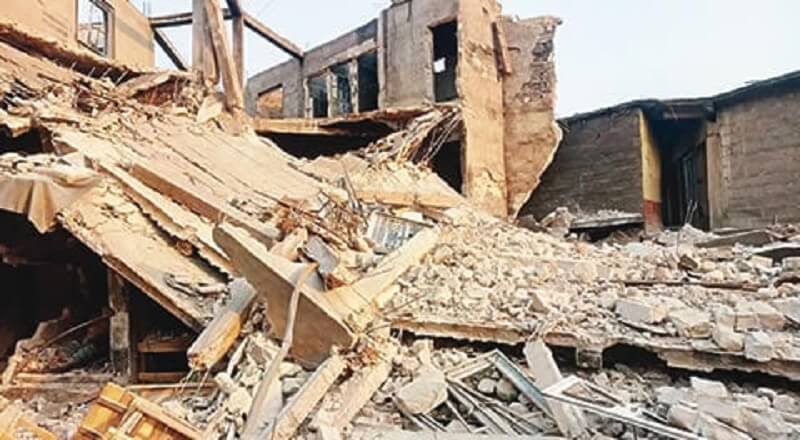
Nigeria loses an estimated N23tn to building collapses, workplace accidents and other construction safety failures, a construction safety expert, Dr Wilson Alli, has disclosed.
Alli, who serves on the Codes and Standards Committee for the adoption of the Draft Harmonised National Construction Safety Guideline for the Nigerian Construction Industry, spoke on Tuesday during the adoption of the draft guidelines in Abuja.
The event, which brought relevant stakeholders in the built industry, was organised by the Council for the Regulation of Engineering in Nigeria (COREN).
Speaking on the rationale for the proposed guideline, he explained that the estimate is based on a globally accepted benchmark that places the economic cost of occupational accidents and safety failures at about four per cent of a country’s Gross Domestic Product (GDP).
According to him, with Nigeria’s GDP estimated at $370bn the country is losing roughly N23 trillion annually to preventable incidents arising from poor compliance with construction safety regulations and protocols.
He noted that the official fatalities documented by the Nigeria Social Insurance Trust Fund represent only a fraction of the actual toll, as many accidents in smaller construction sites and the informal sector go unreported.
“Those figures largely cover multinational companies. What about the numerous other sectors where incidents are never officially captured?” he asked.
He stated that the true scale of construction-related deaths and injuries is significantly higher.
According to him, the proposed harmonised national construction safety guideline is designed to establish uniform safety standards for every aspect of construction work, including civil engineering, building, mechanical and electrical projects.
He said the document would provide a common framework for safety compliance and enforcement across the industry, reducing accidents, protecting lives and saving billions of naira currently lost to preventable failures.
Earlier, the President of COREN, Prof. Sadiq Zubair Abubakar, said the construction sector remains one of the country’s major drivers of economic growth through infrastructure development, job creation and its contribution to national development.
He, however, noted that the industry continues to grapple with persistent occupational health and safety challenges, leading to avoidable accidents, injuries, fatalities, project delays and significant economic losses.
According to him, the growing complexity of construction projects and the increasing number of stakeholders involved make it imperative to establish a comprehensive national safety framework that clearly defines responsibilities, standards, procedures and enforcement mechanisms.
The COREN President described the draft guideline as a product of collective efforts aimed at harmonising existing safety regulations, international best practices and national regulatory requirements into a single document that will serve as a practical reference for everyone in the construction value chain.
Also, the COREN Registrar, Prof. Okorie Uche, said the draft document would restore sanctity and professional discipline in the country’s construction industry.