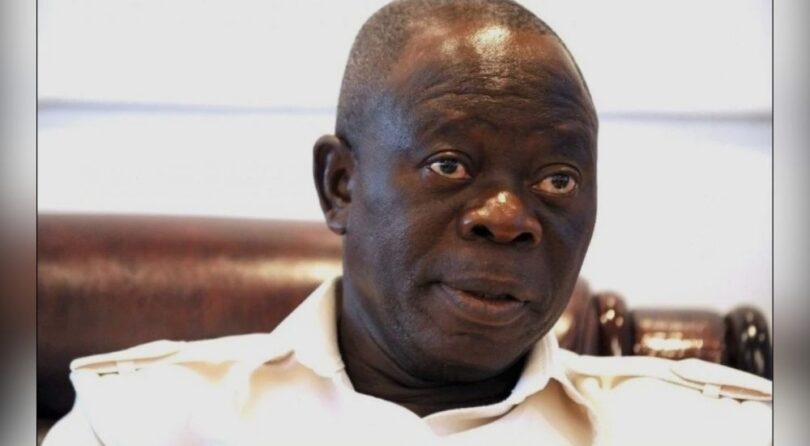
The Senator representing Edo North, Adams Oshiomhole, has called for review of the name of the Nigeria Security and Civil Defence Corps (NSCDC), arguing that the inclusion of the word “Civil” does not reflect the realities of the corps’ security responsibilities.
Oshiomhole made the call on Friday in Abuja during the public presentation of a book titled Nigeria’s Security Dilemma: Rivalries and Implications, authored by the Federal Capital Territory (FCT), Commandant of the NSCDC, Dr. Olusola Odumosu.
The former Edo State governor said the concept of “civil” suggests that personnel of the corps are not expected to bear arms, despite regularly confronting heavily armed criminals in the course of protecting the nation’s critical national assets and infrastructure.
According to him, NSCDC operatives are often deployed against vandals, illegal miners, oil thieves and other hardened criminals who possess sophisticated weapons.
“To be civil means you should not bear firearms. So, if you do not bear arms to deal with people involved in illegal oil bunkering or destruction of public properties which you have been asked to protect, will you then preach while they carry guns?
“If you want to be civil, how do you deal with hardened criminals?” Oshiomhole asked
He further said, “If these criminals carry sophisticated weapons, you who is fighting them, your weapon should not be less sophisticated.”
The senator also questioned the exclusion of the NSCDC leadership from some high-level security engagements, noting that the corps plays a strategic role in Nigeria’s security architecture.
“When I see service chiefs holding meetings and I don’t see the Commandant-General of Civil Defence, I am like there is something missing,” he said.
Oshiomhole stressed that no single security agency possesses the capacity to tackle the country’s security challenges alone, urging politicians and security institutions to put aside differences and work towards a common goal.
He said addressing insecurity requires collaboration, intelligence sharing and national unity. The lawmaker expressed confidence in the efforts of President Bola Tinubu to strengthen security across the country.
According to him, the President will continue to deploy every necessary measure to ensure the country remains safe and that insecurity is reduced to the barest minimum.
Oshiomhole also commended Odumosu for contributing to the national discourse on security through his book, describing it as a courageous intervention from someone still actively serving within the system.
“It is commendable that you put out your thought while in the system and not outside the system. It is much more dangerous to speak truth to power,” he said.
Speaking at the event, security expert Prof. Tyor Terhemba said Nigeria’s security challenges demand collective action and greater cooperation among stakeholders.
He noted that rising cases of banditry, terrorism, kidnapping and other forms of criminality require a united response rather than rivalry among institutions.
“This is a time to have all hands on deck to collectively fight the enemies of the state; hence, it is not a time of rivalry but to be united,” he said.
Reviewing the book, Terhemba said it highlights the importance of synergy among security agencies, intelligence sharing, regional and international partnerships, security sector reforms and accountability mechanisms.
According to him, the publication also examines political interference, ambiguous laws, communication gaps and other factors undermining effective security operations.
In his remarks, Odumosu said the book was written to promote a holistic approach to addressing Nigeria’s security challenges and encourage stronger collaboration among security agencies.
“No one has a monopoly on wisdom or strategy, so there is a need to tackle insecurity from a common front.
“Obviously, there have been issues of unhealthy inter-security agency rivalries, which have been a pain to coordinated national responses to our security challenges.
“I am looking at it from the perspective that all security agencies must understand that we have the same goal. Whether our mandates are interwoven or not, we have a collective responsibility to ensure peace and order in Nigeria,” he said.
The FCT commandant warned that as long as security agencies continue to see themselves as competitors rather than partners, significant gaps will remain in the country’s efforts to combat insecurity.
He urged security institutions to embrace cooperation and shared responsibility in safeguarding the nation.