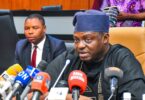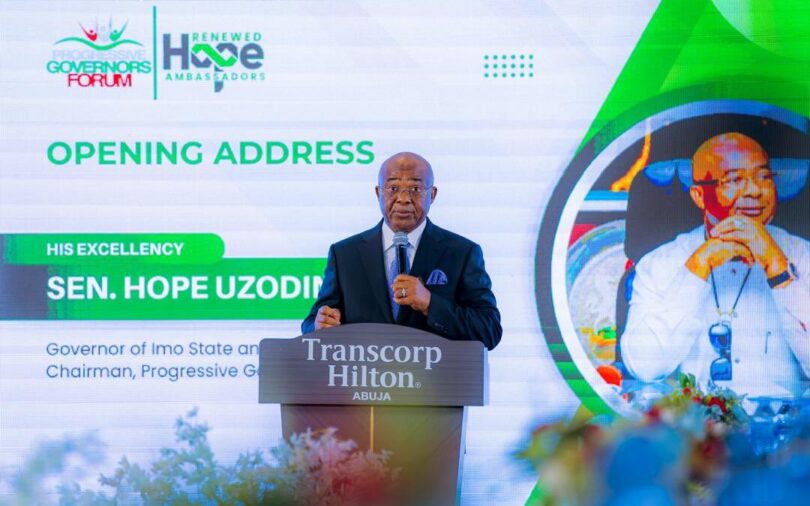
Imo State Governor Hope Uzodimma, who chairs both the PGF and serves as Director-General of the Renewed Hope Ambassadors, delivered the main address.
Governors, ministers, presidential aides and leaders of the All Progressive Congress (APC), on Monday, presented the achievements of President Bola Tinubu’s economic reform agenda to ambassadors and heads of mission from over 20 countries.
The high-level interactive session was jointly organised by the Progressive Governors’ Forum (PGF) and the Renewed Hope Ambassadors (RHA) in Abuja.
It brought together diplomats from the United States, the United Kingdom, China, Qatar, Norway, Turkey, Belgium, Colombia, Algeria, Switzerland, Tunisia, Liberia, Indonesia, the Philippines, Malaysia, Iran, and the Central African Republic, as well as the European Union Ambassador to Nigeria and ECOWAS.
Imo State Governor Hope Uzodimma, who chairs both the PGF and serves as Director-General of the Renewed Hope Ambassadors, delivered the main address. He identified the removal of the petroleum subsidy and the unification of the foreign exchange market as the twin pillars on which every subsequent economic gain has rested.
“Those two decisions can be described as the hinge on which everything has since turned,” Mr Uzodimma told the gathering.
Mr Uzodimma argued that the fuel subsidy, in place for decades, functioned as what he called “the single largest organised corruption pipeline in Nigeria’s public finances,” with independent estimates attributing more than 60 per cent of organised federal corruption to the scheme.
He said President Tinubu’s decision to scrap it on his inauguration day in May 2023 did not merely reduce corruption but “eliminated the channel itself.”
The resources freed by the subsidy removal, he said, have dramatically expanded federation account allocations. Monthly disbursements to the Federation Account Allocation Committee (FAAC) now range between 1.8 and 2.6 trillion naira, compared to approximately 10.14 trillion naira distributed across the entire 2023 financial year. In February this year, state governments collectively received 784 billion naira, a 23 per cent increase over the same month in the previous year.
“The era of state governors travelling to the federal capital to ask for emergency bailouts to pay basic salaries is over,” Mr Uzodimma said.
On the naira float, Mr Uzodimma said the unification of Nigeria’s multiple parallel exchange rates, which had for years enabled rent-seekers to obtain dollars at official rates and resell them at substantial markups, has produced measurable stability.
He said gross foreign reserves, which stood at $32 billion in mid-2024, have risen to $49.4 billion as of the end of March 2026, representing 13 months of import cover, well above international benchmarks. The premium between the official and parallel exchange rates, once exceeding 30 per cent, has narrowed to under two per cent.
“Monthly diaspora remittances have grown from approximately $200 million in 2023 to $600 million currently, with the Central Bank of Nigeria targeting $1 billion per month by year-end. Foreign exchange market liquidity reached $10 billion in April 2026. The Nigerian Exchange Group All-Share Index closed April 2026 at 242,277 points, up 55.7 per cent year-to-date, with total market capitalisation crossing 155 trillion naira for the first time. On 29 April alone, the market recorded its largest single-day point gain in history. Credit rating agencies Fitch and Moody’s have both upgraded Nigeria’s sovereign rating, with Fitch raising the country’s long-term issuer default rating from B-minus to B with a stable outlook,” Mr Uzodinma said.
Mr Uzodimma also walked the diplomats through what he described as an infrastructure programme of unprecedented scale.
The Lagos-Calabar Coastal Highway, a 700-kilometre corridor connecting nine states, has had its first 47 kilometres temporarily open to traffic since December 2025, with the full Section One expected for completion in the second quarter of this year. The Sokoto-Badagry Superhighway, a 1,068-kilometre concrete-paved road with a designed lifespan of 100 years, is under active construction across seven states, with Section 2A at 40 per cent completion. The House of Representatives recently approved a $516.3 million syndicated loan from Deutsche Bank to finance the project.
The governor said more than 440 road projects are ongoing nationwide, with over 2,700 kilometres of superhighway construction underway. The East-West Road, he noted, is “finally being completed” after two decades of abandonment and revival under successive governments.
He also cited the $746 million refurbishment agreement for the Lagos and Tin Can Island port complexes, secured during Mr Tinubu’s March state visit to the United Kingdom, described as the first by a Nigerian president in 37 years.
The Minister of Budget and Economic Planning, Atiku Bagudu, who attended the session, said the engagement was “timely” and that Nigeria “deeply values the longstanding support of the diplomatic corps,” particularly in areas of agriculture and climate change.
In a goodwill message, Liberia’s Ambassador to Nigeria praised Nigeria’s historical role in regional peacekeeping, describing the country as “a pacesetter and the big brother we come up to when there’s a crisis.”
Other ministers at the session included Coordinating Minister of Health Muhammad Ali Pate, Minister of State for Finance Doris Uzoka-Anite, and Sports Minister John Enoh. Presidential aides Sunday Dare, Bayo Onanuga, Hadiza Bala Usman, and Tope Ajayi were also in attendance.
In his speech, Mr Uzodimma acknowledged that the Strait of Hormuz blockade, linked to recent Middle East conflicts, has applied pressure on oil prices and domestic fuel costs, pushing Nigeria’s March inflation slightly higher to 15.38 per cent after 11 consecutive months of decline that had brought it down to 15.06 per cent in February, its lowest since November 2020. He maintained, however, that Nigeria “entered the period of major external shock” with a stable foreign exchange architecture and healthy reserves.
On security, the governor acknowledged the challenge but pointed to the Christmas Day 2025 joint operation with the United States armed forces against an ISIS-affiliated enclave in Sokoto State as evidence of deepened international security cooperation. He said the State Police Constitution Alteration Bill is among 44 harmonised bills before the National Assembly.
He also noted that the Dangote Refinery, with a 650,000 barrels-per-day capacity, is now fully operational, and that Nigeria refined petrol domestically for the first time in four decades in 2025. Non-oil exports for the first half of 2025 reached a record $3.2 billion.
Mr Uzodimma closed his address with a direct appeal to the assembled diplomats to weigh political noise against verifiable data.
“The administration is not asking you to take its word,” he said. “The data is in the public domain. The investors are voting with their capital, and they have voted up 55 per cent on the Nigerian stock market in less than five months. We are content to be judged on outcomes.”