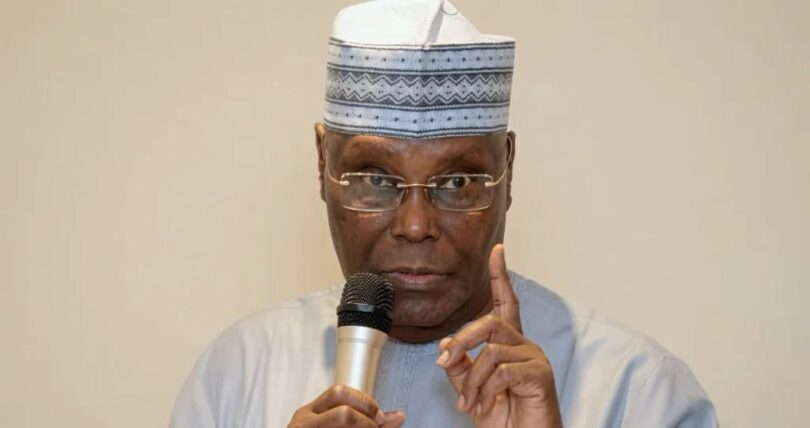
Former Vice-President Atiku Abubakar has dismissed the Tinubu administration’s celebration of economic growth, saying improved macroeconomic indicators have failed to reduce poverty, hunger and the rising cost of living.
Mr Atiku said the Federal Government was relying on Gross Domestic Product, GDP, growth figures and other economic statistics while millions of Nigerians continued to struggle with declining purchasing power and worsening living conditions.
The former vice-president, who is the presidential candidate of the African Democratic Congress, ADC, stated this in a response to the Presidency’s defence of President Bola Tinubu’s economic policies.
In a statement issued by his Senior Special Assistant on Public Communication, Phrank Shaibu, Atiku said the government had failed to answer the question of why Nigerians were becoming poorer despite repeated claims that the economy was improving.
“If the economy is doing so well, why are Nigerians getting poorer?” he asked.
Mr Atiku accused the Presidency of celebrating macroeconomic gains without acknowledging the economic realities confronting ordinary citizens.
“The State House celebrates macroeconomic indicators while ordinary Nigerians struggle with microeconomic realities. It speaks glowingly about GDP growth while families skip meals,” he said.
“It boasts of debt ratios while businesses shut their doors. It trumpets reforms while millions of citizens slide deeper into poverty.”
He said the government’s economic performance should be assessed by its impact on households rather than improvements in official statistics.
“Governments are not elected to improve spreadsheets. They are elected to improve the lives of their people. Nigerians cannot eat GDP. They cannot cook with debt-to-GDP ratios. They cannot pay school fees with statistical projections,” Atiku said.
“The true measure of economic management is whether families are living better today than they were yesterday. On that score, this administration has failed.”
The former vice-president questioned whether economic growth had improved the purchasing power of Nigerians, reduced transport costs or lowered the expenses faced by manufacturers and small businesses.
“Has the purchasing power of the average Nigerian increased? Can civil servants buy more food today than they could three years ago? Are transport fares lower? Are manufacturers paying less for energy? Have small businesses become more profitable?” he asked.
“The answer, tragically, is no.”
Mr Atiku cited figures attributed to the International Monetary Fund, IMF, which he said showed that 63 per cent of Nigerians were living below the national poverty line, while about 27 million people faced food insecurity in late 2025.
He said the figures demonstrated that improvements in macroeconomic indicators had yet to translate into better living standards for the majority of Nigerians.
“Those are not opposition figures. They are the findings of the same institution the government celebrates whenever it commends aspects of its reforms,” he said.
“Until economic growth translates into fuller stomachs, lower prices, decent jobs and improved living standards, it remains a failure of humanitarian crisis proportions.”
Mr Atiku also argued that a reduction in the inflation rate did not mean that food and other essential commodities had become affordable.
“There is an important distinction between lower inflation and lower prices. Nigerians are not buying inflation rates in the marketplace; they are buying food, medicine, transport and other necessities,” he said.