By Onongwu Muhammed — Nigeria has spoken of gas as the fuel that will power its industrial future, for decades. The difficulty has never been the size of our gas reserves. It has been the ability to move that gas from where it is produced to where it is needed. That is why the latest progress on two of the country’s most important gas transmission projects deserves more than a routine announcement.
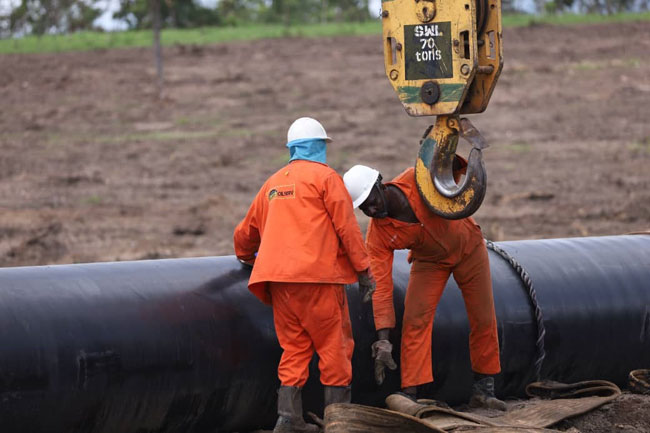
On 1 September, the Nigerian National Petroleum Company Limited (NNPC Ltd) announced that the Obiafu-Obrikom-Oben (OB3) gas pipeline had reached 100 per cent completion and was ready for first gas, while the Ajaokuta-Kaduna-Kano (AKK) pipeline had reached 95 per cent completion. On paper, these are project milestones. In practical terms, they represent something far more consequential: the gradual removal of one of the most persistent constraints on Nigeria’s gas economy which is inadequate transportation infrastructure.
The OB3 development is particularly significant. The completion of the River Niger crossing, achieved through a technically demanding operation involving the drilling of roughly two kilometres beneath the river, has cleared the final major physical obstacle to the full operation of the 130-kilometre pipeline. With a design capacity of about 2 billion standard cubic feet of gas per day, the pipeline will become a major artery connecting gas-producing areas in the Niger Delta to markets further inland. More importantly, it is expected to make more than 500 million standard cubic feet per day of additional gas available to the domestic market.
That distinction matters. Nigeria does not have a gas-reserve problem; we have a gas-delivery problem. Gas trapped in the ground or stranded because there is no reliable infrastructure to transport it cannot power a factory, feed a fertiliser plant or generate electricity. Every major trunkline that comes into operation therefore changes what is economically possible — from electricity generation and fertiliser production to manufacturing, compressed natural gas distribution and other energy-intensive industries.
The Ajaokuta-Kaduna-Kano, AKK pipeline carries similar strategic importance from another direction. At 95 per cent completion, it is approaching the point where gas can begin moving more reliably towards Abuja and, ultimately, further into northern Nigeria, with NNPC targeting early gas delivery to Abuja before the end of 2026. Its importance goes beyond connecting one location to another. It is a critical part of the effort to extend Nigeria’s gas infrastructure beyond the traditional producing areas and build a more integrated national gas network.
This is where the significance of the Ojulari era at NNPC becomes clearer. The real test of leadership at a national energy company is not how many announcements are made or how impressive the targets sound. It is whether projects that have remained on the drawing board, in procurement cycles or in various stages of execution for years are finally completed and put to work. OB3 and AKK are precisely the kind of projects against which that test should be measured.
And the story does not end with gas. Under Engr Bashir Bayo Ojulari’s leadership, NNPC’s operational performance in the upstream sector has also begun to tell a different story. NNPC Exploration and Production Limited recorded peak daily production of 365,000 barrels in December 2025; the highest level achieved in 36 years and surpassing the output last recorded in 1989. Projects including the Madu First Oil Project, Soku Pipeline optimisation, Akpo West development and the commissioning of the Gbaran Nodal Compression Train have added to production capacity and strengthened the resilience of operations.
These are not insignificant developments in an industry where declining production, ageing infrastructure, underinvestment and prolonged project cycles have combined for years to undermine Nigeria’s position as a major oil and gas producer.
Just as important have been efforts to address the commercial disputes and contractual uncertainties that have made investors cautious. The execution of a model Production Sharing Contract for deep-water assets has opened new opportunities for non-associated gas development, while the resolution of the long-running Oil Prospecting Lease 245 dispute has created room for fresh production-sharing arrangements across multiple licences. Such issues may appear technical to the casual observer, but they are central to investment decisions. Capital does not follow rhetoric; it follows certainty.
That is why the question of credibility is perhaps more important than any individual production figure. For much of Nigeria’s oil and gas history, investors have had to contend with uncertainty over contracts, regulatory processes, project approvals, security, infrastructure and the commercial terms governing their investments. Rebuilding confidence in such an environment cannot happen overnight. It requires consistency, financial discipline, clearer decision-making and, above all, evidence that commitments will be followed by execution.
There are indications that this is beginning to happen under Ojulari. The launch of NNPC Limited’s Gas Master Plan 2026 is part of that wider strategy. The plan targets daily gas production of 10 billion standard cubic feet by 2027 and 12 billion by 2030, while seeking to attract more than US$60 billion in investment across the energy value chain. But the real importance of the plan is not in the size of the numbers. It is in what those numbers are supposed to achieve: more gas for power generation, greater industrial capacity, expanded fertiliser production, new jobs and a stronger domestic gas market.
Nigeria has spent decades talking about becoming a gas-powered economy. The opportunity now is building the infrastructure and commercial framework capable of making that ambition real.
This is also why the progress on OB3 and AKK matters to Nigerians beyond the oil and gas industry. A pipeline does not improve anyone’s life simply because it has been completed. Its real value begins when the gas flowing through it keeps a power plant running, allows a manufacturer to produce at lower cost, supports a fertiliser plant, creates employment or gives an investor enough confidence to put fresh capital into an industrial project.
For ordinary Nigerians, the chain is straightforward. More reliable gas supply can support more reliable electricity generation. More reliable electricity can reduce the pressure on businesses that currently depend heavily on expensive alternative sources of power. Lower operating costs can improve production. Increased production can support employment and economic activity. That is how a piece of infrastructure buried beneath the ground eventually becomes relevant to the family sitting above it.
The US$30 billion investment target set for 2027 is an ambitious undertaking and, more importantly, a serious test of institutional capacity. Achieving it will require sustained production growth, regulatory certainty, security of critical infrastructure, disciplined corporate governance and an investment climate in which international and domestic capital can commit with confidence.
This is where the Ojulari leadership will ultimately be judged. Not by the ambition of the targets alone, but by the ability to sustain execution after the headlines have faded. Nigeria has seen ambitious plans before. What the country needs now is continuity between policy, investment and delivery..
That is why the developments at NNPC deserve to be viewed in their proper context. The completion of OB3, the near-completion of AKK, the recovery in upstream production, the resolution of long-standing commercial disputes and the renewed push to attract investment are not isolated events. Together, they point to an NNPC that is attempting to move from managing decline to deliberately building capacity.
The transformation is still a work in progress. There will be setbacks, difficult commercial decisions and targets that will inevitably be tested by the realities of Nigeria’s operating environment. But there is now enough evidence to argue that something has begun to change.
And that, in my view, explains why the achievements and ongoing policy transformation at NNPC under Engr Bashir Bayo Ojulari provide a credible basis for the CEO of the Year 2026 award conferred on him by the LEADERSHIP Group on 3 September.
Awards, of course, are easy to announce. The more important question is whether the record behind them stands up to scrutiny. In Ojulari’s case, the answer will ultimately be found not in the trophy, but in the kilometres of pipeline completed, the barrels brought back into production, the investment unlocked, the gas delivered and, most importantly, the economic value that Nigerians can feel from an oil and gas sector that is beginning to work more deliberately for the country.
ONOGWU Muhammed, B.Tech.(Chemical/Petroleum Tech.), LLB, BL, LLM (In View), MIAD, ANIPR
4th September, 2026