The 2026 Osun governorship election should be viewed as much more than another contest between the APC and the opposition. It is an important chapter in Nigeria’s continuing democratic journey a journey that has taken the country from manually written results, paper-based accreditation and cumbersome physical collation to biometric voter verification, electronic result transmission and an increasingly auditable electoral process.
Governor Ademola Adeleke has won a second term. Contesting on the platform of the Accord Party, he polled 511,067 votes, defeating the APC candidate, Bola Oyebamiji, who scored 444,815 votes, while the ADC candidate, Najeem Salaam, scored 17,180 votes.
Adeleke won 19 of Osun State’s 30 Local Government Areas, while Oyebamiji won 11, giving the governor a margin of 66,252 votes.
But beyond the candidates, political parties and numbers, there is a larger story.
The real winner is democracy.
And, ironically, President Bola Ahmed Tinubu may emerge from the Osun election as one of its biggest political beneficiaries not because his party won, but precisely because the party he leads lost and the result was allowed to stand.
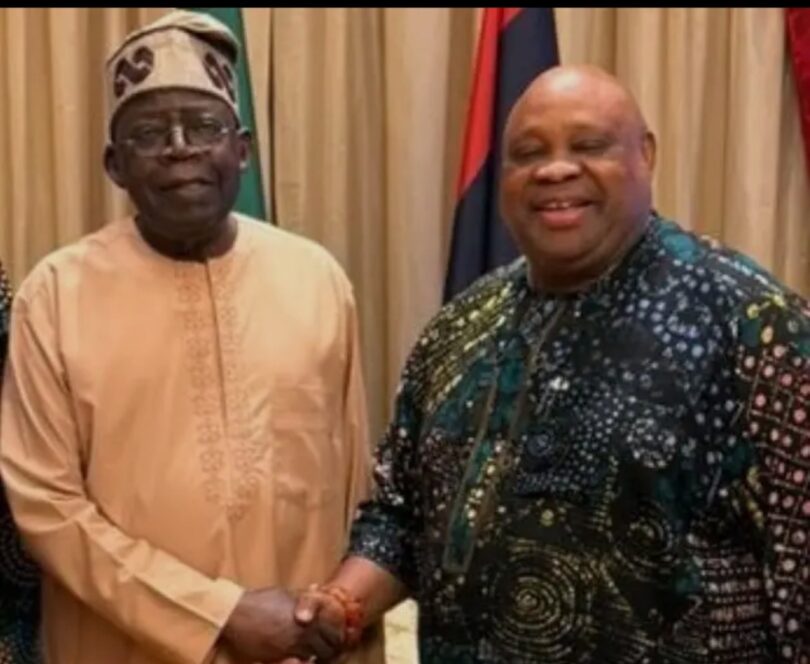
President Tinubu called Governor Adeleke to ask him how the election was going and congratulated after him won and urged him to use his victory to unite the people of Osun for development.
Adeleke, in turn, thanked the President and reaffirmed his support for President Tinubu’s 2027 re-election.
What a remarkable democratic moment.
The President’s party lost. The President congratulated the winner. The winner thanked the President. Political competition did not become political warfare.
That is how democracy should work.
As the late President Umaru Musa Yar’Adua famously acknowledged after the 2007 presidential election that brought him to power: “The April 2007 elections were flawed.”
That admission was followed by a commitment to electoral reform. It remains a powerful lesson: democracy becomes stronger when leaders have the courage to acknowledge weaknesses in the system rather than pretend that everything is perfect.
And that takes us to the heart of Nigeria’s electoral story.
OSUN’S FOUR-ELECTION JOURNEY: 2014, 2018, 2022 AND 2026
To understand the significance of 2026, we must go back to 2014.
In the 2014 Osun governorship election, then Governor Rauf Aregbesola of the APC defeated Iyiola Omisore of the PDP decisively.
Aregbesola polled 394,684 votes, against Omisore’s 292,747, winning by 101,937 votes and taking 22 of the state’s 30 LGAs.
Four years later, the political landscape changed dramatically.
The 2018 election became one of the closest governorship elections in Nigerian history. Gboyega Oyetola of the APC eventually defeated Ademola Adeleke of the PDP after a supplementary election. Oyetola finished with 255,505 votes, while Adeleke had 255,023 — a difference of only 482 votes.
Then came 2022.
Adeleke returned and defeated the incumbent Oyetola, polling 403,371 votes against Oyetola’s 375,027, a winning margin of 28,344 votes.
And now, in 2026, Adeleke has expanded his margin to 66,252 votes.
The four elections tell an extraordinary political story:
2014 — APC dominance.
2018 — APC survives by 482 votes.
2022 — Adeleke overturns the result.
2026 — Adeleke wins again, this time under Accord, and substantially expands his margin. That is electoral politics.
The people decide. Political parties change. Candidates rise and fall. Democracy continues.
THE BIGGER QUESTION: HOW HAVE ELECTIONS BEEN CONDUCTED UNDER PRESIDENT TINUBU?
President Tinubu assumed office on May 29, 2023, so the 2023 general election itself should not technically be described as an election conducted under his presidency.
The more appropriate assessment begins with elections conducted after his inauguration. And when we examine that record, an interesting pattern emerges.
The APC has won some.
The APC has lost others.
Opposition parties have won governorships.
Opposition parties have won legislative seats.
That mixed outcome is important.
The strongest evidence of competitive democracy is not that the governing party wins. It is that the governing party can lose.
IMO 2023 — APC WINS
The first major off-cycle governorship election after President Tinubu assumed office was the November 2023 Imo governorship election.
Governor Hope Uzodimma of the APC won re-election. That was an APC victory.
And there is nothing undemocratic about the ruling party winning an election when voters give it the mandate.
Democracy does not mean the opposition must win. Democracy means the people must be free to choose.
EDO 2024 — APC WINS BACK THE STATE