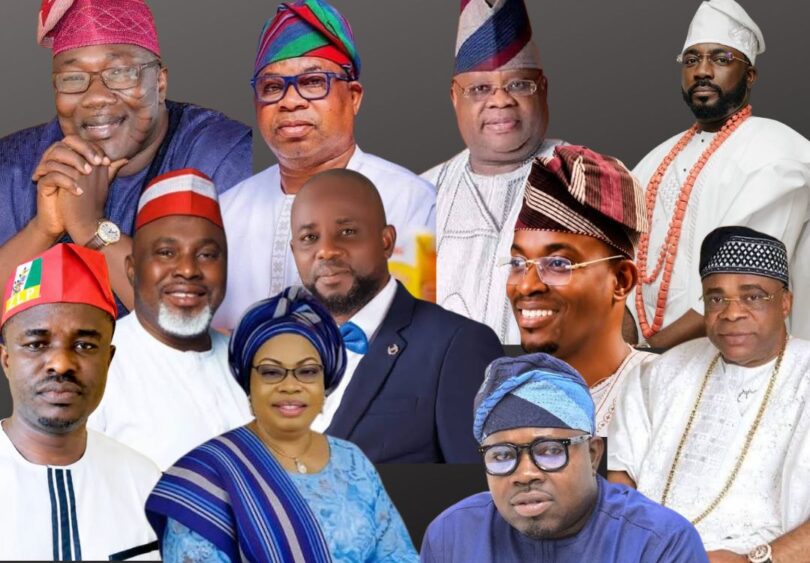
Thirteen candidates are contesting the 15 August Osun governorship election, but the race is largely shaping up as a contest among incumbent Governor Ademola Adeleke, APC candidate Bola Oyebamiji and former House of Assembly Speaker Najeem Salaam of the ADC.
With 13 political parties fielding candidates for Saturday’s governorship election, the race for the Osun State Government House has entered its decisive phase.
Although 14 candidates were initially on the ballot, barely a week before the election, Adesina Adeyemi-Doro, the candidate of the All Progressives Grand Alliance (APGA), withdrew from the contest and endorsed the All Progressives Congress (APC) candidate, Bola Oyebamiji. Mr Adeyemi-Doro will still be on the ballot despite his withdrawal.
The contest has increasingly taken the shape of a three-way battle involving incumbent Governor Ademola Adeleke of the Accord Party, Mr Oyebamiji of the APC, and Najeem Salaam of the African Democratic Congress (ADC).
About 2.4 million people are eligible to vote at the 3,763 polling units, spread across the 332 wards in the 30 councils, for their preferred candidates on Saturday. The voters have a coterie of candidates drawn from different professions and endeavours of life to choose from. Among them are accountants, administrators, social scientists, bankers, economists, entrepreneurs, medical practitioners, estate developers and others.
Here are the 13 candidates on INEC’s list from whom voters will choose who will govern them for the next four years, beginning on 27 November.
Ademola Adeleke, the incumbent governor and former senator, is a businessman and administrator. He was born on 13 May 1960 in Enugu, south-east Nigeria. His mother was Igbo from Abia State, while his father, a former senator, hailed from Ede in Osun State.
Mr Adeleke attended Jacksonville State University, Alabama, United States, where he majored in criminal justice and minored in political science. But after much controversy, he got enrolled at Atlanta Metropolitan State College, also in the US, where he earned a BSc in criminal justice in 2021.
He was executive director of Guinness Nigeria Plc and group executive director of Pacific Holdings Ltd.
Mr Adeleke hails from a political family. His father, Ayoola Adeleke, was a Second Republic senator, representing Oyo East on the platform of the defunct Unity Party of Nigeria (UPN). His late elder brother, Isiaka Adeleke, was the first executive governor of Osun and a former senator, while his younger brother, Adedeji Adeleke, is a businessman and founder of Adeleke University.
The governor is also the uncle of Nigerian musician David Adeleke, popularly known as Davido.
Mr Adeleke became governor in 2022 after defeating the incumbent, Gboyega Oyetola, in a keenly contested election. He secured 403,371 votes to Oyetola’s 375,027 and won in 17 of the state’s 30 local government areas.
The victory was particularly significant because Messrs Adeleke and Oyetola had previously faced each other in the 2018 governorship contest, which Mr Oyetola won by a very narrow margin.
Before becoming governor, the 66-year-old represented Osun West District in the Senate from 2017 to 2019. His entry into electoral politics was also closely linked to the influence of the Adeleke family.
The family connection remains an important part of his political identity.
Mr Adeleke’s political rise has therefore combined personal popularity, family name recognition and grassroots mobilisation.
Bola Oyebamiji, aged 60, popularly known as AMBO, is a banker, economist, public administrator and politician from Ikire in Irewole Local Government Area of Osun State.
Mr Oyebamiji holds an OND and HND in banking and finance from The Polytechnic, Ibadan, Oyo State and later obtained a master’s degree in Public Administration from Lagos State University.
He bagged another master’s degree in Business Administration from the University of Ado-Ekiti.
He is also a Fellow of the Chartered Institute of Bankers.
His career spans the private and public sectors. He worked in the banking industry before moving into government and became the managing director of the Osun State Investment Company, now associated with Omoluabi Holdings.
He subsequently served as Commissioner for Finance under the administrations of former Governor Rauf Aregbesola and his successor, Gboyega Oyetola. His long involvement in managing the state’s finances has made fiscal management a central component of his political profile.
His public-service career later extended beyond Osun. President Bola Tinubu appointed him managing director and chief executive officer of the National Inland Waterways Authority (NIWA) in 2023. He resigned from the position in November 2025 to pursue the governorship race.
His political profile is also closely connected to the APC establishment in Osun. His years in government under Messrs Aregbesola and Oyetola place him within the political structure that controlled the state before Adeleke’s victory in 2022.
Najeem Salaam, 61, hails from Ejigbo. The man, popularly called “Iwaloye,” holds a doctorate in political science from the Obafemi Awolowo University, Ile-Ife.
He is an author, having co-authored a book, Rudiments of Government and Politics. It is a textbook used by students studying government and politics.
The ADC candidate is a former Speaker of the Osun State House of Assembly and a long-standing grassroots politician. He served as Speaker during the administration of former Governor Rauf Aregbesola and became a prominent figure within the progressive political bloc in Osun.
Mr Salaam’s emergence is significant because he represents a third political platform in a race otherwise dominated by the rivalry between Mr Adeleke and the APC.
His political strength comes largely from his long experience in Osun politics and his association with Mr Aregbesola, under whom he served as Speaker.
He has promised to prioritise workers’ welfare, education, youth empowerment, security, local enterprise and public confidence in government. He has also made electricity one of the key issues in his campaign, saying he has been engaging investors and stakeholders in the power sector to seek solutions to the state’s electricity challenges.