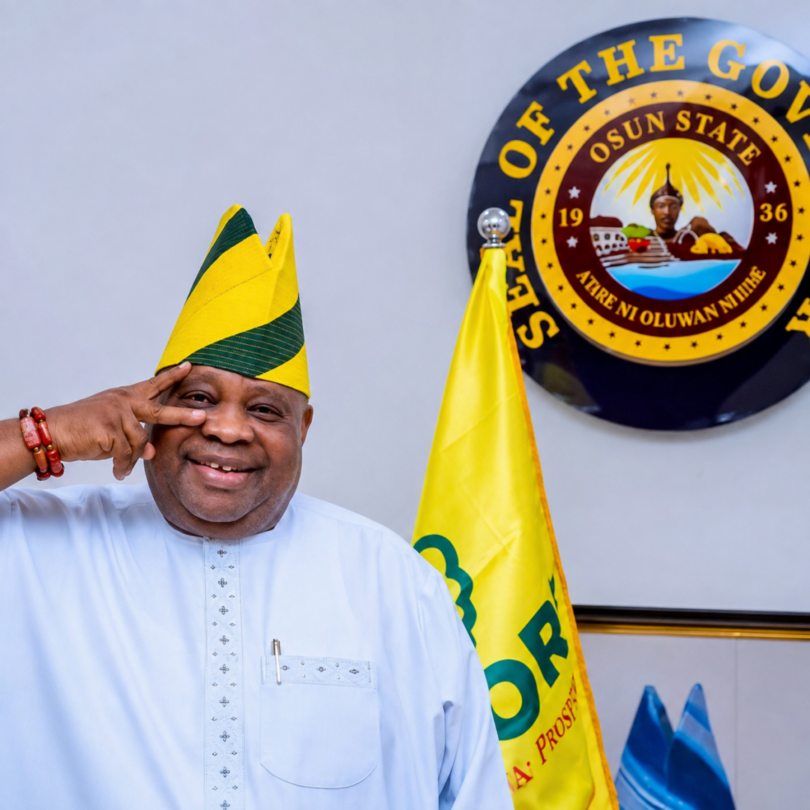
Osun State governorship election recorded higher voter participation and a wider victory margin for the incumbent governor compared to his 2022 victory.
The 2026 Osun governorship election produced a striking electoral paradox: more voters came to the polls, both leading candidates increased their parties’ vote totals, yet the gap between the leading candidates, Governor Ademola Adeleke of the Accord Party and Bola Oyebamiji of the All Progressives Congress (APC) widened dramatically.
The figures are contained in AEO’s comparative assessment of the August 15 election, based on the final results declared by the Independent National Electoral Commission (INEC). The observatory said the data provide a high-confidence picture of the declared outcome, while its more detailed reconciliation of polling-unit results is still ongoing.
Mr Adeleke, who contested in the state’s 2026 governorship election to seek re-election polled 511,067 votes to defeat APC candidate, Bola Oyebamij, up from the 403,371 votes he secured in 2022 when he contested under the Peoples Democratic Party (APC) against the then incumbent Adegboyega Oyetola of APC.
His closest challenger in the 2026 election, APC’s Mr Oyebamiji, also improved significantly from the 375,027 votes secured by the party’s candidate, Gboyega Oyetola, in 2022, polling 444,815 votes in the recently concluded election.
The increase in votes for both candidates means Mr Adeleke’s victory cannot simply be explained by an increase in his own support. Rather, both major political camps mobilised more voters, while the incumbent ultimately expanded the distance between himself and his closest challenger.
According to the AEO’s report, the size of Osun’s electorate increased considerably between the two elections. Registered voters rose from 1,952,387 in 2022 to 2,339,544 in 2026, an increase of 19.8 per cent.
Accredited voters also increased by 22.2 per cent, from 827,218 in 2022 to 1,010,684 in 2026, while total votes cast rose from 823,124 to 1,005,800.
But despite the increase in the absolute number of voters, the proportion of registered voters who were accredited changed only marginally. The accreditation rate moved from 42.37 per cent in 2022 to 43.20 per cent in 2026, an increase of just 0.83 percentage points.
The report highlighted that the election drew more voters largely because the electorate itself had grown, rather than because there was a dramatic improvement in the proportion of registered voters participating.
AEO said this larger and more competitively mobilised electorate could have implications for attempts to influence voters through inducements.
“For anyone seeking to influence an election through large-scale retail vote buying, a larger and competitively mobilised electorate can raise both the cost and uncertainty of the exercise,” the observatory said.
The observation, however, does not mean that vote buying did not occur during the election. Rather, AEO argued that a larger electorate with stronger competition can make large-scale manipulation more difficult to execute without detection.
The results also reveal that the 2026 contest was more than an incumbent simply defeating an opposition.
Mr Adeleke increased his vote total by 107,696 votes, moving from 403,371 in 2022 to 511,067 in 2026. The APC also increased its vote total by 69,788 votes, from 375,027 in 2022 to 444,815 in 2026.
Yet the governor’s share of valid votes increased from 50.13 per cent to 51.90 per cent, while the APC’s share fell from 46.63 per cent to 45.17 per cent.
The result, however, was a significantly wider margin. In 2022, Mr Adeleke defeated Mr Oyetola by 28,344 votes. Four years later, he defeated Mr Oyebamiji of the party by 66,252 votes. That represents a 133.7 per cent increase in the winning margin.
The numbers therefore suggest that while the APC remained a major electoral force in Osun State, its attempt to regain the governorship did not translate into the level of statewide support required to overcome the incumbent.
The increase in participation was accompanied by a rise in rejected ballots. According to the AEO’s report, rejected votes grew at a slower rate than valid votes. While valid votes increased from 804,450 to 985,079, representing a 22.5 per cent rise, rejected votes increased from 18,674 to 20,721, an 11 per cent increase.
The AEO does not attribute the increase to any particular cause. But the rise remains relevant to the assessment of the election as more than 20,000 votes were ultimately excluded from the valid-vote tally.
However, beyond the numbers, AEO’s assessment places considerable emphasis on the role of political competition in protecting electoral integrity.
The observatory argues that competitive elections require political parties to maintain agents across polling units, understand electoral procedures and independently track results through successive levels of collation.
Where competing parties possess these capabilities at scale, AEO says, manipulating an election becomes harder to execute without detection.
“Competition of this kind is expensive to build. It requires agents across polling units, a working knowledge of the electoral process, effective party organisation, and the capacity to track results independently from polling unit through successive levels of collation,” the report expressed.
That argument is particularly relevant to Osun, where the 2026 election was fought principally between the ruling Accord Party and the APC, with the ADC emerging as a distant third with 17,180 votes.
It stated that the presence of competing party agents across polling units provides an additional layer of scrutiny because parties are able to compare their own records with the results announced at different stages of the process.
AEO consequently describes organised political competition as “an important safeguard for electoral integrity.”
The election also offered another test of INEC’s electronic election infrastructure, particularly the Bimodal Voter Accreditation System (BVAS) and the INEC Result Viewing Portal (IReV).
AEO said BVAS accreditation, IReV uploads of polling-unit results and structured digital result capture are increasingly creating an auditable trail from the polling unit to the final result.
But the organisation cautioned that important weaknesses remain. It identified upload delays, transparency around transmission timelines, system resilience and reconciliation across different electoral records as areas requiring further improvement.