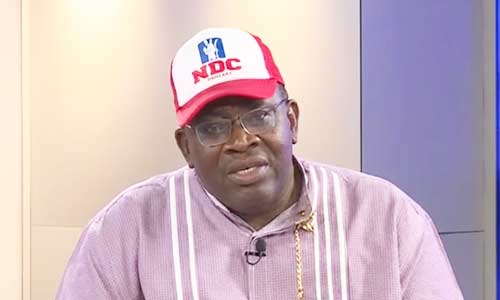
The National Leader of the Nigeria Democratic Congress (NDC), Senator Seriake Dickson, a former two-term Governor of Bayelsa State, former Attorney General of Bayelsa State, and sitting senator, has delivered a comprehensive legal, political, and constitutional response to the Federal High Court Lokoja ruling that set aside the judgment directing INEC to register the NDC, describing the court as “functus officio,” meaning it had exhausted its jurisdiction and had no business entertaining the application, declaring the Peace Movement Party (PMP) “unknown to the laws of Nigeria,” assuring all NDC candidates that they will be on the 2027 ballot, and warning that desperate politicians are using the judiciary to constrict the opposition space in ways that threaten Nigeria’s democracy.
Dickson made the statements during an extensive interview on Channels Television’s Sunday Politics programme with Seun Okinbaloye, broadcast on Sunday evening, where he addressed the Lokoja ruling, the state of opposition politics, the state police constitutional amendment, and the internal dynamics of the NDC.
Dickson mounted his most detailed legal argument on the question of jurisdiction, invoking the doctrine of functus officio, which holds that once a court has delivered a final judgment on a matter, it has exhausted its jurisdiction and cannot revisit or set aside that judgment.
“It is a court that ordinarily doesn’t have jurisdiction to sit on appeal over its own earlier judgments,” Dickson stated. “Once a federal high court has given a judgment on a matter, the court is functus officio and shouldn’t have any business.”
He argued that the court’s invocation of fair hearing principles to justify reopening a concluded case was “misplaced and an attempt to be clever by half.”
“What that section of the fair hearing rule says is that when they went to court, if you properly construe it, they had a right to be heard on the application. And what the court ought to have done would have been on its own to ask: can you address me on the jurisdiction I have? I have delivered a judgment. Am I not functus officio?” Dickson stated.
He further questioned why the court went beyond the jurisdictional question into the substantive merits: “If what was concerned was fair hearing, why did he go into the substantive issue of the judgment that he had delivered, over which he is functus officio?”
Dickson delivered what amounted to a systematic demolition of the Peace Movement Party’s legal standing, describing it as an entity unknown to Nigerian law that has no capacity to sustain any claim against a functioning political party.
“That applicant is unknown to the laws of this country. It is not a political association. It is also not a registered political party. It is not carrying out political activities. It is not sponsoring political candidates for this election or for any election at all,” Dickson stated.
“Nobody even knows the national chairman of that so-called association. Nobody knows the secretary. Nobody knows the office or headquarters. Nobody knows any member. Only someone described herself as pro tem legal adviser of an association, and it is even anomalous that it refers to itself as a party,” he continued.
Dickson went further, arguing that the PMP’s self-designation as a “party” is itself a criminal offence: “By the laws of this country, only a registered political party can call itself a political party and can undertake or be part of political activities. It is a criminal offence to do so.”
He noted that the PMP claimed to have applied for registration in 2015 but was denied: “So 10 years that association has been moribund, dormant, non-existent. It is not a body that can pursue any claim against our party. It is not a body capable of having any rights that can be enforced.”
Dickson addressed the PMP’s claim that the NDC’s victory sign symbol was copied from its own application, dismissing it as legally baseless.
“This is a victory sign and political icons all over the world, not only in Nigeria, have used it. Mahatma Gandhi used it. Nelson Mandela used it. In Nigeria, Chief Awolowo used it. As a matter of fact, in NEPU in the 1940s and 1950s, this was their sign, ‘Nasara,’ meaning victory in the North,” Dickson stated.
He argued that even under the Electoral Act, if a political association is denied registration and ceases to function for five years, INEC is at liberty to allow another party to use that symbol: “I’m saying that INEC is at liberty to allow another party to use that symbol. Symbols are not reasons why you deregister a political party.”
Dickson directly addressed the court’s finding that material facts were suppressed during the original proceedings, an allegation he rejected emphatically.
“There was full and complete disclosure. By who? INEC, who came to oppose us the application. One of the reasons they advanced was that this sign was used by a Peace Movement. They referred to this application. And his lordship asked them himself in the proceedings: ‘Are they applying now to be registered in this exercise?’ They said no. ‘Are they a registered political party in the country?’ They said no,” Dickson recounted.
“So there was disclosure, material disclosure. They didn’t have to be joined. You don’t join a party you don’t know. You don’t join a party that is not in existence,” he stated.
Dickson drew a critical legal distinction between the court setting aside its earlier judgment and ordering deregistration, arguing that the two are not the same.
“This ruling did not contain a positive mandatory order directing INEC to deregister. This ruling did not do that,” Dickson stated.
When the interviewer pressed that the judgment upon which INEC registered the party was now “a nullity,” Dickson pushed back firmly: “Courts don’t function that way. Orders of courts are to be construed strictly. It was possible for the court to have made that order on deregistration. If that was what it wanted, but the court did not say so.”
He assured all NDC candidates that their nominations remain valid: “The NDC has validly nominated candidates for all elective offices in primaries monitored nationwide by INEC, from House of Assembly to House of Representatives to Senate to governorship and to a presidential candidate who has also nominated a running mate. All nominations have been validly carried out, monitored by INEC in accordance with the timeframe given by INEC.”
Dickson stated that nominations are done at the primaries level and that submission to INEC is “an administrative procedure,” meaning the candidates’ rights are vested from the moment they were validly nominated.
In a counter-intuitive development, Dickson said the Lokoja ruling had actually strengthened the NDC’s public profile.
“From Friday, thousands of Nigerians have been flocking to our website to register. They now know more about our party. They sympathise with our party and our candidates. They are flocking and buying into the vision of our party and our candidates,” Dickson stated.
Dickson placed the Lokoja ruling within a broader pattern of what he described as attempts to eliminate opposition platforms ahead of 2027, linking it to the earlier Court of Appeal-stayed judgment by Justice Peter Lifu ordering the deregistration of the ADC and four other parties.
“What people are trying to do is to look for flimsy reasons to truncate the political opposition, destabilise and weaken and scatter the political opposition,” Dickson stated.
He issued a direct plea to those he described as being behind the legal manoeuvres: “Even if somebody is a hangman, you should know how to hang properly. This is a terrible hangman job.”
He warned the APC: “You can only beat them silly in a contest, in an electoral contest. So let’s have a free and fair contest. Let the ADC be on the ballot. Let the NDC be on the ballot. Let the APP be on the ballot. Let the Labour Party and the PDP, whatever it is, let’s protect the opposition space.”
While carefully avoiding personal attacks on the judge, Dickson delivered a broader warning about the institutional damage being caused by politically motivated litigation.
“I’m concerned that political players, for fear of going through elections and competitions, are destroying the judiciary, putting the judiciary in a very bad light, and putting INEC also in a very bad light,” Dickson stated.
He acknowledged that judges can err but insisted the remedy lies in the appellate process, not in public condemnation of individual judges: “Judges don’t speak, so people should be careful. I don’t like people making statements about individual judges and justices because by their conservative rules and their precedents, they can’t speak for themselves. We have a duty to protect the judiciary as a critical institution.”
“We can’t have a democracy without the judiciary. We can’t have a democracy without the media. We can’t have a democracy without the security agencies being fair and impartial. We can’t have a democracy without INEC being an unbiased umpire,” Dickson stated.
Dickson disclosed that the NDC’s vice-presidential candidate, former Kano Governor Rabiu Musa Kwankwaso, visited him shortly before the television interview.
“His Excellency Rabiu Musa Kwankwaso, shortly before I came here, visited me before I came to this studio. He came from Kano, drove straight, and we had interactions before I came here. We have formed a partnership,” Dickson stated.