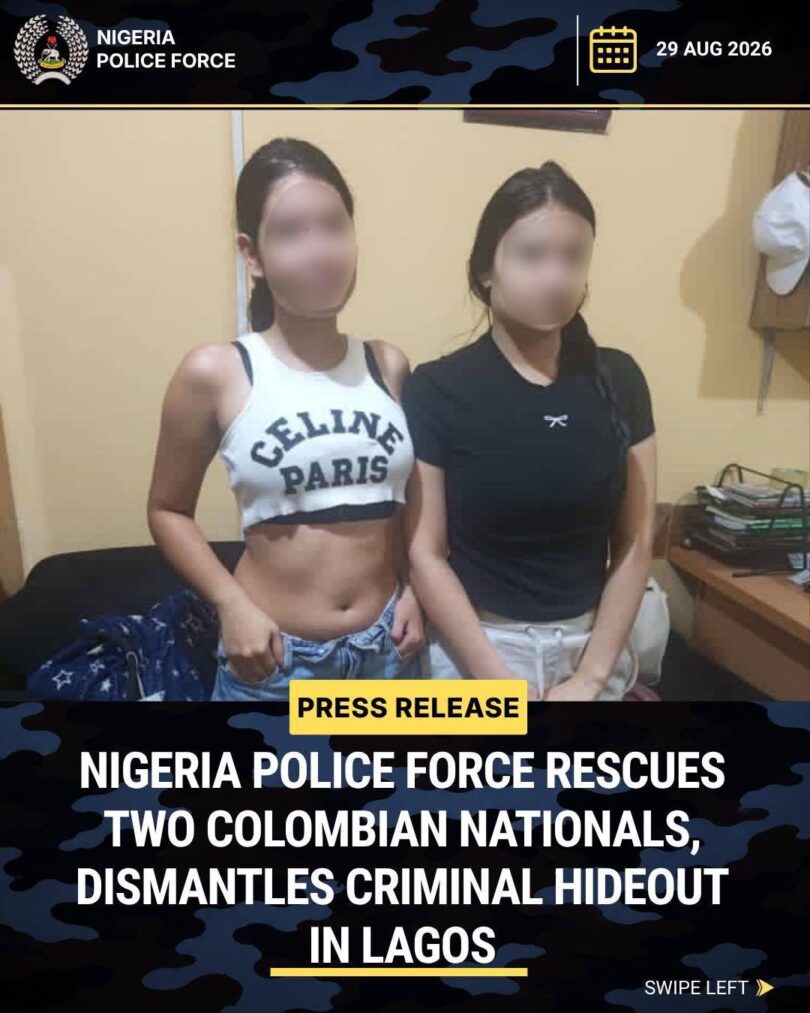
The Nigeria Police Force has rescued two Colombian women who were allegedly lured to Nigeria and held captive by a human trafficking syndicate in Lagos.
The police confirmed the rescue in a statement posted on X on Saturday by the Force Public Relations Officer, Ani Iniedu.
“Upon receipt of the intelligence, police operatives promptly launched a covert tracking operation, locating the hideout in Lagos where both victims were safely rescued on the same day,” he stated.

Mr Iniedu stated that the women were allegedly deceived into travelling to Nigeria, where they were held against their will.
Also, they had their travel documents confiscated by some Chinese nationals who are now at large.
Following the intelligence from Bogotá, operatives of the National Central Bureau-INTERPOL, Lagos Annex, began tracking the victims and located the hideout in Lagos later that day.
The suspects fled the location when they sighted the approaching police team, abandoning the two women, according to the police.
The police said efforts were ongoing to arrest the fleeing suspects and other members of the syndicate.
The two women are currently in police custody and receiving support, the statement noted.
The Colombian Embassy in Accra is working with the bureau to arrange hotel accommodation for the women and obtain emergency travel documents for their return to Bogotá.
The operation relied on cooperation between law enforcement agencies in Nigeria and Colombia. INTERPOL describes National Central Bureaus as the focal points through which member countries connect their law enforcement agencies with police authorities in other countries and the organisation’s General Secretariat.
Nigeria’s National Central Bureau works with agencies including the Nigeria Police Force and the National Agency for the Prohibition of Trafficking in Persons (NAPTIP) on transnational crimes, including human trafficking and migrant smuggling, according to INTERPOL.
The Inspector-General of Police, Olatunji Disu, reaffirmed the force’s commitment to protecting residents and strengthening cooperation with international law enforcement agencies to tackle cross-border crimes.