The senate president directed the committee to submit its report within one week, detailing the federal government’s efforts toward settling the outstanding debts owed to the contractors.
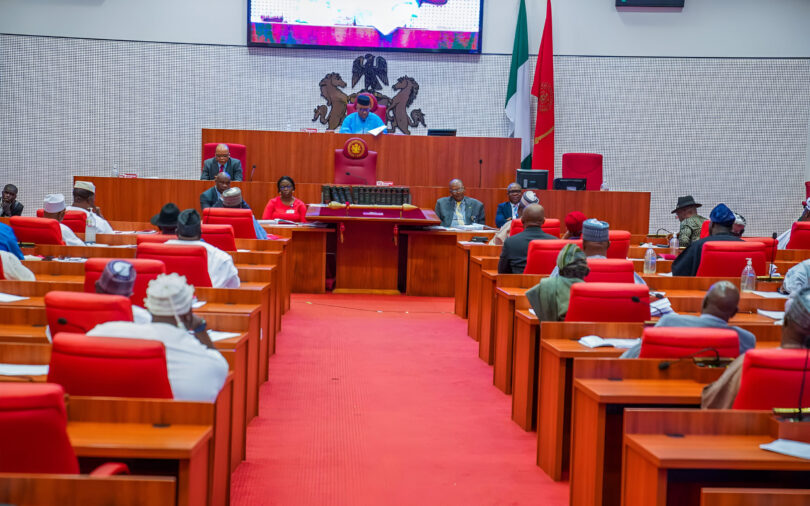
The Senate on Tuesday constituted a six-member committee to liaise with the Federal Ministry of Finance and facilitate the reimbursement of outstanding payments owed to local contractors for capital projects executed across the country.
Mr Akpabio said the committee would be chaired by the Chairman of the Senate Committee on Finance, Sani Musa (APC, Niger East).
Other members of the committee are Adetokunbo Abiru (APC, Lagos East), Kawu Sumaila (APC, Kano South), Abubakar Sani Bello (APC, Niger North), Isah Jibrin (APC, Niger East) and Abdullahi Yahaya (APC, Kebbi Central).
The senate president directed the committee to submit its report within one week, detailing the federal government’s efforts toward settling the outstanding debts owed to the contractors.
The upper chamber’s decision to constitute a committee on unpaid contractors’ debts comes after the contractors staged different protests to demand for their obligations on capital projects they executed in different parts of the country.
While government officials and contractors have offered varying figures, contractors under the umbrella of the All Indigenous Contractors Association of Nigeria (AICAN) have repeatedly claimed that the federal government owes them about ₦4 trillion for completed projects, particularly those executed under the 2024 budget.
The government, however, has maintained that a substantial portion of the verified claims has already been settled and that the remaining liabilities are undergoing verification and phased payment.
The debt dispute has triggered a series of protests in Abuja since 2025. Contractors have on several occasions occupied the premises of the Federal Ministry of France and blocked access to the ministry, accusing government officials of failing to honour promises to release funds for completed projects.
The protesters argue that many contractors borrowed from commercial banks to execute government contracts and have since been unable to repay the loans due to delayed payments. Some claim the situation has resulted in loan defaults, business closures and the seizure of assets by financial institutions.
In response, the federal government has announced several measures aimed at clearing the backlog. Former Minister of Finance, Wale Edun, before his exit, previously disclosed that more than ₦2 trillion in capital obligations had been paid, while the ministry confirmed the release of ₦152 billion to contractors after verification processes.
The government also made provisions in subsequent budgets to address outstanding liabilities and has continued engagements with contractors’ representatives on a phased settlement plan.
The issue has nevertheless remained contentious because of its wider economic implications. Delays in paying contractors can slow infrastructure delivery, increase the cost of government projects through accumulated interest and inflation, and weaken the financial position of local construction firms.
The controversy has become even more pronounced as the federal government continues to seek new borrowing to finance budget deficits and infrastructure development.
Government officials, however, continuously argue that borrowing is necessary to fund ongoing projects and support economic growth while outstanding obligations are settled in phases based on available revenues and verification procedures.