
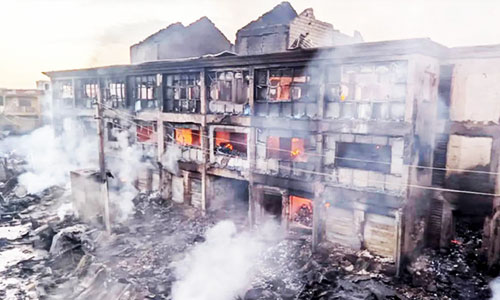
A devastating fire has once again struck Kano’s historic Singer Market — the largest commodity hub in northern Nigeria — destroying over 1,000 shops, razing four residential buildings, and leaving seven persons unaccounted for in what traders and market leaders are calling one of the worst tragedies in the market’s history.
The blaze, which started on Saturday afternoon in the Gidan Glass section of the market, raged through the night and into Sunday morning, consuming goods, equipment, and valuables estimated at over N5 billion and crippling the livelihoods of hundreds of families. The inferno came barely two weeks after a similar fire on February 2 destroyed more than 70 shops in the same market.
An eyewitness described the rapid spread of the fire: “The fire started from a shop selling provisions. Within minutes, it spread to other shops. We tried to remove some items, but the heat and smoke were too much.”
Despite the intervention of the Kano State Fire Service, private water tankers, and support from companies including Aspira Nigeria Limited, Umza, and Gongoni, the fire raged for hours, overwhelming emergency responders.
Trader Nasir Maharazu, speaking while the fire was still burning, said: “As I speak to you now, I can see the fire burning. The whole three-storey building is under fire. This fire is even worse than the one recorded less than two weeks ago in the market.”
The market’s chairman, Alhaji Junaid Zakari, confirmed that the inferno destroyed property worth over N5 billion, affected more than 1,000 businesses, and left seven persons missing. He described the incident as a tragedy that would never be forgotten in the history of Singer Market.
“This is a disaster that will never be forgotten. Hundreds of families have been left without livelihoods. Emergency responders and security agencies are working to determine the cause of the fire and locate those declared missing.”
Zakari disclosed that four residential buildings housing small-scale businesses were completely razed. Goods, equipment, and valuables were burnt to ashes, and investigations were ongoing to determine the whereabouts of the seven missing persons.
Individual traders recounted catastrophic personal losses. Alhaji Isa Abubakar said he lost goods worth over N200 million, while Musa Ibrahim estimated his losses at N340 million.
“The fire consumed everything we had. It is heartbreaking to see decades of hard work destroyed in hours.”
While official investigations into the cause of the fire are still ongoing, many traders and experts believe a solar battery explosion may have triggered the outbreak. The growing use of solar power systems in the market, combined with poor installation practices and a lack of safety protocols, has emerged as a primary area of concern.
Nasir Ibrahim, a trader, told Daily Trust that the fire may have been caused by an explosion from a lithium solar battery.
“We are suspecting that it could be an explosion from a solar battery in one of the shops that later affected virtually all the shops in Gidan Glass.”
Malam Buhari Saminu Danhajiya, another trader, blamed unsafe solar practices, revealing that many shop owners leave their solar systems running overnight without proper shutdown procedures.
“After market hours, some traders do not properly switch off their systems. A minor technical fault can easily ignite a fire. There should be urgent enforcement of electrical standards for all solar systems, including mandatory training and certification of installers.”
Saminu Yusif Abdullahi, spokesperson of the Kano State Fire Service, however, cautioned that most of the narratives about the possible cause were still speculative, stating that the agency was still working to determine the real cause. He confirmed that the level of destruction was high, with some buildings completely burnt to ashes.
“While the fire has been brought under control, we are still working to extinguish it completely. Some parts of the buildings are not yet accessible.”
Traders and experts identified congestion as one of the most critical factors behind the repeated infernos at Singer Market. The market is densely packed with shops, kiosks, and residential buildings, many of which have been converted into storage facilities for highly flammable goods. Narrow pathways and poorly planned layouts make evacuation difficult and significantly delay emergency response.
Firefighting trucks often struggle to access affected areas, forcing emergency crews to improvise by drawing water from distant points, including from flyovers.
Alhaji Usman Sani Dakata, a shop owner, painted a vivid picture of the danger.
“During peak trading hours, especially after closing time, the volume of human traffic alone is enough to tell you the kind of danger we face in the event of a fire disaster. There is urgent need for government to decongest the market by ensuring that all major stores are moved out.”
Dakata described traders’ resistance to the state government’s attempts to relocate large storage facilities to the Dangwauro International Market as “costly.” Market leaders admitted that past efforts to move large stores to alternative locations were resisted by traders — a decision that has worsened congestion and increased fire risk.
The Kano State Government had previously hinted at relocating some markets to Kano Economic City at Dangwauro, a new commercial hub along the Kano-Zaria Road. Although no specific timeline was given for Singer Market’s final relocation, the government had mentioned Yanlemo fruits market and Yankaba vegetables market as next in the relocation agenda. A visit to the Dangwauro site confirmed that a good number of pharmaceutical traders had already relocated, while many blocks designated for other markets were still under development.
Efforts to reach the state’s Commissioner for Commerce, Investment and Industry, Shehu Wada Sagagi, for comment on the planned relocation proved unsuccessful, as calls were neither answered nor returned.
Dr Sulaiman Yunus, a disaster management specialist and senior lecturer at Bayero University, Kano’s Geography Department, explained that anthropogenic factors — particularly negligence — are the primary cause of market fires. He attributed most incidents to faulty electrical wiring and poorly installed solar installations.
“We are still using obsolete methodology of waiting until an outbreak occurs, and then we start rushing to respond. We need to be proactive rather than reactive.”
Dr Yunus, whose doctoral dissertation focused on this very issue and was presented to the state government, stressed the need for proactive safety measures, including proper wiring, fire extinguishers, and modern firefighting strategies.
Governor Abba Kabir Yusuf of Kano State visited the scene of the fire and urged calm and cooperation among traders. In a statement, he called on the Federal Government to urgently provide modern firefighting equipment, including air support, to strengthen Kano’s emergency response capacity.
“This intervention would help prevent future occurrences and enhance our ability to respond effectively to large-scale emergencies.”
The governor commended the Kano State Fire Service and other security agencies for their commitment and efforts in battling the blaze.
President Bola Ahmed Tinubu expressed deep concern and commiserated with traders and the people of Kano State over the fire outbreak. According to a statement by his spokesperson, Bayo Onanuga, the president described the incident as tragic and was particularly alarmed that it came less than two weeks after another fire destroyed dozens of shops at the same market.
Tinubu, who had earlier reached out to Governor Yusuf for a situation report, directed a comprehensive investigation into the causes of the repeated fires at Singer Market.
In a follow-up statement, Onanuga announced that the president had directed Vice President Kashim Shettima to lead a high-powered federal government delegation to Kano to express sympathy and support for victims. The delegation was scheduled to depart Abuja the following day and would convey the president’s condolences to affected traders.
The delegation would also pledge, on behalf of the government, financial assistance to aid victims and support Kano State in facilitating the quick reopening of the market. Members of the delegation include the Speaker of the House of Representatives, Tajudeen Abbas; Deputy Senate President, Senator Barau Jibrin; Senator Kawu Ismaila; Abubakar Kabir Bichi, Chairman of the House of Representatives Appropriation Committee; the Minister of Humanitarian Affairs, Bernard M. Doro; and Mrs Zubaida Umar, Director-General of the National Emergency Management Agency (NEMA).
The Deputy President of the Senate, Senator Barau I. Jibrin, visited Singer Market on Sunday and donated N100 million to affected traders to cushion the impact of the inferno. He was received by market chairman Alhaji Junaidu Zakari alongside hundreds of traders.






Leave a Comment