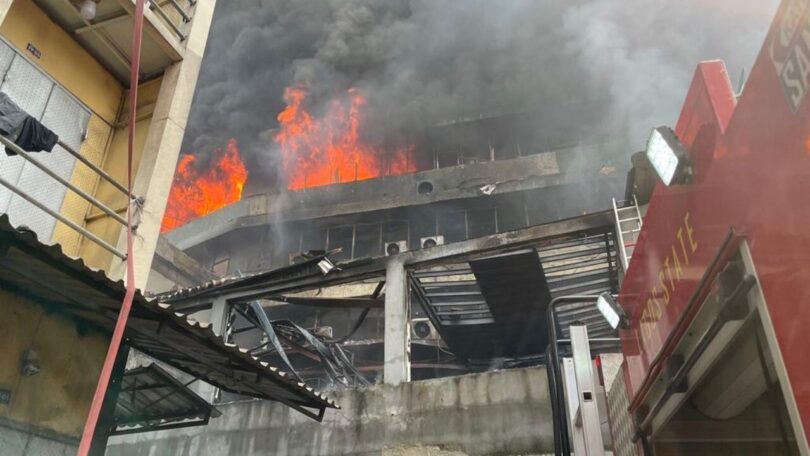
“For over two months now, this (fire) station has not received even a drop of diesel,” an official said on condition of anonymity because he was not authorised to speak publicly on the incident.
Blackened palm oil flowed across the wet market walkway. Burnt roofing sheets hung loosely over collapsed wooden stalls. Damaged freezers, melted buckets of rice, scorched cartons of tomatoes, and warped metal doors lay in heaps. Traders wandered through the debris in stunned silence, some clutching keys to shops that no longer existed.
But while the fire advanced, residents and traders said the closest emergency response unit, a fire station inside the market, could not respond.
The reason, according to multiple witnesses and fire service officials interviewed by PREMIUM TIMES, is that there was no diesel to power the firefighting truck.
By the time federal firefighters eventually arrived hours later, traders, desperately fighting to put out the raging inferno, had formed human chains with buckets and basins. Residents fetched water from nearby homes. A hotel in the area supplied additional water. By then, millions of naira in goods had already been reduced to ashes.
“If not for the people in this street, this fire would have consumed far more shops in the market than this,” said Godwin Emmanuel, a phone and laptop repair technician, whose shop, luckily, was not destroyed by the fire.
Mr Emmanuel said he received a distress call shortly after 1 a.m. and raced about four kilometres from his house to the market, as public transportation was unavailable at night.
“When we called the fire service station inside the market, they told us the truck was working, but there was no diesel,” he said. “We called other places too, and heard the same thing. Help finally came after the chairman of Uyo Local Government contacted the federal fire service.”
PREMIUM TIMES visited the market around 11 a.m. on the day of the fire and observed smoke still emitting from several shops hours after the blaze was extinguished.
This newspaper counted at least eight container shops built along the market fence, which were completely razed. Another eight lock-up stores inside the market were severely damaged.
Inside one of the burnt stores, palm oil still coated the floor in thick layers.
Utibe Udeme, who stored drums of palm oil in the shop, stood motionless beside the wreckage.
“I have lost over N12 million,” he said quietly. “I invested everything I had and even collected loans because of the expected returns later in the year. Now I am back to square one.”
Witnesses said the stored palm oil intensified the fire.
Nearby, Irene Edet sifted through charred bags of rice, burnt beans and blackened cartons of tomatoes.
“I recently got over N6 million to equip this shop,” she said. “There is nothing left to recover.”
She said she was informed about the fire during the night, but by the time she reached the market in the morning, her shop had already been destroyed.
“I asked how this could happen when there is no electricity in the market. They told me it was an electrical fault from another shop,” she said. “I am begging the government and the market leadership to help us.”
For Emah James, a food vendor, the losses went beyond merchandise.
“I lost the N50,000 I collected from my thrift contribution,” she said. “I buy rice and garri in bags for my business. Everything is gone.”
But beyond grief, many traders expressed anger.
Umoh Jeremiah, another victim, said no senior government official had visited them as of Tuesday afternoon, on the day of the fire incident.
“They are busy with elections, while people are suffering here,” he said. “We pay taxes every day in this market. Yet when an emergency happened, there was no emergency response.”
When PREMIUM TIMES visited the fire station inside the market, officials confirmed they had received distress calls but could not deploy immediately due to fuel shortages.
“For over two months now, this station has not received even a drop of diesel,” an official said on condition of anonymity because he was not authorised to speak publicly on the incident.
The official, however, said the firefighting truck was functional.
“If we had diesel, not up to two shops would have been affected,” he said. “The incident happened within reach. We would have responded almost immediately.”
Using Google Earth, an open-source tool that allows distance measurement, PREMIUM TIMES measured the distance between the fire station and the fire outbreak site. It was 105.98 metres, about the distance of 10 buses parked end to end.
Measurement of the distance between the fire service station at Akpan Andem Market and the location of the fire outbreak
According to the official, less than 20 litres of diesel would have been sufficient for the emergency response because of the short distance between the station and the fire scene.