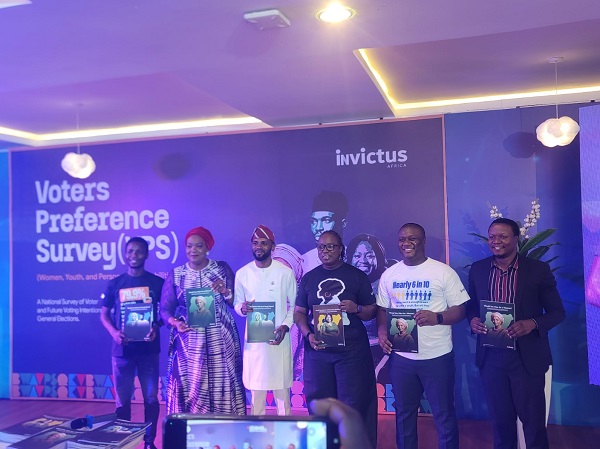
The survey conducted by Invictus Africa found that 64.4 per cent of respondents would vote for a woman in 2027, while 74.3 per cent would support a young candidate but often do not see them on the ballot.
A new voters’ survey has challenged the long-held assumption that Nigerian voters are largely unwilling to elect women, youth and persons with disabilities, saying the bigger problem may lie in the limited opportunities given to these groups to emerge as candidates and gain visibility.
The Executive Director of Invictus Africa, Bukky Shonibare, disclosed the findings on Tuesday at the official launch of the organisation’s Voters’ Preference Survey (VPS) Series (Pre-Election, 2026).
The nationally representative survey covered 11,196 eligible voters across Nigeria’s 36 states and the Federal Capital Territory.
According to Ms Shonibare, the findings point to a need to move the national conversation away from simply asking why Nigerians are not voting for women, young people and persons with disabilities, to examining whether political parties are providing them with a fair opportunity to contest elections in the first place.
“We asked voters about their previous voting behaviour, their views of women, young people, and persons with disabilities as political candidates, and their intentions ahead of the 2027 General Elections. The findings challenge some long-held assumptions, but they also raise important questions,” she said.
The survey found that 69.1 per cent of respondents had never voted for a woman in an election.
However, 51.1 per cent of those who had never done so said the reason was that they had not seen a woman on the ballot.
The finding contrasts with voters’ stated willingness to support women in future elections.
According to the survey, 64.4 per cent of respondents said they would vote for a woman in the 2027 elections, while 55.1 per cent said a woman’s track record would be sufficient to earn their vote.
Ms Shonibare said the findings suggest that the absence of women in elected positions cannot be explained solely by voters’ attitudes towards female candidates.
“The conversation must go beyond whether Nigerians are willing to vote for candidates from underrepresented groups. We must also ask whether these candidates are being given a fair opportunity to emerge.”
She said political parties must also be examined for their role in determining who gets nominated, who survives party primaries and who receives the resources and visibility required to compete.
She said the process begins with who is encouraged to seek office, who can afford nomination forms, who survives internal party processes, who receives meaningful support and who eventually becomes known to voters as a credible candidate.
The same pattern emerged in the findings on youth. The survey showed that 79.9 per cent of respondents who had never voted for a young candidate said they were unaware of any young candidate on the ballot.
Yet, 74.3 per cent of respondents said they would vote for a young person in 2027.
Interestingly, middle-aged voters were slightly more willing to support young candidates than young voters themselves, with 77.2 per cent of middle-aged respondents indicating their willingness compared with 74.5 per cent of young respondents.
The survey also found that nearly six in 10 voters considered merit alone sufficient to earn the support of voters for a young candidate.
Ms Shonibare said this reinforces the need for political parties and candidates to focus on competence, credibility and track record rather than relying solely on identity-based appeals.
For persons with disabilities, however, the survey showed that the challenge goes beyond visibility.
The survey found that 61.3 per cent of respondents who had never voted for a person with a disability said they were unaware of any such candidate on the ballot.
Only 8.7 per cent of respondents said they had ever voted for a candidate with a disability, but 38.7 per cent said they would support one in the 2027 elections.
The level of intended support was considerably higher among voters with disabilities, at 59.2 per cent, compared with 37.7 per cent among voters without disabilities.
The survey also found that voters were more willing to support persons with disabilities at lower levels of government. While 71.3 per cent said they would support a candidate with a disability for councillor, the figure fell to 48.9 per cent for president.
According to Ms Shonibare, one in three voters also remained undecided on whether they would vote for a person with a disability.
Although 80.1 per cent of reasons given for supporting candidates with disabilities were merit-based, and 87.9 per cent of respondents prioritised qualification, honesty and track record over identity, 12.1 per cent considered party and ethnic alignment.
Ms Shonibare said the figures suggest that limited visibility is not the only obstacle confronting persons with disabilities, as perceptions about disability and leadership could also influence voter choices.
Ms Shonibare called for legislation requiring political parties to establish minimum quotas for women and other underrepresented groups, citing the Reserved Seats Bill and Gender Equality and Equal Opportunities Bill.
She also urged the government to fast-track stalled legislation and fully implement existing laws promoting equality and inclusion.
She called for greater inclusion of women, young people and persons with disabilities in executive appointments as ministers, commissioners and special advisers, saying such roles would help them build experience, visibility and track records ahead of elections.