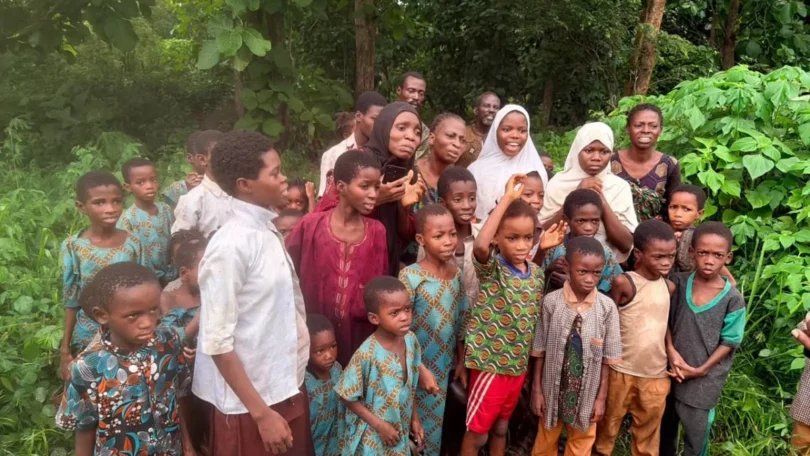
The principal of Community High School in Oriire Local Government Area of Oyo State, Mrs Racheal Alamu, has shared details of the traumatic experience she and dozens of pupils and teachers endured during their 56 days in captivity.
Alamu spoke on Tuesday after she, alongside the rescued teachers and pupils, was formally received by Governor Seyi Makinde at the Governor’s Office in Ibadan following their rescue from captivity.
The principal described a difficult period spent in the forest, where the victims battled harsh weather conditions, fear and uncertainty while under the watch of their abductors.
According to her, the captives were forced to remain in open locations for most of the period, enduring both heavy rainfall and intense sunshine.
“You can only imagine it. It was not easy. We were in the forest, in the open, most of the time, under the sun and under the rain, with the children. But we kept going because there was no way out.
“We knew it was only God that could help us, and we believed people were praying for us. That kept us going,” she said.
Alamu disclosed that although she was not physically assaulted, several of the children suffered punishment whenever they cried or made noise.
She explained that the abductors were constantly worried that any sound could reveal their location.
“Personally, I was not beaten, but some of the children were beaten. What they hated most was noise because they believed it could attract attention.
“The youngest children suffered the most. They would tie their mouths with pieces of cloth and beat them very well,” she said.
The principal further revealed that male members of the group faced harsher treatment throughout the ordeal.
According to her, several male teachers were blindfolded and restrained for long periods.
“The men had it worse than us. They were blindfolded, handcuffed and chained on their legs,” she added.
Despite the harsh conditions, Alamu said none of the victims was sexually abused during their time in captivity.
“There was no form of molestation,” she stated.
She also narrated how the captives were repeatedly moved from one location to another whenever the abductors suspected that security operatives were closing in on their hideouts.
The relocation exercises, she said, often took place at night and involved long treks through difficult terrain.
“When the place was discovered, we had to move, and that usually started around seven or eight at night. Sometimes we walked for three to four hours. That is why you see bruises on our bodies.
“The younger ones were carried, but the older children had to walk. They fell many times. It was very difficult,” she said.
Alamu recalled that shortly after the abduction, the victims were transported deeper into the forest through a combination of vehicles, trekking and motorcycles.
“My car was used to convey us to a point where we met the primary school pupils and their teacher.
“From there, we walked for about one hour before they brought motorcycles. About 10 motorcycles were used to move us for more than four hours through bush paths they knew very well,” she said.
The veteran educator, who said she has spent 28 years in service and is only a few years away from retirement, admitted that the experience had left her deeply shaken.
She noted that returning to work in remote communities would be difficult after what she had gone through.
“I have worked for 28 years, and I have just about four years to retire. Going to rural areas now will take the grace of God.
“Before this happened, I had already sacrificed a lot because of the distance. Now, coupled with this experience, I don’t know what will happen. I want to see my husband. When I get home, I can think of every other thing,” she said.
Meanwhile, relatives of some of the rescued pupils also shared accounts of what the children endured while being held in the forest.
According to family members, the victims survived largely on cocoyam and noodles provided by their captors. They also depended on water sourced from a nearby waterfall within the forest where they were kept.
The accounts emerged as more details surfaced about the extensive security operation that eventually led to the rescue of the abducted schoolchildren and teachers.