A review of Benue State’s audited financial records from 2018 to 2025 reveals a troubling pattern: a disconnect between the scale of the crisis in Benue and the transparency and accountability of public spending meant to address it.
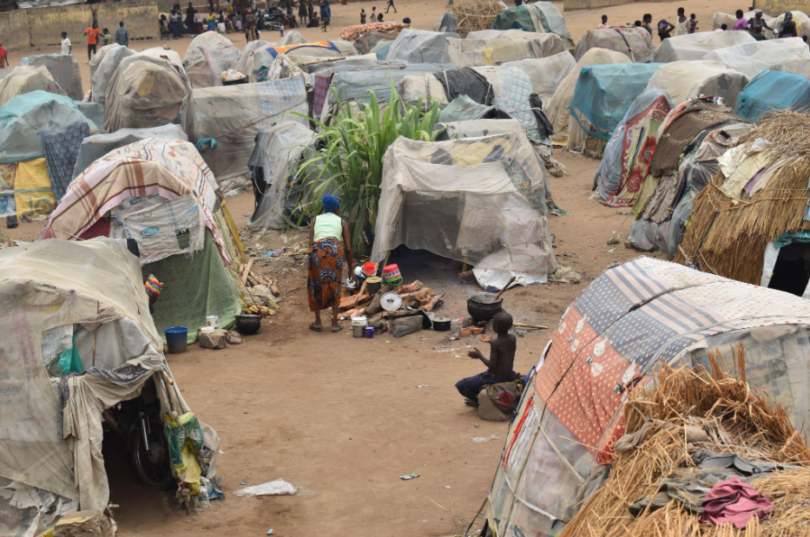
On 31st July 2025, hundreds of protesting IDPs blocked the Makurdi–Lafia expressway in Makurdi. Their message that morning was simple: there is hunger, neglect, and broken promises.
For Mwuese Ugela, one of the protesters, the timing was not a coincidence.
“We heard in the news that the First Lady had given the Benue State Government ₦1 billion. And if we don’t protest, that money will never reach us. They have been doing this to us over and over,” she said.
Ms Ugela’s fears are not unfounded.
A detailed review of Benue State’s audited financial statements from 2018–2024, alongside the 2025 Budget Implementation Report published on the Open Nigerian States platform and the Benue State Budget and Economic Planning Commission site, which represents the government’s official record of actual expenditure, reveals troubling inconsistencies, unexplained gaps, and a pattern of fiscal decisions that appear to have compounded rather than alleviated the humanitarian crisis.
Benue has, for many years, and under different administrations, witnessed different forms of fatal violence. Under the administration of Samuel Ortom, 2015 to 2023, Benue faced repeated waves of displacement due to violent attacks. Donations flowed in. And the state repeatedly budgeted funds for IDP-related interventions, but actual expenditures were often extremely low or poorly described.
On 7 February 2018, the then Governor of Rivers State, Nyesom Wike, reportedly donated ₦200 million to support internally displaced persons (IDPs) in Benue State.
However, a closer examination of official financial records and subsequent statements reveals troubling inconsistencies that raise serious concerns about transparency and accountability.
A review of Benue State’s 2018 audited financial statements shows no clear evidence that the ₦200 million donation was recorded under capital receipts.
The absence of this entry immediately casts doubt on whether the funds were formally received, properly documented, or accurately reported within government accounts.
Yet, in November 2018, the then Executive Secretary of the Benue State Emergency Management Agency (SEMA), Emmanuel Shior, publicly confirmed that the funds had indeed been received and utilised.
“The ₦200 million donated by Rivers State Governor Nyesom Wike to cater for the IDPs has been judiciously utilised for the purpose it was meant. The money in question has been used in the procurement of food and non-food relief materials meant for their upkeep,” he said.
This assertion appears to directly contradict the state’s own audited financial report. In 2018, the state budgeted ₦50 million for “Rehabilitation of IDPs” by SEMA, but spent only ₦46 million. While this suggests moderate implementation, the recurrent expenditure line tagged “Welfare Packages” recorded only ₦328,000 in actual spending, an amount that is strikingly insignificant given the scale of displacement already affecting communities at the time.
This discrepancy raises a fundamental and unresolved question: if ₦200 million was received and “judiciously utilised,” why did the official records reflect only ₦50 million in expenditure? More critically, what happened to the remaining ₦150 million?
The gap between public declarations and audited figures points to a deeper issue: systemic weaknesses in financial reporting, oversight, and institutional accountability.
In 2019, despite ₦80 billion in the state’s total revenue from all sources, only ₦15,000 was recorded as capital expenditure on IDP welfare according to the 2019 audited financial statement.
₦15,000 — for IDP rehabilitation in a year marked by crisis!
Although ₦30 million was approved for the rehabilitation of IDPs, only ₦15,000 was reportedly spent. That represents an implementation rate of just 0.05 per cent.
In practical terms, the state almost entirely failed to utilise the allocated intervention funds despite continued attacks and displacement across rural communities.
This is despite the fact that Governor Ortom was known for appealing for assistance for IDPs, yet government spending on them remained minimal.
The 2020 records stand out as one of the few years where expenditure descriptions were relatively specific.
The government reported ₦86.2 million under recurrent expenditure for “COVID-19 protective and relief materials for Internally Displaced Persons.” An additional ₦79.4 million was recorded, against an approved budget of ₦110 million.
However, even in that year, capital expenditure on “Rehabilitation of IDPs” remained low, with only ₦4.24 million spent against a budgeted ₦8 million.
This raises critical accountability questions. If the humanitarian situation was severe enough to justify emergency COVID-19 interventions for IDPs, why did long-term rehabilitation and resettlement spending remain minimal?
Perhaps the most disturbing pattern emerges in 2021 and 2022.
The audited records show no actual expenditure on IDP-related capital projects in either year. In 2021, there were no reported recurrent or capital expenditure lines tied to IDPs.
In 2022, the state approved ₦800 million for “Welfare Packages” under recurrent expenditure, but actual spending recorded was zero. This is despite the states’ earned revenue of ₦80.8 billion in 2021 and ₦101.5 billion in 2022, respectively.
This occurred during a period when violent attacks, mass killings, and displacement continued across Benue communities.
Data obtained from the SBM Violence Tracker and the Foundation for Justice, Development & Peace of the Catholic Diocese of Makurdi report published in September 2025 showed that about 308 persons were killed in 2021 following attacks on several communities across the state. Media reports further indicated that, in a single attack on 23 May 2021, over 100 people were killed in Katsina-Ala Local Government Area.