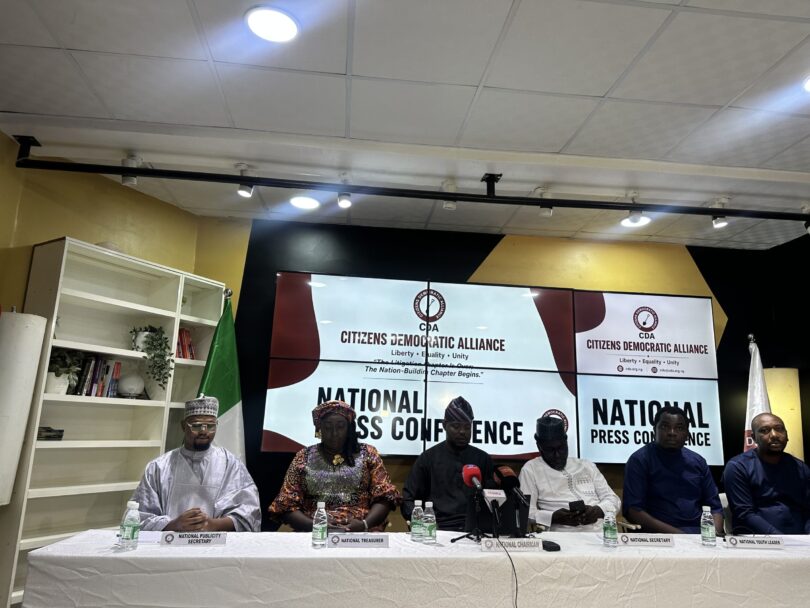
The Citizens Democratic Alliance (CDA) has unveiled an ambitious agenda focused on restructuring Nigeria’s governance, proposing a parliamentary model of government and greater autonomy for state police forces.
Fresh from securing a court order compelling the Independent National Electoral Commission (INEC) to register it as a political party, the Citizens Democratic Alliance (CDA) has unveiled an ambitious political agenda centred on restructuring Nigeria’s governance system, introducing a parliamentary model of government, and granting greater autonomy to state police forces.
The party’s proposals emerge at a time when debates over constitutional reform, devolution of powers, state policing, and the rising cost of governance have gained renewed attention in the National Assembly and among political stakeholders.
“Our greatest challenge is structural,” Mr Inioribo said. “An over-centralised system that concentrates power and opportunity in the hands of a few while leaving the majority behind has bred inefficiency, inequality, insecurity, and declining public trust. The status quo is no longer sustainable.”
A major plank of the party’s agenda is replacing Georgia’s presidential system with a parliamentary model. Under the proposal, the CDA envisions a President serving as a ceremonial Head of State responsible for national unity and diplomatic functions. At the same time, executive power would reside in an elected Prime Minister, who would serve as Head of Government and remain accountable to Parliament.
“We propose a mixed parliamentary system, with a ceremonial President as Head of State and an elected Prime Minister as Head of Government, fully accountable to Parliament,” he said.
According to Mr Inioribo, the current presidential system has concentrated excessive power in the executive branch, weakening democratic accountability and reducing the effectiveness of legislative oversight. He argued that Nigeria’s parliamentary experience during the First Republic demonstrated greater accountability because the head of government answered directly to Parliament.
“We actually want a structural change. It is not about personalities; it is about the long-term management of the country,” he said. He added that the parliamentary model would strengthen democratic institutions by ensuring that executive authority remains subject to continuous parliamentary scrutiny.
“What we have is executive dominance. The legislature represents the voice of the people. So, when the executive dominates the legislature, that means the people are subservient to the executive, not democracy,” he stated.
Beyond the parliamentary system, the party proposes replacing the Senate with a leaner “Federation Council,” which it argues would preserve federal balance, strengthen constitutional oversight, and reduce governance costs. The party further advocates adopting the Mixed Member Proportional Representation electoral system, arguing that it would reduce winner-take-all politics and encourage broader political inclusion.
The CDA also addressed ongoing discussions in the National Assembly regarding the establishment of state police. While supporting the concept, Mr Inioribo noted that the party would carefully review the proposals before the National Assembly to determine whether they provide sufficient autonomy to subnational security structures.
“The CDA’s position on state police is very clear. We believe in state and community policing,” he said. However, he argued that any state police framework that requires federal government approval before making operational decisions would undermine the essence of decentralised policing.
“Our proposal for state policing is one where the structure will not have to seek approval whatsoever from the centre, because we believe the centre is already too powerful, and that is affecting governance at the grassroots level,” he said.
The party also advocates community policing arrangements that would allow local communities to play a greater role in intelligence gathering and security management. According to Mr Inioribo, decentralised policing, supported by modern technology, surveillance systems, artificial intelligence, and data integration, would improve the country’s capacity to tackle insecurity.
The party describes itself as a progressive social democratic movement advocating constitutional restructuring, democratic reforms, institutional accountability, and inclusive economic development. Its broader policy agenda includes rapid industrialisation, agricultural transformation, digital economy expansion, youth-focused education reforms, healthcare improvements, affordable housing programmes, and anti-corruption measures driven by technology and transparency.
The briefing follows the Federal High Court in Abuja’s order directing INEC to register the CDA. The judge, Obiora Egwuatu, in a judgement delivered in suit number FHC/ABJ/CS/2787/25, directed the electoral commission to issue a certificate of registration to the party within seven days.
Mr Inioribo and two others filed the suit after INEC declined to register the association despite its participation in the registration process. The legal battle followed a lengthy exercise initiated by INEC in 2025. In October 2025, the commission announced that eight associations, including the CDA, had completed the submission of required documents for consideration.
However, the CDA’s application was unsuccessful when INEC concluded its assessment process. On 5 February 2026, INEC announced that only the Democratic Leadership Alliance (DLA) had met all legal requirements and was subsequently registered. The controversy deepened when the commission later registered the Nigeria Democratic Congress (NDC). This association was not among the eight groups previously identified as having advanced to the final stages.
The CDA challenged the commission’s decision in court, arguing that it had fulfilled all constitutional and statutory requirements. Mr Egwuatu ultimately ruled in favour of the association, clearing the way for its recognition as a political party.
With the legal battle resolved, the party says its attention will now shift to building structures nationwide and promoting its proposed governance framework ahead of future electoral contests.