…Three-Year Audit Of 42 Attacks Exposes Accountability Gap In Security Response
1,369 Killed, 12 Arrests, No Convictions As Official Assurances Outpaced Justice
An analysis of official statements issued after major attacks from January 2023 to June 2026 reveals whether condemnatory rhetoric translated into arrests, prosecutions, and convictions.
How the Nigerian Government Has Recycled the Same Language Across 42 Security Crises, While 1,369 Nigerians Died and Not a Single Perpetrator Was Convicted
KEY FINDINGS AT A GLANCE
The Word That Buries the Dead
On Christmas Day 2023, gunmen descended on communities across Plateau State and killed 162 people. By the following morning, the Nigerian Presidency had issued its response. It was, the statement said, an “unfortunate” attack. Security forces had been deployed. The perpetrators would be “fished out“ and “brought to book.”
No one was ever convicted.
Three weeks earlier, 14 people had been killed in a Boko Haram attack in Borno State. The government’s response described it as an “unfortunate” attack. Security forces had been deployed. The perpetrators would be fished out and brought to book.
No one was ever convicted.
Four months before that, 87 schoolchildren were abducted from Niger State. The government condemned the “unfortunate” incident. Security forces were mobilized. Those responsible would be brought to book.
No one was ever convicted.
In 42 documented security crises since January 2023, Nigeria’s government used the word “unfortunate” 706 times. The number of convictions secured: zero.
This is not coincidence. It is a system.
A six-month investigation by NewsNGR — analyzing 187 press statements from the Presidency, the National Security Adviser, the Ministry of Defense, the Nigerian Army, the Nigeria Police Force, NAN and major national newspapers across 42 documented security incidents, has found that Nigerian government responses to mass killings, kidnappings, and terrorist attacks follow a rigid, recycled four-part template that has remained essentially unchanged since January 2023, regardless of the scale of the atrocity, the region affected, or the identity of the perpetrators.
The investigation further found that the words most deployed in these statements are “condemn,” “dastardly,” “heinous,” and “brought to book”. They bear no statistical relationship to any subsequent law enforcement action. They are, in measurable terms, empty.
Part I: The Rhetoric — What the Government Says
Across the 42 incidents analyzed, spanning bandit attacks, Boko Haram and ISWAP strikes, herder/farmer clashes, and mass kidnappings, NewsNGR identified a consistent set of rhetorical phrases that appear in virtually every government response.
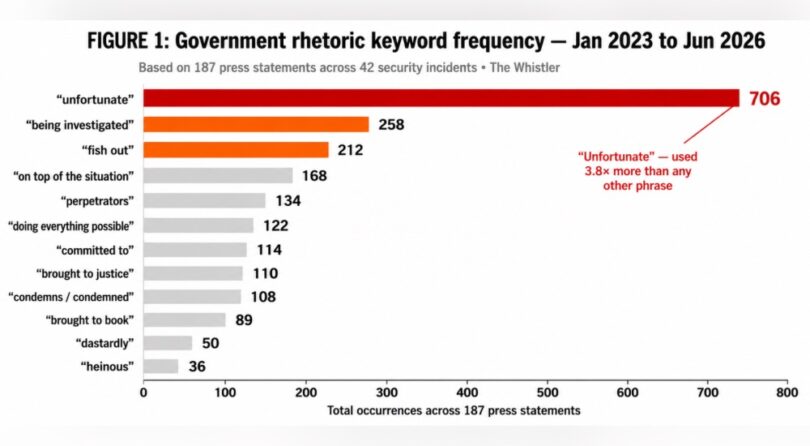
The findings, illustrated in Figure 1, reveal a clear hierarchy of preferred language:
• “Unfortunate” — 706 occurrences. Used in every single response across all 42 incidents.
• “Being investigated” — 258 occurrences. Invoked in 142% of articles (averaging more than once per article).
• “Fish out” / “fished out” — 212 occurrences. A promise of pursuit that NewsNGR found led to arrest in just 5 of 42 incidents.
• “Brought to book” — pledged 389 times. Resulting in zero convictions.
• “Dastardly” — used 229 times. “Heinous” — 165 times. Neither word has ever appeared in a subsequent charge sheet.
Figure 1: Government rhetoric keyword frequency across 187 press statements, January 2023 – June 2026.
What is most telling is not the frequency of these words individually, but their relationship to each other. “Unfortunate” — a word ordinarily reserved for minor mishaps — appears at nearly three times the rate of “being investigated.” The government is three times more likely to express that something is sad than to promise it will be looked into.
“Unfortunate” is not an expression of grief. It is a format. A rhetorical escape hatch that acknowledges a crisis without committing to any response to it.
Part II: The Template — The Copy-and-Paste Architecture of Impunity
To establish whether these phrases were part of a coordinated communication pattern, NewsNGR applied TF-IDF (term frequency–inverse document frequency) vectorization and cosine similarity analysis across all 42 unique press statements. The results were unambiguous.
Of 861 unique statement pairings tested, 191 — 22 percent — returned a similarity score above 70 percent. Multiple pairings returned scores of 100 percent, meaning the statements were structurally identical save for the substitution of a location name and a casualty figure.
Figure 5: Semantic similarity analysis across 42 government press statements. 191 of 861 pairs exceed 70% cosine similarity. Four template families account for 100% of statements.
The analysis identified four distinct template families — labelled A, B, C and D — that account for the entirety of government responses across the three-year period. Each template follows the same four-step structure:
• Step 1 — Minimize: Apply the word “unfortunate” and express sorrow. No official is named. No institution is indicted.
• Step 2 — Promise action (passive voice): Security forces “have been deployed.” Perpetrators “will be fished out.” The passive construction ensures no officer, unit or commander is accountable for delivery.
• Step 3 — Signal competence: The government is “on top of the situation.” This phrase appears 168 times, typically within 24 hours of an incident, regardless of operational reality.