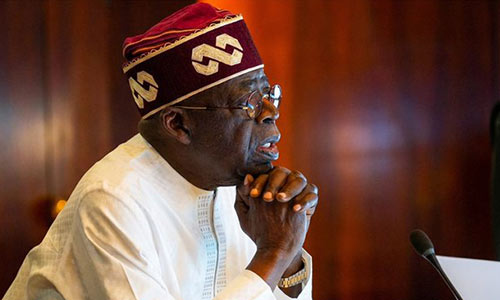
President Bola Tinubu on Monday declined to personally receive a special delegation sent by South African President Cyril Ramaphosa over the renewed attacks on Nigerians and other African nationals in South Africa.
The delegation, led by South Africa’s Minister of International Relations and Cooperation, Ronald Lamola, had reportedly arrived in Abuja on Friday seeking an audience with Tinubu, but the President directed the team to meet instead with the Minister of State for Foreign Affairs, Ambassador Sola Enikanolaiye.
Presidency sources said the South African delegation came without prior notice and was initially told that the President’s availability would have to be confirmed. According to one source, Tinubu later indicated that the delegation could return on Monday, but when the day came, he directed them to meet Enikanolaiye, who would brief him on the outcome.
“They actually came here on Friday wanting to see the President. But there was no prior notice. And we said we can’t just allow you to see the President without first asking him if he is available. So we asked, and the President said they could come on Monday. But when Monday came, he simply said they should go and meet the Minister of State for Foreign Affairs, Ambassador Enikanolaiye, and whatever they discuss, the Minister would come and brief him,” one Presidency source said.
Another source confirmed that the President would not meet the delegation, while a third official said the engagement was not on Tinubu’s schedule for the day.
The development comes amid a diplomatic row between Nigeria and South Africa following fresh xenophobic attacks targeting Nigerians and other Africans. The violence reportedly forced the evacuation of hundreds of Nigerians back home.
Sources also said the Minister of Foreign Affairs, Ambassador Bianca Odumegwu-Ojukwu, who was away on official engagements in Addis Ababa, advised that it was not appropriate for Tinubu to personally receive the South African delegation while attacks on Nigerians and their businesses were still ongoing.
Receiving the delegation in Abuja, Enikanolaiye said Tinubu had asked him to engage the envoys on ways to resolve the crisis, stressing that the longstanding relationship between Nigeria and South Africa should not be damaged by attacks on African migrants.
“It is with profound pleasure that I welcome our brothers from South Africa. President Bola Ahmed Tinubu had actually asked us to meet with you and exchange views and perspectives on how to address and resolve the ongoing Afrophobic attacks in South Africa, of which Nigerians, and other citizens of Africa, have been victims,” he said.
The minister lamented what he described as a recurring pattern of attacks against Nigerians in South Africa, saying such incidents had been recorded over the years in 1995, 1998, 2006, 2015, 2016, 2019, 2021, 2024 and 2026.
He said Nigeria had records showing that since 2022 alone, 98 Nigerians had died in mob actions and hate-related attacks in South Africa, which he described as Afrophobia because the victims were mostly Africans, with Nigerians particularly affected.
Enikanolaiye recalled Nigeria’s historic support for South Africa during the struggle against apartheid and said the attacks were inconsistent with the brotherly relationship both countries had built over decades.
He stressed that Nigeria does not support criminality, including drug trafficking or other offences, but insisted that anyone accused of a crime must be treated according to law and not subjected to mob violence.
“If someone is, quote-unquote, a criminal for drug trafficking, there are rules, there are regulations for when they are arrested, prosecuted, and jailed. The Nigerian government will not support drug peddlers, but please, what we’re saying is that treat them in accordance with your constitution, in accordance with international human rights instruments, in accordance with the minimum requirement of humanity,” he said.
He added that the attacks had gone beyond alleged criminals, saying Nigerians with legitimate reasons to live in South Africa had also been attacked.
Enikanolaiye also raised concern over videos of mob attacks in which police officers allegedly watched helplessly, saying such incidents raised questions about state responsibility and possible complicity where authorities were unable or unwilling to protect victims.
He described the humanitarian impact of the violence as devastating, recalling the evacuation of Nigerians who returned home with little or nothing after losing properties and businesses.
“The last batch of evacuees we moved from there, we had almost 1,500 of our nationals. It was not a pleasant experience. I shed tears in the plane when I saw children, women, the elderly returning home almost with nothing. Some of them, their properties have been looted. Some of them have been destroyed,” he said.
Responding, Lamola said Ramaphosa sent him as a special envoy to deliver a message to Tinubu and reaffirm South Africa’s opposition to xenophobia, racism, homophobia, violence and discrimination.
“We have been outspoken against any intolerance, including xenophobia, racism, homophobia, violence, discrimination directed at individuals within our borders,” Lamola said.
He, however, maintained that South Africa would continue to enforce its immigration laws and deal with irregular migration, undocumented immigrants and criminal activities within its borders.
“President Ramaphosa has also been very firm on South Africa’s sovereign right to enforce immigration laws, including to deal decisively with irregular migration, undocumented immigrants, including acts of criminality that is sometimes committed within our borders,” he said.
Lamola said migration remained a continental challenge that required joint solutions, adding that Nigeria and South Africa shared a responsibility to respond to migration-related issues across Africa.
He expressed optimism that the Abuja engagement would strengthen bilateral relations and help both countries resolve the crisis through sustained dialogue.
Relations between Nigeria and South Africa have worsened in recent weeks following xenophobic violence that reportedly broke out in April 2026 across several South African provinces.
The crisis prompted Tinubu to approve five Air Peace evacuation flights after more than 1,000 Nigerians registered for voluntary repatriation. Nigeria also warned that retaliatory diplomatic steps remained an option, while the House of Representatives recommended the suspension of business permits for South African companies operating in Nigeria and the Senate sent a delegation to Pretoria to register Nigeria’s displeasure.
Lamola’s visit was said to be part of Ramaphosa’s effort to de-escalate tensions through diplomatic engagement with Nigeria ahead of the African Union Extraordinary Summit on conflict prevention and resolution scheduled for Angola from August 29 to 30, 2026.