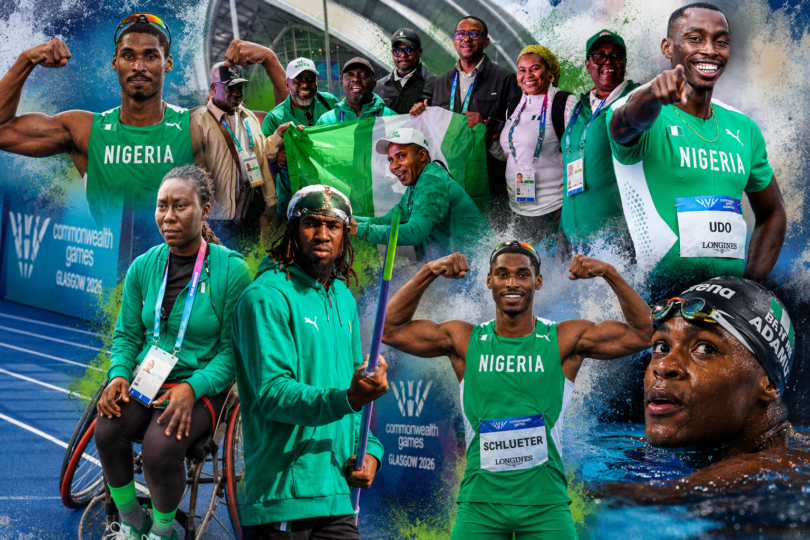
Not every memorable Commonwealth Games story ends with a medal. While Team Nigeria returned from Glasgow with 24 medals and a seventh-place finish, several athletes quietly produced performances that could shape the country’s future.
When the Glasgow 2026 Commonwealth Games ended, the spotlight naturally fell on Nigeria’s medal winners.
But beyond the podium, another group of athletes quietly made a strong statement.
Some reached career milestones. Some competed in finals for the first time. Others broke new ground for Nigerian sport. Though they returned home without medals, their performances suggested that the country’s future is in safe hands.
PREMIUM TIMES highlights five of Team Nigeria’s unsung heroes from Glasgow.
Swimming has rarely been one of Nigeria’s strongest sports at major international competitions.
That is why Abdul Jabar Adama’s performance stood out.
The young swimmer booked a place in the men’s 50m butterfly final after winning a dramatic swim-off, becoming one of Nigeria’s biggest surprises in the pool.
Although he narrowly missed out on a medal in the final, reaching that stage was a significant achievement and another encouraging sign that Nigerian swimming is beginning to make steady progress internationally.
Still only 18, Adama showed composure beyond his years. His Glasgow campaign suggests that Nigeria may finally have a swimmer capable of regularly challenging at elite competitions.
![Eddiong Udo is pointing to a bright future ahead. [Credit: MakingofChampions]](https://i0.wp.com/media.premiumtimesng.com/wp-content/files/2026/08/1003791875.jpg?resize=1502%2C1001&ssl=1)
Samuel Ogazi’s historic gold rightly dominated the headlines.
But Edidiong Udo also played a major role in Nigeria’s return as a force in the men’s 400 metres.
On his Commonwealth Games debut, Udo progressed confidently through the heats and semi-finals before reaching the final, giving Nigeria two finalists alongside Ogazi.
For a country that had struggled for years to produce world-class male quarter-milers, that achievement alone represented significant progress.
The Games also marked another important milestone in Udo’s career after making the bold decision to switch from the 800m to the 400m.
“First of all, I give God all the glory. This is very important to me because it’s a dream come true,” he told PREMIUM TIMES in Glasgow.
“It’s something I’ve been looking forward to for a long time. I tried a couple of times to make Team Nigeria, but it didn’t happen. I realised I was competing in the wrong event, so I decided to step down to the 400m, and everything just started falling into place.”
Although he finished eighth in the final, Udo proved that Nigeria once again has real depth in one of its traditional events.
![Jami Schlueter exhibited more than physical strength in Glasgow. [Credit: MakingofChampions]](https://i0.wp.com/media.premiumtimesng.com/wp-content/files/2026/08/1003791860.jpg?resize=2048%2C1365&ssl=1)
The decathlon rarely receives the attention given to sprint events.
Yet Jami Schlueter quietly produced one of Team Nigeria’s most impressive all-round performances.
Competing across 10 demanding events over two days, Schlueter finished seventh overall with 7,665 points.
He spent much of the competition among the leading contenders, ending Day One in fourth place after strong performances in the 100m, long jump, shot put, high jump and 400m.
For a country that has produced very few elite decathletes in recent years, Schlueter’s showing offers genuine hope that Nigeria can become competitive in combined events again.
![Gbemisola Ijibamigbe described the campaign as a landmark moment. [Credit: Tunde Eludini]](https://i0.wp.com/media.premiumtimesng.com/wp-content/files/2026/08/1003719414-scaled.jpg?resize=1920%2C2560&ssl=1)
One of Team Nigeria’s most inspiring stories came from the women’s wheelchair basketball team.
Making their Commonwealth Games debut, the Nigerians reached the quarter-finals after a dramatic comeback victory over India, proving they belonged on the international stage.
Team captain Gbemisola Ijibamigbe described the campaign as a landmark moment.
“It has been an amazing experience. This is our first time competing on an international stage like this, and we are proud of ourselves and how far we’ve come.” She told PREMIUM TIMES in Glasgow.
She also explained the mentality that helped the team overcome difficult moments.
“I think it’s just who we are as Nigerians. Once you’re Nigerian, you have that fighting spirit… As we always say, ‘Nigeria we no dey carry last.’”
Their campaign was about more than basketball. It challenged stereotypes, promoted inclusion and showed that Nigerian para-sport continues to make meaningful progress.