They [governors] are taking four to five times their money. Nobody is borrowing money to pay salaries now,” the president added.
President Bola Tinubu has criticised state governors for prioritising the construction of flyovers over more pressing infrastructure needs, despite what he described as a significant rise in monthly allocations to states since he assumed office.
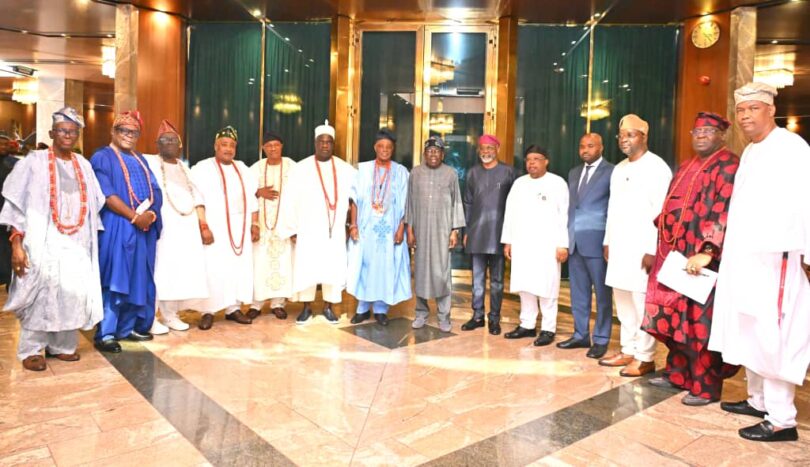
Details of the visit were shared with PREMIUM TIMES by the presidency.
The president said many governors were spending public funds on flyovers in areas with little vehicular traffic, rather than channelling resources into road networks that would improve security response and residents’ quality of life.
“They are taking four to five times their money. Nobody is borrowing money to pay salaries now,” Mr Tinubu said, referring to increased federal allocations to states. “Pensioners are receiving their pay, and they should do more instead of building flyovers where there is no numeric traffic to build roads and arteries that will enhance the quality of life and improve the accessibility of security agencies to those areas.”
Since the removal of the petrol subsidy in May 2023, monthly allocations from the Federation Account Allocation Committee (FAAC) to states have risen sharply, a development PREMIUM TIMES has previously reported has left many governors with considerably more revenue than their predecessors, alongside growing scrutiny over how the additional funds are spent.
Mr Tinubu appealed to the visiting traditional rulers to relay his concerns directly to governors.
“You need to help us communicate to these governors,” he said. “Today, the cost of operation is high. But the money that I’m pushing to the states, if you had it during your own time or during my time, it would have been different.”
Mr Ladoja, who governed Oyo State from 2003 to 2007, was in office when Mr Tinubu served his second term as Lagos State governor.
Beyond the criticism of governors, Mr Tinubu used the meeting to update the traditional rulers on the administration’s security strategy, describing recent successes against banditry and terrorism in parts of the country, including the rescue of kidnapped victims in Oyo State.
He said the Nigerian Army had been expanded from eight to 12 divisions to reduce response time in tackling insurgents, and disclosed that forest guards were being strengthened to pursue criminal elements operating in forested areas, rather than focusing solely on wildlife protection.
The president reiterated that his administration would not negotiate ransom payments with criminal gangs or release detained suspects to secure the freedom of kidnap victims.
“We refused to pay ransom,” he said. “These criminals wanted us to release members of their gangs already in detention. That was one of their conditions, aside from the money they were demanding. We said no deal.”
Mr Tinubu also linked worsening insecurity in parts of Nigeria to instability in the Sahel region, citing Mali, Burkina Faso and the Niger Republic as sources of additional pressure on the country’s security architecture.
He further disclosed plans to establish state police, alongside safeguards to prevent abuse of the new outfits, and said forthcoming engagements with traditional rulers nationwide would allow him to consult more directly on local security concerns.
“The immediate challenge is monumental. It’s not an easy job, but I asked for it, and I got it,” he said. “You gave me the support, and I got to do it. I accept the assets and liabilities of my predecessor; that’s the challenge of today.”
He commended security personnel for their role in stabilising Oyo State and urged the traditional rulers to encourage residents to support ongoing operations.