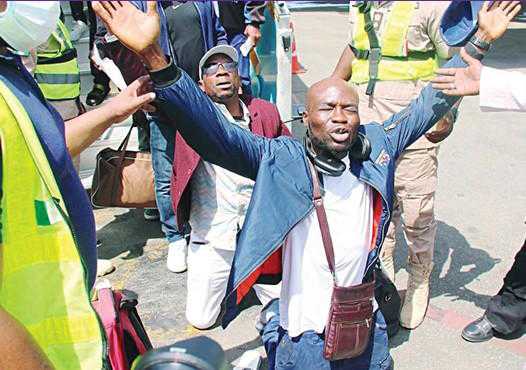
Hundreds of Nigerians awaiting evacuation from South Africa have raised alarm over worsening hardship, as delays in the Federal Government’s repatriation process leave many stranded without food, shelter, or financial support.
Several affected Nigerians, including women, children and elderly persons, are reportedly battling severe conditions after exhausting their savings while waiting for evacuation flights back to Nigeria.
The stranded citizens had travelled from different provinces in South Africa for registration and screening after responding to the government’s evacuation programme. However, many now say they have been left abandoned as uncertainty continues over the next batch of flights.
President of the Nigerian Citizens Association South Africa (NICASA), Rev. Frank Onyekwelu, raised the concern on Friday, calling on the Federal Government to urgently intervene and speed up the evacuation process.
According to him, many Nigerians who complied with official directives are now sleeping in harsh conditions with no clear timeline for their return home.
“Several have exhausted their limited resources after travelling long distances in good faith, believing arrangements had been adequately concluded for their departure.”
Onyekwelu said the prolonged delay has pushed many families into desperate conditions.
“Many of these citizens travelled from distant provinces across South Africa after being instructed to report for registration and screening. Today, numerous families, including women and children, are stranded without shelter, food, transportation or the financial means to sustain themselves.”
He also expressed concern over reports of poor communication and alleged mistreatment during the registration process.
“Of grave concern are reports from affected citizens alleging humiliation, insensitive treatment and poor communication from certain officials during the registration and screening exercise.”
He stressed that Nigerians who followed government instructions deserve protection and humane treatment, not additional suffering.
“Our citizens are not merely statistics. They are fathers, mothers, children, students, workers and entrepreneurs who have found themselves in desperate circumstances. Their cries for help must not go unanswered.”
The NICASA president further appealed to the Ministry of Foreign Affairs and other relevant agencies to immediately deploy emergency support for stranded Nigerians pending their departure.
He also called for urgent arrangements to conclude the evacuation process.
“We also urge relevant government agencies to urgently facilitate the remaining four evacuation flights so that all registered citizens can be safely returned home without further delay.”
Onyekwelu also said the Nigerian community in South Africa has not felt adequately supported by the country’s diplomatic mission, especially at a time when many citizens are facing growing uncertainty and fear.
Meanwhile, anxiety has continued to rise among undocumented migrants in South Africa over the June 30 deadline issued by anti-immigration groups.
A Nigerian resident, who spoke anonymously, described the situation as tense and frightening, revealing that many Nigerians have gone into hiding while waiting for evacuation.
“Things are not easy here, my brother. There is a lot of fear about that deadline, though some groups are trying to prevent South Africans from joining the protest. Right now, I am hiding in a friend’s house, and he generously gave us shelter.”
The source added that the humanitarian situation is becoming more severe as many migrants remain stranded at consulates or in temporary shelters.
“Many of our people are stranded at the consulate awaiting evacuation to Nigeria, while others are temporarily staying with friends and acquaintances across different towns. It is not easy. There are many other nationalities too, with their luggage in consulates, sleeping in the open in the freezing weather. It is a sorry sight.”
He said many Nigerians became homeless after losing jobs that previously came with accommodation.
“Many of us became homeless at the same time, particularly those who worked in factories, stores and farms where accommodation was provided. We were thrown out after the South African president announced that employers who hire undocumented immigrants would be arrested. But we hope to leave before the June 30 deadline.”
Another Nigerian, Nze Akumezienwata, also urged fellow citizens to remain cautious and prioritize their safety amid rising tensions.
In a Facebook post, he wrote, “Please, I urge all Nigerians in South Africa, especially those sleeping on the streets, to leave the country. To those who still have businesses here, let us be careful about our movements. Try to prepare and leave this country for them.”
The latest development comes amid renewed xenophobic tensions in parts of South Africa, where anti-immigrant protests have triggered fears among foreign nationals.
Foreign-owned businesses and migrant communities have increasingly come under pressure, with undocumented migrants being blamed for rising unemployment, crime and pressure on public services.
The Nigerian community has suffered repeated attacks over the years. The Nigerian Union South Africa previously documented at least 118 deaths linked to xenophobic violence, including recent incidents involving Nigerians.
Despite the growing concerns, the Federal Government has assured citizens that evacuation efforts remain ongoing.
Minister of Foreign Affairs, Ambassador Bianca Odumegwu-Ojukwu, disclosed that the first batch of 258 Nigerians arrived in Lagos on June 11 after being evacuated from South Africa.
She said nearly 1,000 Nigerians had registered for evacuation, leaving more than 742 still awaiting transportation back home.
Odumegwu-Ojukwu explained that President Bola Tinubu approved the evacuation exercise following reports of harassment, intimidation and attacks against Nigerians and other African migrants living in South Africa.
For many stranded Nigerians, however, the immediate concern remains survival as they wait for government assistance and a safe return home.