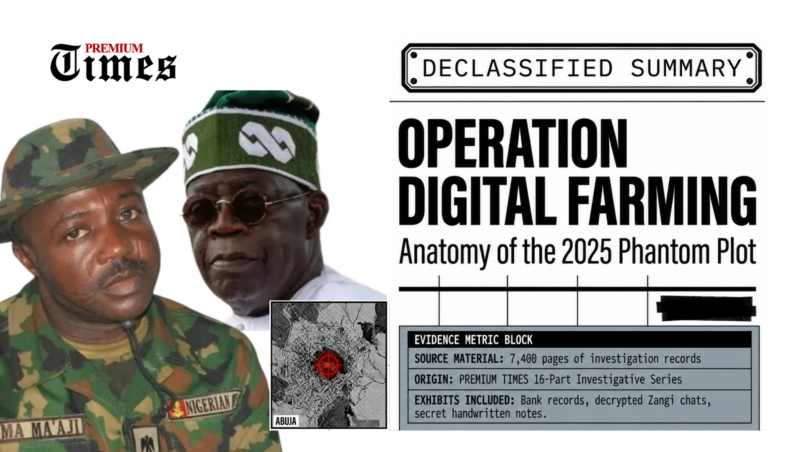
Over 17 days, PREMIUM TIMES rolled out an exclusive 16-part series of revealing reports on the 2025 failed coup plot against the President Tinubu administration, uncovering missing pieces of the puzzle.
Many Nigerians were quick to dismiss last year’s failed coup plot to topple the President Bola Tinubu administration as a ruse. Scanty information from the authorities, at best, painted only a hazy picture.
Whether attempted, aborted or successful, coups are steeped in Nigeria’s history, leaving lasting impressions on its landscapes, and considerably shaping its trajectory. After 30 years’ break, another coup suddenly looming on the horizon last year jolted many who were conscious of its historical significance and implications for the nation’s future.
The news about the plot first emerged in October 2025 following the arrest of a group of serving and retired officers in late September. The Defence Headquarters initially described the arrests as part of a “routine internal process” to maintain discipline and professionalism in the military. It later acknowledged that the officers were being investigated over an alleged coup plot.
When the military finally admitted the plot publicly, only little more than what the public knew through scoops was said. Some more details emerged when some suspects were charged and their trials began at the General Court Martial and the Federal High Court in Abuja, but stubborn questions persisted.
Over 17 days, PREMIUM TIMES rolled out a series of detailed exclusive reports on the plot, uncovering missing pieces of the coup puzzle.
Starting from 25 July to 10 August , this newspaper published a 16-part series, drawing on about 7,400 pages of investigation records, including statements by suspects, bank records, secret notes, chat exchanges, receipts, hotel records and other exhibits.
These reports painted vivid mental images, chronicling for the first time an unbroken line of events – from the conception of the alleged plot to its collapse in September – about the alleged coup.
In sum, the PREMIUM TIMES series revealed the events, key actors, and networks, offering the most detailed account of the plot yet.
From poring over the piles of documents and reporting them in the series, PREMIUM TIMES has endeavoured to provide details of the alleged conspiracy from the accounts of the participants, offering answers to some nagging questions those concerned about the plot have asked for months.
At the centre of the alleged conspiracy was Mohammed Ma’aji, a Nigerian Army colonel who had served in many military formations.
Investigators identified him as the principal coordinator of the plot. His own account as contained in the documents exclusively obtained by this newspaper provides perhaps the clearest explanation of how he came to contemplate overthrowing the government.
Mr Ma’aji said he had twice failed in his bid for promotion to brigadier general—first in 2023 and again in 2024. He said the disappointment contributed to his decision to revive a movement to change the government.
But he also presented the proposed coup as a response to insecurity, pervasive corruption in the country, bad governance, suppression of critical voices of the youth, bad governance, what he considered the poor welfare and working conditions of serving and retired military personnel. He claimed that widespread frustration existed within the armed forces and that the desire for change was genuine.
He wrote of how he incessantly came under pressure from those he called “like minds” within the military.
However, some of the allies offered a less flattering picture of the man.
One officer told investigators that Mr Ma’aji’s alleged relationships with women and his reliance on Islamic clerics and traditional spiritualists made him question whether the colonel possessed the character and judgement required to lead a country. Another participant eventually dismissed him as a “joker” because of his failure to deliver on logistics for the execution of the plot.
Mr Ma’aji was eventually arrested on 29 September 2025 after military authorities allegedly used his long-running promotion ambition as bait. He said he was summoned to meet the then Chief of Army Staff, Olufemi Oluyede, about his promotion and arrived at Niger Barracks believing his career prospects were finally being addressed. But that was the last time he would walk freely.
The documents suggest a mixture of personal frustration, military grievances and dissatisfaction with the government as the motivations behind the coup plot.
Mr Ma’aji told investigators that insecurity and the condition of military personnel were among his motivations. His secret notes also show that he wanted a future military government to address what he saw as shortcomings of the Tinubu administration.
The alleged conspirators were particularly interested in the removal of petrol subsidy, which has contributed to the persistent cost of living crisis in the country.
A handwritten document recovered from Mr Ma’aji contained an “Immediate Actions” section proposing a committee to review the fuel subsidy removal, review salaries and wages of military and security personnel, and a mechanism for giving national recognition to fallen military heroes.
For years, military operatives—particularly the junior ranks who constitute the larger percentage of the country’s frontlines—have lamented about poor welfare. Many of them have taken their grievances to social media, actions that were met with condemnation by military authorities.
In what could not be directly associated with the coup plotters’ concerns, Mr Tinubu reviewed soldiers’ salaries, approving up to an 80 per cent increase.
The series also revealed motivational writings kept by Mr Ma’aji, including quotations about courage, success, dreams and the pursuit of goals.
Investigators believed the alleged conspirators had developed an operational plan for the execution of their alleged plot.
The conspirators allegedly divided responsibilities among military officers and civilians. They also purchased vehicles suspected to be meant for use for the operation. Targets included the Presidential Villa, military formations, the residences of senior military commanders, Radio House, Air House and airports.
One officer was allegedly assigned to lead the operation at Aso Villa, while others were tasked with seizing military formations and securing strategic locations. Another was expected to take control of Radio House and deliver a broadcast announcing the takeover.
The alleged conspirators also used coded language. They referred to themselves as “farmers” and the movement as “farming”. While logistics were coded as “fertilisers,” the operation was “digital farming,” clerics were “technical partners,” and the execution day was “harvest.”
There was no final date for the alleged coup when the plot was uncovered.