Some transactions raise money. Others raise the standing of a market. The Dangote Refinery IPO could be both. With 4.1 billion shares priced at ₦525 each, the offer presents the Nigerian Exchange Limited (NGX) with more than its biggest equity-raising opportunity yet; it presents a moment to prove that Nigeria’s capital market is ready to play on a bigger stage.
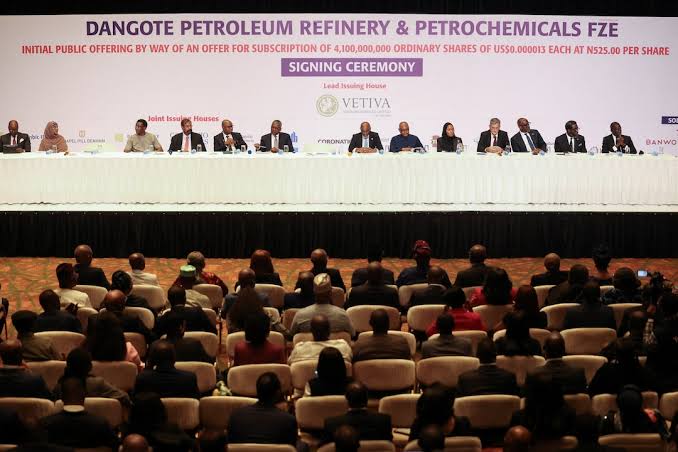
Many stories are already in the public domain about the much-anticipated Initial Public Offering (IPO) of Dangote Refinery following the Securities and Exchange Commission’s (SEC) approval of an offer price of ₦525 per ordinary share. The offer, comprising 4.1 billion ordinary shares, could raise about ₦2.15 trillion if fully subscribed, making it potentially the largest equity offering in the history of the Nigerian Exchange Limited (NGX).
But the bigger story may not be the money raised. It is what the IPO could change about Nigeria’s capital market. For years, the Nigerian equity market has grappled with the challenge of attracting more companies of significant scale, deepening liquidity, broadening participation and convincing domestic and international investors that it can effectively support long-term capital formation. The Dangote Refinery IPO presents an opportunity to confront several of these challenges at once.
The listing of a globally significant energy and petrochemical company could reshape the composition and profile of the NGX, introducing a major industrial asset into a market traditionally dominated by banking, telecommunications and consumer stocks. It would provide investors with another major large-cap investment option while strengthening sectoral diversification.
But size alone does not make a market deep. The real test will be whether the Dangote Refinery IPO generates sustained activity in the secondary market. An offer that attracts huge subscriptions but subsequently trades with limited liquidity would fall short of its transformative potential. The challenge, therefore, is to convert the excitement of the primary offer into sustained participation, trading and price discovery.
This puts institutional investors under the spotlight. Pension funds, asset managers, insurance companies and other institutional investors will have to determine where the refinery belongs within their portfolios. A successful transaction could encourage greater deployment of Nigeria’s long-term domestic savings into equities and demonstrate that the market can provide investible assets of sufficient scale to meet the needs of large institutional portfolios.
The IPO could also redefine the relationship between retail investors and the capital market. For millions of Nigerians, the opportunity to own a stake in one of the country’s most strategically important industrial assets could make equity investment more tangible and meaningful. If participation is broad-based, the transaction could help rekindle an investment culture in which Nigerians see the stock market not merely as an institutional preserve, but as a vehicle for wealth creation and participation in national economic growth.
There is, equally, a significant confidence dividend at stake. A successful IPO of this magnitude would demonstrate that Nigeria can mobilise substantial capital through its domestic market for productive enterprise. It could strengthen the NGX’s reputation as a credible platform for large-scale capital raising and encourage other sizeable private companies to consider public listing as a pathway to growth, expansion and value creation.
For market operators, this is more than another transaction. It is a defining opportunity to demonstrate the depth and sophistication of Nigeria’s capital market infrastructure from issuing houses and brokers to the Central Securities Clearing System (CSCS) registrars, custodians, fund managers and the Exchange itself. The execution of the offer, investor onboarding, allocation, settlement and subsequent trading must match the expectations of a transaction of international significance.
The IPO could also strengthen Nigeria’s proposition to international investors. A successful outcome would send a powerful signal that the country possesses a capital market capable of accommodating companies with continental and global ambitions. More importantly, it could encourage other Nigerian corporates of significant scale to see the capital market not simply as a source of funding, but as a credible platform for expansion, ownership and long-term value creation.
Yet the strategic importance of the IPO should not be confused with the investment decision itself. At ₦525 per share, discerning investors must still interrogate the refinery’s earnings capacity, cash-flow generation, crude supply arrangements, operating costs, expansion plans, debt obligations, dividend prospects and valuation. The size and prestige of the project do not eliminate investment risk. If anything, they make rigorous analysis and proper price discovery even more important.
That scrutiny is healthy. A sophisticated capital market is not one where investors subscribe simply because an asset is prestigious or because its promoters are celebrated. It is one where price, risk, value and future earnings are properly assessed, allowing capital to flow to productive enterprises on commercially sustainable terms.
Ultimately, the success of the Dangote Refinery IPO should be measured by far more than the ₦2.15 trillion it seeks to raise. Its real impact will be determined by its ability to deepen the NGX, broaden investor participation, strengthen liquidity, restore market confidence and further demonstrate that Nigeria’s capital market has the capacity to attract, accommodate and support companies with global ambitions.
That is why the Dangote Refinery IPO could become much more than a landmark transaction. It could be a moment when the market is tested not merely by the size of the offer, but by its capacity to rise to the occasion. When NGX meets its destiny, the question is not simply how much the market can raise. It is how much the market can become.
Oni, an Integrated Communications Strategist, Chartered Stockbroker, Commodities Broker and Capital Market Registrar, is the Chief Executive Officer, Sofunix Investment and Communications