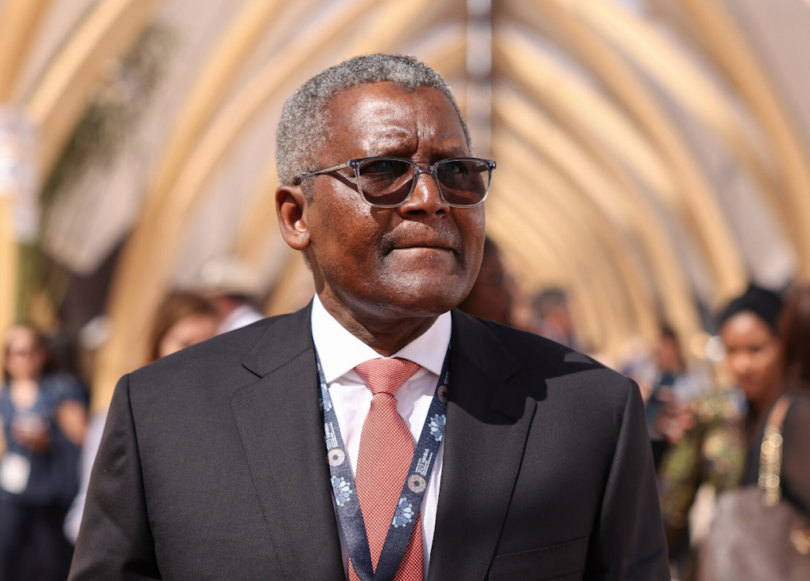
Aliko Dangote has unveiled plans to collaborate with Kenya and Uganda on a large-scale refinery project in Tanzania, signalling a new phase in Africa’s push for energy self-sufficiency and industrial expansion.
Africa’s richest man and President/CEO of the Dangote Group, Aliko Dangote, has signalled plans to partner with Kenya and Uganda to construct a major oil refinery in Tanzania—modelled after his flagship 650,000 barrels-per-day facility in Nigeria.
Mr Dangote, who participated in the conference alongside other regional presidents, including Kenya’s president, William Ruto, and Uganda’s president, Yoweri Museveni, among others, expressed confidence that the venture would materialise, provided political backing is secured.
“If they will support the refinery, we’ll build the identical one that we have in Nigeria,” he said, referring to discussions with the presidents of Kenya and Uganda.
Though still at an early stage, he struck an assured tone: “It will work. There’s nothing that can stop it.” His remarks drew resounding applause from participants.
The proposed project underscores Mr Dangote’s growing ambition to reshape Africa’s energy and industrial landscape through large-scale, locally anchored infrastructure.
He revealed that construction efforts tied to his broader refining vision are already underway, with early-stage piling works in progress for what could scale up to 1.4 million barrels per day—potentially making it the largest refinery complex in the world.
Such capacity, he noted, would rival global benchmarks.
“We’ll have about 10 per cent of the entire United States’ refining capacity,” Mr Dangote said, adding that the refinery would be integrated with petrochemical production to support downstream industries.
Drawing lessons from Nigeria, Mr Dangote highlighted the critical role of local manufacturing in cushioning economies against global shocks.
He pointed to polypropylene production as a lifeline for industries ranging from cement packaging to food supply chains.
Without it, he warned, many businesses would have struggled to survive amid surging global prices, which (polypropylene) recently climbed from $900 to $3,000 per tonne within weeks.
The industrialist framed the East African refinery push as part of a broader call for self-sufficiency across the continent.
“That is why we must learn how to build self-sufficiency,” he said, emphasising that Africa now has both the financial institutions and human capital to execute large-scale projects.
Reflecting on his company’s earlier financing challenges, Mr Dangote recounted securing a $478 million international loan in the early 2000s under difficult conditions, including steep domestic interest rates.
Despite initial skepticism from lenders, the loan was repaid ahead of schedule—an example he cited to counter doubts about African capacity.
“It is possible. Africans can do it. Let us not be scared,” he said.
He also praised Uganda’s policy stance on limiting raw material exports, arguing that such measures compel value addition within the continent.
“Why take raw materials out and then bring back finished goods?” he asked. “We too have educated people. We have big financial institutions. It is not like before—things have changed.”
If realised, the Tanzania refinery project would mark a significant step toward regional energy integration and industrialisation, positioning East Africa as a new hub in the continent’s evolving petrochemical landscape.
East Africa currently imports most of its refined petroleum products, mainly from the Middle East, leaving the region vulnerable to supply disruptions and price spikes, as seen in the fallout of the Iran conflict.
On his part, Mr Ruto noted that the East African countries are discussing plans for a joint oil refinery at Tanzania’s port of Tanga.
“We’re going to have a joint refinery in Tanga to benefit all of us because that refinery is going to take on board the oil from DRC (Democratic Republic of the Congo), the oil from Kenya, the oil from South Sudan, and the oil from Uganda,” Mr Ruto said.