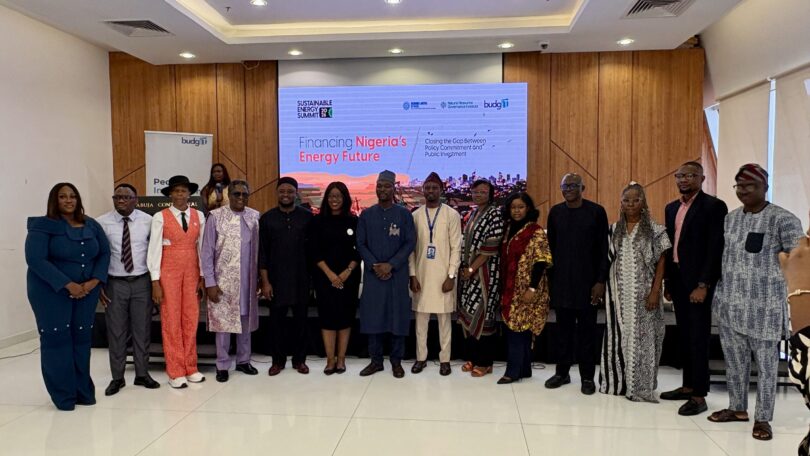
Mr Shelleng said Nigeria had the policies, natural resources and investment opportunities needed to transform its energy sector but lacked a reliable link between policy commitments and projects capable of attracting investment
The Presidency has urged Nigeria to turn its energy transition policies and climate commitments into bankable projects capable of attracting the investment needed to transform the country’s energy sector.
The summit, themed “Financing Nigeria’s Energy Future: Closing the Gap Between Policy Commitment and Investment,” brought together government officials, development partners, private sector representatives and civil society organisations to examine how Nigeria can bridge the gap between its energy policies and actual investment.
Mr Shelleng said Nigeria had the policies, natural resources and investment opportunities needed to transform its energy sector but lacked a reliable link between policy commitments and projects capable of attracting investment.
“What we still lack is a sufficiently reliable bridge between policy commitments and investable transactions. And that is the gap we must now close,” he said.
Nigeria’s Energy Transition Plan estimates that the country will require about $1.9 trillion in investment to achieve net-zero emissions by 2060, including about $410 billion above business-as-usual expenditure.
Mr Shelleng said the figure should not be viewed solely as a financing burden but as a major investment opportunity in renewable energy, gas infrastructure, electricity transmission and distribution, clean cooking, electric mobility, industrial energy efficiency, battery storage, green hydrogen and decentralised energy systems.
He said the key challenge was not the availability of global capital but why insufficient amounts of it were reaching viable Nigerian projects at affordable costs and within reasonable timeframes.
“An inspiration is not yet an investment opportunity. A policy announcement is not a bankable project,” he said.
According to him, investors require feasibility studies, credible demand assessments, permits, land documentation, environmental safeguards, reliable financial models, clear revenue arrangements and mechanisms for managing risks before committing funds.
He identified regulatory uncertainty, institutional fragmentation, currency risks, inflation, limited access to long-term naira financing and inadequate early-stage capital as some of the factors discouraging investment in Nigeria’s energy sector.
Speaking on the role of public finance in driving the energy transition, Mr Shelleng said government could not finance the process alone and should instead use public and concessional funds to reduce investment risks and attract larger volumes of private capital.
He said public resources should be targeted at early-stage project development, public infrastructure and underserved markets where government intervention could improve the commercial viability of energy projects.
Mr Shelleng also called for greater participation by pension funds, insurance companies, commercial banks, development finance institutions and the capital market in financing the country’s energy transition.
He said projects that generate revenue mainly in naira should, where possible, be financed with local currency to reduce the risks posed by foreign exchange fluctuations.
He also urged Nigerian financial institutions to strengthen their capacity to assess renewable energy, energy efficiency and other climate-related investments, noting that unfamiliarity with such projects could lead to them being wrongly classified as excessively risky.
The concerns raised at the summit come against the backdrop of the enormous financing requirement for Nigeria’s energy transition.
In December 2025, PREMIUM TIMES reported that the Nigerian Extractive Industries Transparency Initiative (NEITI) told lawmakers that Nigeria would require about $1.9 trillion to achieve its net-zero energy targets by 2060.
NEITI said about $410 billion of the amount would be required for gas infrastructure and warned that inadequate financing could stall the country’s energy transition.
The federal government has also set an ambitious target for mobilising climate finance.
In January, President Bola Tinubu said Nigeria aimed to mobilise up to $30 billion annually in climate and green industrial finance as the government accelerated energy transition reforms and efforts to expand electricity access.
Mr Shelleng said achieving such ambitions would require a stable and coordinated policy environment in which investors could clearly understand the approval process, tariff arrangements, contractual obligations and mechanisms for resolving disputes.
He said the Electricity Act had created opportunities for states to participate more actively in electricity market development, but warned that decentralisation must be accompanied by regulatory coordination and institutional capacity.
Also speaking, Tengi George-Ikoli, Country Manager of the Natural Resource Governance Institute (NRGI), said Nigeria’s energy transition could not be achieved without adequate, affordable and equitable climate finance.
Ms George-Ikoli said Nigeria was at a defining point in its transition, facing the effects of climate change while possessing significant potential for renewable energy investment.
“The climate ambition that we might have, the energy future we want to see, cannot be realised without capital. Otherwise, it remains an aspiration,” she said.
She said Nigeria needed to participate more actively in shaping the global climate finance architecture and ensure that financing available to fossil fuel-producing countries was equitable, credible, accessible and deployable.
She urged participants to move beyond setting targets and develop practical measures for mobilising finance and delivering projects.
The push for new financing mechanisms is already underway.
In March, PREMIUM TIMES reported that the House of Representatives Committee on Renewable Energy backed a private-sector proposal to establish Nigeria’s first dedicated Green and Climate Finance Bank.