Special Reports
FACT-CHECK: How true is Oshiomhole’s claim at APC rally about Cross River’s oil-producing status

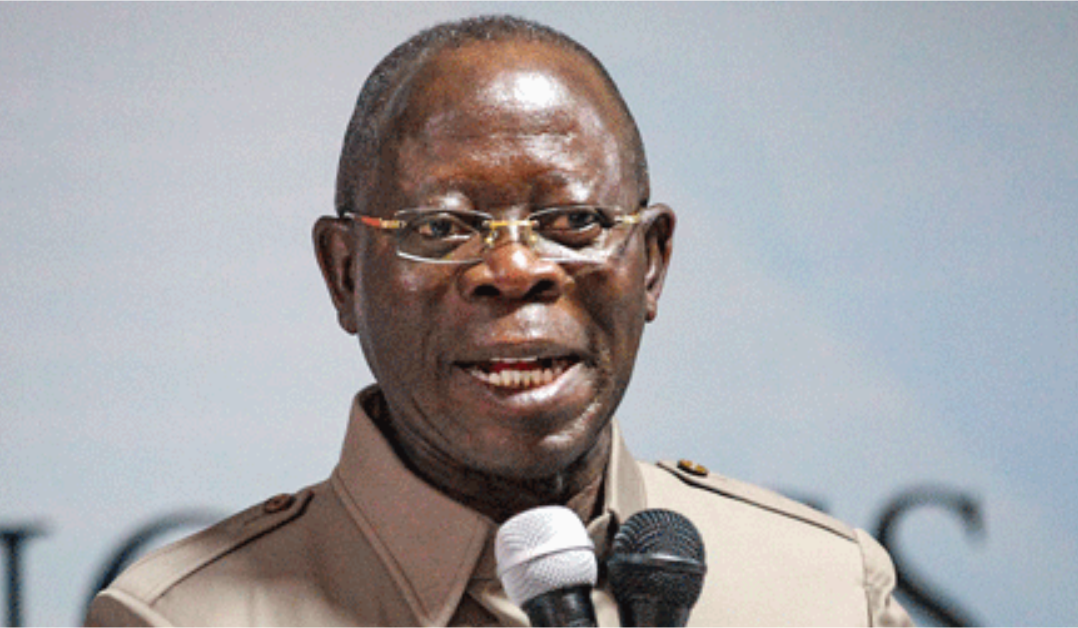
“Once upon a time, Cross River State became out as a littoral state. Today, under President Bola Ahmed Tinubu, Cross River State is considered and is an oil-producing state,” Mr Oshiomhole claimed.
Adams Oshiomhole, the senator representing Edo North Senatorial District in the 10th National Assembly, has claimed that President Bola Tinubu‘s administration secured recognition for Cross River State as an oil-producing state, a development he said would permanently increase the state’s revenue.
At an All Progressives Congress (APC) rally in Calabar on 2 November to mobilise support for Mr Tinubu’s 2027 re-election bid, Mr Oshiomhole, the deputy director-general for Mobilisation of the APC Presidential Campaign Council, told the crowd that Cross River had regained its littoral status and was now recognised as an oil-producing state.
“When good things happen, leaders must claim the glory. Once upon a time, Cross River State became out as a littoral state. Today, under President Bola Ahmed Tinubu, Cross River State is considered and is an oil-producing state. This is important because this is a structural change that will forever increase the revenue accruing to the great people of this great state,” he said.
But a PREMIUM TIMES review of official revenue allocation records, a federal government gazette, relevant court judgments and statements from the agency responsible for monitoring revenue allocation found no evidence that Cross River has been formally recognised as an oil-producing state or become eligible for the 13 per cent derivation fund.
The Revenue Mobilisation, Allocation and Fiscal Commission (RMAFC) also expressly rejected the senator’s claim, saying Cross River had not been recognised as a littoral state and was not eligible for derivation revenue.
PREMIUM TIMES reviewed the Federation Account Allocation Committee (FAAC) reports published by the Office of the Accountant-General of the Federation between May 2023 and August 2026.
The reports show that Cross River has not featured among the states receiving the 13 per cent derivation allocation from oil and gas production during the period reviewed.
The latest available report, published in August 2026, covers revenue distributed for July 2026. Its state-by-state allocation table lists the beneficiaries of the derivation fund but excludes Cross River.
The 11 states listed as beneficiaries are Abia, Akwa Ibom, Anambra, Bayelsa, Delta, Edo, Enugu, Imo, Kogi, Ondo and Rivers.
Although Cross River received its regular statutory allocation and other revenue entitlements, it was not listed among the beneficiaries of the 13 per cent derivation allocation.
Receiving revenue from the Federation Account does not automatically confer oil-producing status on a state or qualify it for derivation revenue.
Section 162(2) of the 1999 Constitution, as amended, provides that the principle of derivation shall be reflected in any approved revenue allocation formula. It further stipulates that not less than 13 per cent of revenue accruing to the Federation Account directly from natural resources shall be allocated to the states from which such revenue is derived.
The provision forms the constitutional basis for the 13 per cent derivation fund, which benefits states whose natural resources generate revenue for the Federation Account.
Consequently, a political announcement alone cannot establish a state’s entitlement.
Recognition and allocation of derivation revenue must follow the relevant technical and administrative processes.
Further evidence contradicting Mr Oshiomhole’s claim is contained in a federal government gazette published in March 2024.
The Federal Republic of Nigeria Official Gazette, produced by the National Boundary Commission, identifies oil and gas host communities located within littoral states and situated within a 500-metre coastline buffer for the purpose of benefiting from Host Communities Development Trusts under the Petroleum Industry Act.
The gazette lists qualifying communities in five states: Lagos, Ogun, Ondo, Delta and Akwa Ibom. Cross River is not included.
The document was issued pursuant to Regulation 6(2)(a) of the Nigerian Upstream Petroleum Host Communities Development Regulations, 2022. The regulation provides for the identification and gazetting of littoral communities situated in or adjoining shallow-water and deep-water areas of operation along the Gulf of Guinea.
It states that a littoral community adjoining a deep-water area of operation along the Gulf of Guinea, and located within approximately 500 metres inland from the Nigerian shoreline, shall be gazetted by the National Boundary Commission.
The gazette therefore provides an official record of communities recognised within the coastal framework for implementing the Petroleum Industry Act.
Cross River’s exclusion, while communities in Akwa Ibom and four other states were listed, raises further questions about the basis for the senator’s assertion that the state had regained littoral recognition.
Although the gazette specifically concerns the identification of eligible host communities under the Petroleum Industry Act, rather than the legal instrument determining a state’s entitlement to derivation revenue, it provides additional evidence against the claim that Cross River had secured formal recognition under the relevant coastal framework.
The controversy over Cross River’s oil-producing status predates the Tinubu administration.
The state previously enjoyed littoral status and received derivation revenue from offshore oil wells. However, the International Court of Justice (ICJ), in its 2002 judgment on the Nigeria-Cameroon boundary dispute, awarded the Bakassi Peninsula to Cameroon.
The eventual transfer of the peninsula and the Cross River estuary to Cameroon in 2008 affected the state’s maritime boundary and its entitlement to revenue from offshore oil wells.
Cross River subsequently became embroiled in a dispute with neighbouring Akwa Ibom over 76 offshore oil wells and the derivation revenue accruing from them.
The state approached the Supreme Court, seeking recognition of its entitlement to the oil wells and the associated derivation revenue.
However, in its 10 July 2012 judgment in Attorney-General of Cross River State v. Attorney-General of the Federation and Attorney-General of Akwa Ibom State (Suit No. SC.250/2009), the Supreme Court dismissed the state’s claims.


FACT-CHECK: How true is Oshiomhole’s claim at APC rally about Cross River’s oil-producing status

“We Recognise What Every Hour Without Power Means” — FG Blames Gas Shortage As Outages Hit Four States, FCT

FG Backs Zamfara Power Push As Minister Launches Electricity Policy

“He Threatened To Kill Two Police Officers With A Knife” — Court Remands Gombe Constabulary Officer

Traffickers Now Targeting Women At Gyms, NAPTIP Warns

FG, Enugu align on agro-industrialisation, market access to boost food security

EFCC Probes Ex-Access Bank Manager Over Alleged ₦515 Million Diversion From Customer’s Account

“Courts Must Guard Their Independence, Impartiality And Integrity” — NDC Warns After Atiku’s Candidacy Is Nullified

INVESTIGATION: How Anthony Kila falsified all his academic qualifications – from Bachelor’s to Doctorate

Customer Service Week: Inside How Jumia Is Using Technology To Go The Extra Mile For Shoppers

Google opens AI-content detector to enable verification

Kayefi headlines Tales & Tunes as ID Cabasa leads music direction in Sheffield

UK migrant workers wear chains, sing Asa’s ‘Jailer’ to protest proposed visa reforms

Ogaga Ifowodo wins $100,000 Nigeria Prize for Literature

How Lagos Families Are Allegedly Buying Contaminated Meat In Dirty Conditions At Mushin, Oshodi, Mile 12, Surulere Markets

How Houthi military aggression in Red Sea threatens Africa
-

 News7 days ago
“We Will Continue To Pursue Hall” — US Offers $5,000 Reward For Nigerian Woman Who Failed To Report To Prison
-

 Special Reports2 days ago
ADC warns Sokoto govt, vows to hold governor responsible for intimidation, violence against opposition
-
Top Stories7 days ago
“Ebola Outbreak Is Not Yet Under Control” — Africa CDC Warns As Confirmed Cases Exceed 10,200, Death Toll Surpasses 5,000
-
Special Reports7 days ago
How PR Executes Expectation Setting Without Stakeholders’ Knowledge
-
Special Reports7 days ago
EXCLUSIVE: NSCDC ‘s Niger commandant fabricated ‘disease outbreak’ to cover up 33 deaths in cell – Report
-
Special Reports7 days ago
“I Thought He Came To Settle The Fight” – Bariga NURTW Member Stabbed By Police Inspector Battling For Recovery In FMC Oyingbo
-
Business6 days ago
“We’re Covering Every Loss” — Binance Sets Aside $6.34bn After Record Crypto Hack Linked To North Korea As FBI Investigates
-
Special Reports7 days ago
Binance reserves $6.34bn to cover stolen assets after cyberattack – CEO