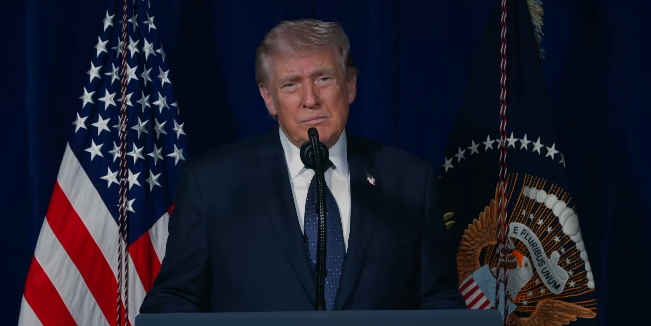
With the United States midterm election campaign intensifying, Mr Trump’s approval ratings have fallen to their lowest recorded levels.
President Donald Trump’s decision to accept a ceasefire in the war against Iran was not a voluntary act of statesmanship. It was, by most accounts, a retreat forced by a convergence of military setbacks, a crippling global energy crisis, and an unprecedented domestic political revolt that had begun to threaten his presidency.
The political cost of the war at home has been severe for Mr Trump. With the United States midterm election campaign intensifying, his approval ratings have fallen to their lowest levels on record, placing his Republican Party at risk of losing its narrow majorities in both the House of Representatives and the Senate.
Public opinion polls show a substantial majority of Americans opposing the war and expressing frustration over rising fuel prices — a combination that has handed Democrats a potent campaign weapon heading into the midterms.
Since late February, the conflict has effectively closed the Strait of Hormuz, severely disrupting exports from major OPEC members, including Saudi Arabia, the United Arab Emirates, Kuwait, and Iraq.
Iran has maintained a tight grip on the waterway throughout the conflict, while simultaneously launching strikes on economic targets in Gulf states it accuses of supporting the American and Israeli war effort. What was originally conceived as a campaign to cripple Iran’s military capacity may have inadvertently strengthened Tehran’s regional influence, with the Islamic Republic demonstrating a credible ability to hold the global oil supply hostage.
On Tuesday, Mr Trump said he had received a ten-point proposal from Iran, which he described as a “workable basis” for negotiations. He said he expected a final deal to be concluded within two weeks and confirmed that the agreement was contingent on Iran lifting its blockade of oil and gas shipments through the strait.
Iran’s Foreign Minister, Abbas Araqchi, said in a statement that Tehran would halt counter-attacks and guarantee safe passage through the strait — though he noted that passage would operate under Iranian military management. He added that if peace negotiations collapsed, Tehran reserved the right to reimpose the blockade.
Mr Trump also indicated that the United States would help manage the anticipated surge in shipping traffic as the strait reopened.
The closure of the Strait of Hormuz is arguably Iran’s most effective weapon during the war, and its global impact, including on the US economy, contributed significantly to Mr Trump accepting a ceasefire. That is why the American leader repeatedly insisted that the Strait had to be reopened as a condition of the ceasefire.
The ceasefire was brokered through the mediation of Pakistan, whose Prime Minister, Shehbaz Sharif, played a central role in bringing the two sides to the table.
According to an informed source cited by Reuters, Islamabad delivered a two-stage proposal to both Washington and Tehran overnight — an immediate ceasefire, to be followed by the negotiation of a comprehensive agreement.
Late on Tuesday, Mr Sharif urged Mr Trump to extend his deadline by two weeks to allow diplomacy to proceed. He separately appealed to Iran to reopen the strait for the same period.
In a post on X (formerly Twitter), Mr Sharif announced that the parties “have agreed to an immediate ceasefire everywhere, including Lebanon and elsewhere, EFFECTIVE IMMEDIATELY.” He added that he had invited Iranian and American delegations to meet in Islamabad on Friday for in-person talks.
Tehran confirmed it would participate in the proposed talks. The White House said it was “considering” the in-person meeting, but that the arrangements had not yet been finalised.
Among the most damaging episodes of the conflict for the United States military was the loss of six aircraft — two fixed-wing planes and four helicopters — in a single rescue operation inside Iranian territory.
Reuters, citing a United States official, reported that the mission was launched to extract the second crew member of an F-15E Strike Eagle fighter jet shot down over south-western Iran. The operation came close to catastrophe when two MC-130 aircraft that had transported approximately 100 special operations forces into rugged terrain south of Tehran suffered a mechanical failure and were unable to take off.
Commanders made the high-stakes decision to send additional aircraft into Iranian airspace in waves to extract the stranded commandos, leaving elite troops waiting in hostile territory for several tense hours.
“If there was a ‘holy shit’ moment, that was it,” a United States official told Reuters, adding that the gamble ultimately paid off. The rescue force was eventually extracted in stages. American troops destroyed the disabled MC-130 and four additional helicopters inside Iranian territory rather than risk leaving sensitive military equipment behind.
While Washington said its forces disabled the aircraft, Tehran claimed it targeted and destroyed them during the rescue effort.
The political fallout inside the United States has been equally severe. By Tuesday afternoon, more than 20 Democratic members of Congress had called for Mr Trump’s cabinet to invoke the 25th Amendment to the Constitution — the provision that allows the vice president and a majority of the cabinet to declare a president unfit for office and remove him.
Representative Yassamin Ansari, a Democrat from Arizona and the first Iranian-American Democrat elected to Congress, announced she was introducing articles of impeachment against Defence Secretary Pete Hegseth. “I am introducing Articles of Impeachment against Pete Hegseth for repeatedly violating his oath of office and his duty to the Constitution,” she said in a statement.
Representative Rashida Tlaib of Michigan wrote on X that Mr Trump had bombed a school and massacred young girls, and demanded his removal. “It’s time to invoke the 25th Amendment,” she wrote.
Representative Ilhan Omar of Minnesota described Mr Trump as an “unhinged lunatic” and called on Republican colleagues to act. Representative Mark Pocan of Wisconsin demanded the “25th Amendment RIGHT NOW,” arguing that Mr Trump was too dangerous to retain control of the nuclear codes.
Senator Ed Markey of Massachusetts said both chambers of Congress should return to session and pass articles of impeachment, or the cabinet and vice president should invoke the 25th Amendment.
Senator Chris Murphy of Connecticut agreed, saying no president “in control of his senses” would publicly promise to eradicate an entire civilisation.
Similarly, Representative Ro Khanna of California called Mr Trump’s threats a “blatant violation” of the Constitution and the Geneva Conventions.
Mr Trump was impeached twice during his first term and was acquitted by a Republican-led Senate on both occasions.
But the criticism has not been confined to Democrats.
Former allies of Mr Trump’s Make America Great Again movement — including commentators Tucker Carlson, Alex Jones, and Candace Owens — have condemned his threats against Iran as a betrayal of his America First promise to end what they call “forever wars.”