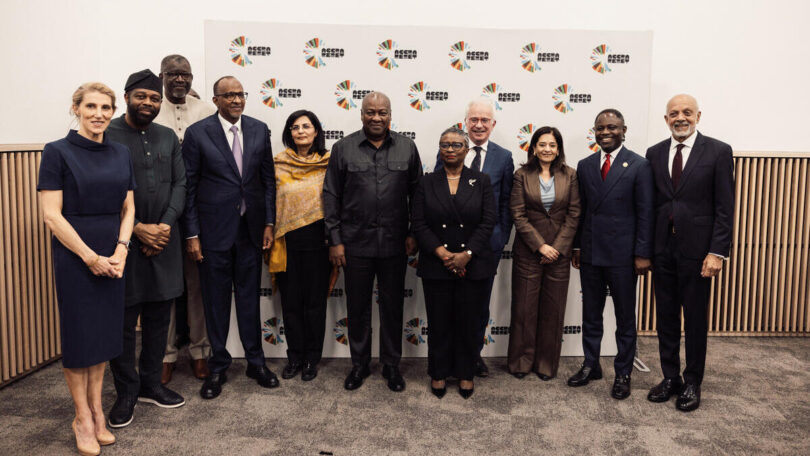
The push came during the Accra Reset High-Level Dialogue on Global Health Architecture, held on the sidelines at the recently concluded 79th World Health Assembly (WHA79) in Geneva, Switzerland.
A renewed push to restructure global health governance and financing emerged in Geneva as Heads of State, ministers, multilateral agencies and health financing institutions called for a sovereign, country-led approach to healthcare delivery and reform.
The event, themed “Geneva Clarion Call: Rethinking Power, Financing and Global Health Delivery,” brought together member states of the World Health Organisation (WHO), including presidents, ministers, philanthropic organisations and global health experts.
At the centre of discussions was the Accra Reset initiative, launched by Ghanaian President John Mahama during the 2025 United Nations General Assembly. The initiative seeks to reshape development and global health systems around national sovereignty, coordinated execution, domestic capacity and regional cooperation.
Participating leaders also reflected on lessons from national reform experiences and the growing importance of domestic financing, regional manufacturing, institutional resilience, and sovereign decision-making in health systems.
In his presidential address, Mr Mahama announced the next phase of the Accra Reset agenda through the High-Level Panel on Global Health Architecture and Governance (HLP-GHAG), established to propose reforms to global health systems and financing structures.
He also launched two additional pillars under the Accra Reset Sovereign Health Agenda: the Reform Observatory (RIO) and the Health Investment National Gateways Enabler (HINGE) mechanism.
According to him, the initiatives are expected to support implementation, track reforms, and drive investments into locally led health programmes.
“If the Accra Reset can move health commitments into working programmes, it can do so for any sector. Health is the vanguard, the proof of concept, and the moral imperative,” he said.
Several ministers at the meeting argued that countries in the Global South must take greater control of health financing and decision-making.
The Minister of Health of Indonesia, Budi Sadikin, said countries must develop sustainable healthcare financing pathways that can attract domestic and international investment.
Mr Sadikin said, “The money is there. My proposal is to help all countries develop proper health care financing pathways so health ministers can convince their finance ministers and the big banks to invest in health.”
Also, Brazil’s Health Minister, Alexandre Padilha, said countries in the Global South should play a stronger role in shaping international health decisions.
Mr Padilha noted that sovereignty is not merely an aspiration or a rhetorical concept, but an “executable agenda grounded in stronger national health systems, sustainable financing, and local and regional production capacities.”
Kenya’s Health Minister, Aden Duale, cited domestic financing efforts in Kenya as an example of practical health sovereignty.
Mr Duale said, “Kenya and Ghana are leading in terms of creating a practical health sovereignty. In eighteen months, we have mobilised domestically to fund our health care and universal health coverage.”
Speakers at the meeting also warned that multiple reform initiatives across the global health sector risk deepening fragmentation if not properly coordinated.
The CEO of Seed Global Health, Vanessa Kerry, referenced a new analysis reviewing more than 11 major global health reform initiatives.
Ms Kerry noted that there is increasing agreement around country ownership, stronger national systems and sustainable financing, but insufficient clarity on implementation.
She said there is a remarkable agreement on the need for and direction of reform, adding that “while the sector is increasingly aligned on what needs to change, there is not yet enough agreement on how reforms are to be carried out.”
“The next phase of reform must be a coherent implementation roadmap,” she added.
The Director-General, National Health Insurance Authority (NHIA), Kelechi Ohiri, said Nigeria’s Health Sector Blueprint had become a coordinating framework for engagement with development partners.
Mr Ohiri also disclosed that Nigeria and the Global Fund had begun piloting the integration of HIV, tuberculosis and malaria programmes into broader health insurance systems.
“The whole principle of having one plan, one national dialogue was put in place. With the Global Fund, we began to pilot the integration of vertical programmes, not just in the health system broadly, but also in health insurance,” he said.
Representatives of major global health financing institutions said their organisations were adjusting strategies to support long-term country ownership and sustainability.
The Executive Director of the Global Fund to Fight AIDS, Tuberculosis and Malaria, Peter Sands, said the organisation is evolving its partnerships to strengthen national and regional leadership.
Mr Sands said the collaboration reflects how it is supporting national and regional leadership while strengthening the systems, workforce and supply chains needed to save lives and sustain progress.
Also, the Chief Executive Officer of Gavi, the Vaccine Alliance, Sania Nishtar, said the organisation’s reform programme is aimed at promoting country sovereignty while reducing inefficiencies.
Ms Nishtar said, “through our Gavi Leap reform programme, we are demonstrating that it is possible to achieve radical change at scale and at pace.”
The Executive Head of the Pandemic Fund, Priya Basu, also said that future global health security would depend on countries’ ability to finance and sustain resilient health systems.