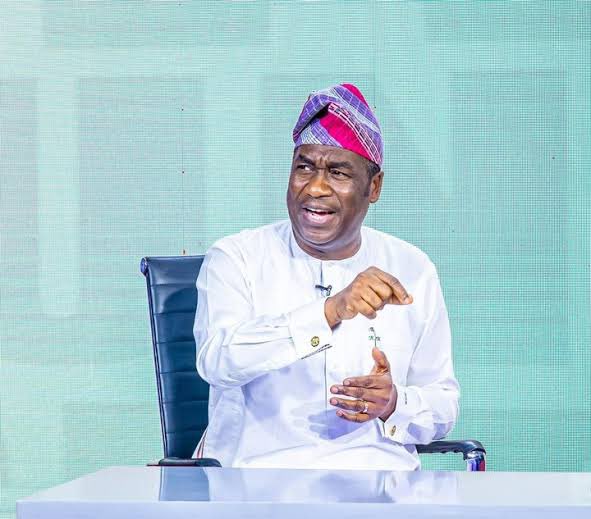
The recent furore generated by the comments attributed to the Lagos State All Progressives Congress (APC) governorship candidate and Deputy Governor of the state, Dr Kadir Obafemi Hamzat came to me as a matter blown out of proportion.
Having gone through what transpired at the event where Dr Hamzat met with youths, interacted with them and engaged them on various matters, not limited to the housing issue, I came to conclusion that many people rather than offering solutions to a problem that has been there since the creation of Lagos State, chose to hang onto a mundane matter – the advice by the Deputy Governor to a group of youths on how they can survive the high cost of getting accommodation, early while they progress in life.
The bone of contention was the suggestion by the Deputy Governor that youths just starting life should consider either living with their parents or shared accommodation rather than spend more than 60%
of their annual earnings on accommodation.
Dr Hamzat rightly noted that there are other compelling matters to spend earnings on, hence, the need to maximise their earnings by ensuring equitable shares of such earnings to cater for their needs.
At the forum, Dr Hamzat spoke extensively on his programmes especially on the issue of finding solutions to the housing problems of the state.
The question is why the furore over the Deputy Governor’s suggestion?
In advanced cities and countries of the world, such as London, New York, Toronto, Dubai, Singapore, and rich Middle East countries, youths shared accommodation to cut down their spending, youths stay with their parents even while they are gainfully employed. In some of these countries and cities, they only get separate accommodation when they are about to start their own families.
The Deputy Governor offered the advice as a stop gap, going on to explain in detail the housing policy of the current administration in which he is 2ice and the new one he will form by the grace of God in 2027, all of which will bring in expected relief to the populace.
We have to face the fact: Lagos housing problems did not just materialise today. The problem started since the creation of the state.
The two major causes of this are: the size of the state and its growing population.
Since its creation in 1967, Lagos has been and remains the smallest state in Nigeria but conversely, the state with the largest population.
From 1967 till the advent of the Tinubu administration in 1999, the state was sitting on 3,577 square kilometres, out of which 22 percent are lagoons, creeks and wetlands.
The ingenuity of the Tinubu administration through its reclamation policy increased the state mass to 4,050 square kilometres.
Juxtapose that with the increasing population of the state, between 1967 and 1975, the population grew from 1.24 million to 1.87 million, rose to 3.86 million in 1983, it was 7 million in 1999 and now projected to be 17.8 million in 2026.
Lagos remains one of the fastest growing cosmopolitan cities globally with an annual growth rate of between 3.2 to 3.78 percent.
Annually, it is projected that more than 600,000 people come to Lagos not as visitors but as residents. Between 1967 and 2026, the ratio of people residing in one room rose from between 4-5 people to 8-10 people in a room widening the housing deficit of Lagos to about 3.4 million.
The result of all these is the ever-increasing house rents. Paying house rents evolved from the monthly payment to annual payment upfront. It also gives rise to various rent agents who explore the dire situation to extort money from residents seeking accommodation.
Various administrations in the state have reacted with policies aimed at mitigating the rising cost of tenancy in the state.
In 1973, the Mobolaji Johnson administration enacted state rent edict which aimed at controlling money paid for rent; Jakande came with massive low-cost housing programme which led to the provision of 30,000 housing units spread across 15 major areas; Tinubu introduced private partnership with government, constructed housing units for low and medium income earners; Fashola introduced Lagos Home Ownership Mortgage Scheme (LagosHOMS) while Ambode introduced the rent-to-own scheme where low and middle income earners have the opportunity of becoming house owners via a rent scheme where they pay a percentage of the house cost and pay monthly rent until the full house money is remitted.
I have to go into the historical background of the housing problem to show that it is not something that started today or yesterday or last year.
It has always been there.
The Sanwo-Olu/Hamzat’s intervention has been massive.
The present administration recognised the need to expand housing constructions outside the central areas hence thousands of housing units have been delivered at communities like Epe, Agbowa, Ikorodu and Badagry.
Knowing that people have to work and mostly in the central areas, the government has improved transportation facility. Provision of train service is central to this. The Blue Line Rail system is fully operational moving thousands of commuters daily from Central Lagos to Okokomaiko while plans are on to extend to Badagry.
The Red Line is 80 percent completed while there are plans to introduce Yellow and Green Lines.
Alongside this, the state government has come out with a tenancy law which regulates rents and tenancy issues in the state.