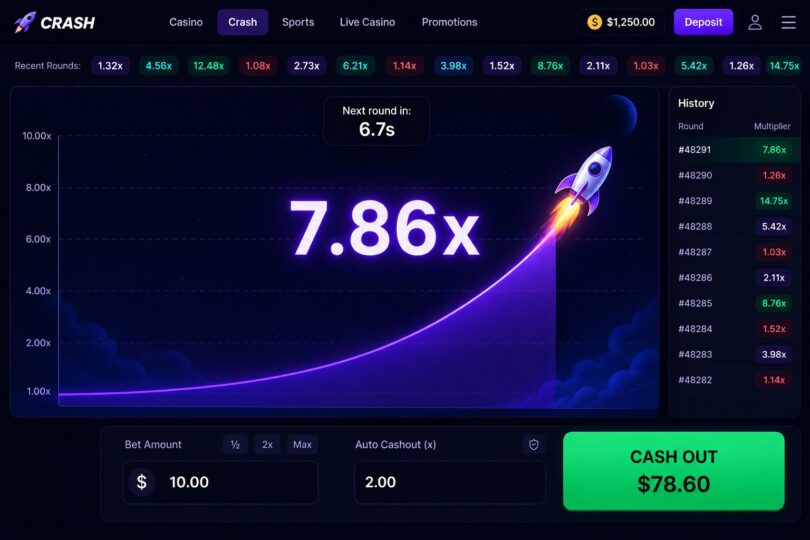
The crash game barely existed outside cryptocurrency forums before the mid-2010s. It is now built by the largest studios in the business, holds its own section of the casino menu, and has begun absorbing old games rebuilt into its format
When Evolution, the Swedish company that supplies live casino games to much of the online industry, announced its third crash-style title late in 2025, its chief product officer, Todd Haushalter, did not bother introducing the format. The crash genre, he said, is “well-established online.”
The “fastest-growing” label is the industry’s own, and it comes without an audited league table behind it. What can be tracked is where the software companies are putting their names, and on that measure the crash game’s ascent is hard to argue with.
Industry histories generally credit the format to a lone Canadian developer, Eric Springer, who built a Bitcoin game called MoneyPot in 2014. It changed hands, became better known as Bustabit, and spent years as a speciality of the cryptocurrency scene, well outside the licensed mainstream.
The mainstream came to it in stages. Pragmatic Play, among the biggest names in slot software, released Spaceman in March 2022 and described it at the time as the company’s first crash-style game. Others followed, and by the time Evolution was releasing its third entry in the genre, the announcement could treat the mechanics as common knowledge.
The game asks very little explaining. A round opens with a multiplier at 1.00, and the figure climbs. Any player who cashes out while it is still climbing has their stake multiplied by the number on screen at that moment. At some point, unannounced, the round ends, and whatever has not been cashed out is gone.
The stopping point is settled before the round begins, by a random number generator that, in licensed markets, has to carry an approved laboratory’s certificate. What looks like a game of nerves is, underneath, a random result fixed in advance, with a decision built on top of it.
That decision is the product. A slot resolves itself once spun; a crash round waits on the player, and the single input it accepts is the moment a player chooses to leave. Every other participant’s choice of moment is printed in the same window as the round runs, so each round is a single decision, made in company.
What the studios do with their old names is a fair measure of how seriously they take that appeal. Games Global took Thunderstruck, a slot name first released in 2004, and reissued it last year as Thunderstruck FlyX, which now sits with the other casino crash games at Betway in Britain. Converting a twenty-year-old flagship is a statement about where the audience has gone, made with the company’s most recognisable asset, and a cheap statement to make, since the recognition was paid for two decades ago.
The mobile fit
Another engine of the category’s growth is the handset. A crash round asks almost nothing of one: the visuals amount to a curve and a number, the traffic to a trickle of small updates between phone and server, and a round is over in seconds. It is a lean product in a period when leanness decides which mobile products survive, and it pays off most where data is bought in small bundles, and networks cannot be taken for granted.
Nigeria’s own experience makes the point from a different industry. The country’s fintech sector has learned, sometimes expensively, that mobile products live or die on how they handle real users and real conditions, reckoning this paper’s business desk has covered as the sector matures. Crash games arrived already suited to those conditions, and their seconds-long rounds fit the fragments of attention that mobile products of every kind now compete for.
The category’s next test is durability rather than growth. Formats built on novelty tend to fade when the novelty does, and the crash game’s answer to that risk has been to keep re-engineering its one decision: automatic cash-outs set in advance, partial cash-outs, themed variants layered over the same curve. The suppliers appear to have made up their minds; nobody rebuilt a 2004 brand for a passing fashion.
The likeliest future is an unglamorous one: the crash game as a standing item on the casino menu, the way the video slot became one a generation ago. The studios’ release calendars suggest they are already planning on it.