With the 2027 electoral calendar now moving into the campaign phase, Kaduna’s political landscape is being reshaped by incumbency, opposition fragmentation, the El-Rufai-Uba Sani fallout, regional calculations and persistent insecurity.
The 2027 election season is entering a new phase, and in Kaduna State, the political battle is already taking shape.
For Kaduna, the countdown has added urgency to an already fluid contest.
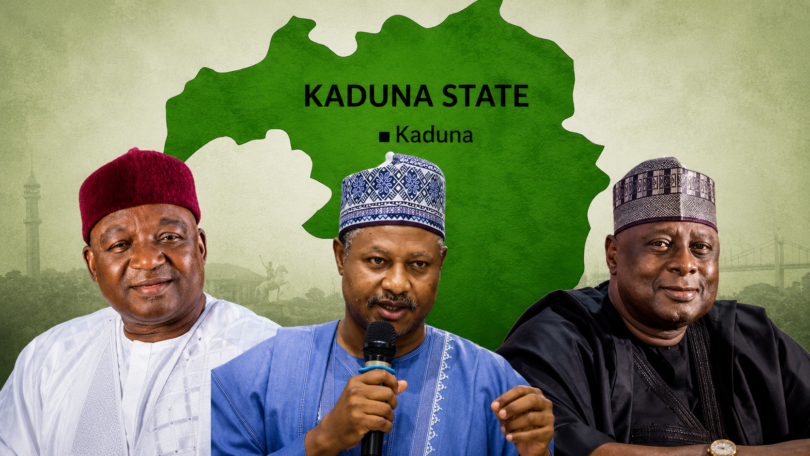
Governor Uba Sani of the All Progressives Congress (APC) is seeking a second term against a familiar challenger, Isah Ashiru of the African Democratic Congress (ADC), while former senator Danjuma La’ah has emerged on the platform of the Nigeria Democratic Congress (NDC).
The three men represent different political calculations.
Governor Sani enters the race with incumbency, government machinery, federal alignment and an increasingly dominant APC structure.
Mr Ashiru has statewide name recognition, two previous governorship campaigns and a substantial political network.
Mr La’ah brings two terms in the Senate, a strong Southern Kaduna identity and a powerful argument that the governorship should now go to Kaduna South.
But the biggest question may be whether the opposition can turn its combined strength into a single electoral force.
Kaduna has always been politically complex. Its three senatorial zones have distinctive political identities, while religion, ethnicity, geography, insecurity and longstanding regional grievances influence political behaviour.
But perhaps the most important feature of Kaduna politics is that alliances rarely remain permanent. The current contest illustrates that perfectly.
Mr Sani was once closely associated with former Governor Nasir El-Rufai. He succeeded activist politician Shehu Sani as senator for Kaduna Central and later became former governor El- Rufai’s preferred successor in 2023.
Today, the two are political opponents.
Mr El-Rufai has since left the APC for the ADC, while elements of his political network have increasingly aligned with Mr Ashiru.
That development has transformed the political calculations for the 2027 election.
Governor Sani remains the candidate with the strongest institutional advantage.
He controls the government machinery and leads a ruling party that has expanded its influence considerably since 2023.
He also secured the APC governorship ticket unchallenged, receiving 459,393 affirmation votes at the party primary.
More importantly, the governor has succeeded in attracting politicians from outside the APC.
Former governor Ramalan Yero, former senators Shehu Sani and Suleiman Hunkuyi, among others, moved into the APC camp in 2025. Mr La’ah was also among those who joined the ruling party before eventually leaving it for the NDC.
Twelve opposition lawmakers subsequently defected to the APC, further strengthening the ruling party’s structure in the state.
The significance is not merely numerical.
Mr Sani is building a political machine that reaches beyond traditional APC supporters.
But the governor’s strength also presents a possible vulnerability.
A dominant ruling party can become complacent, particularly when politicians begin to assume that victory is inevitable. Opposition parties will attempt to turn that confidence into an argument for change.
For Mr Ashiru, 2027 represents another attempt to reach Sir Kashim Ibrahim House.
He contested the governorship in 2019 against El-Rufai and again in 2023 against Mr Sani.
His second-place finish in 2023 demonstrated that he has a substantial statewide following.
His move to the ADC has also placed him at the centre of the broader opposition realignment.
The emergence of Mr El-Rufai within the ADC has created an unusual political situation.