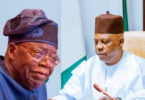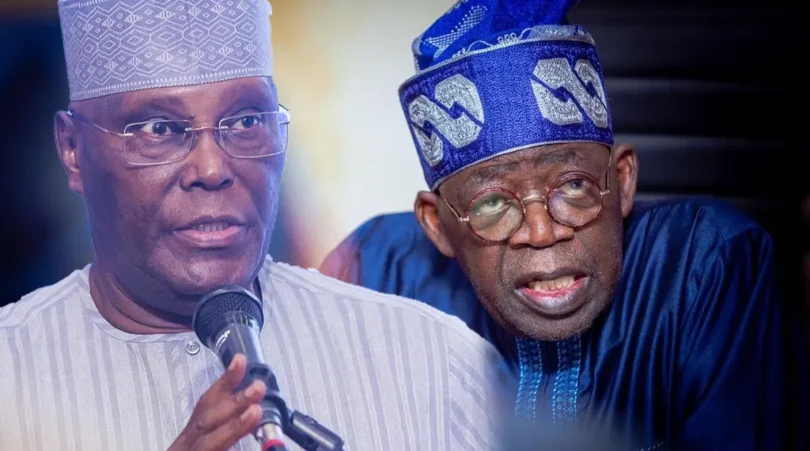
The judge adjourned the eligibility suit against Mr Tinubu until a new date following the disagreement between the lawyers.
Lawyers representing opposing sides in a suit challenging President Bola Tinubu’s eligibility to contest the 2027 presidential election disagreed on Tuesday on the service of the filings in the case on Mr Tinubu.
Judge Inyang Ekwo adjourned the matter until 28 September for further mention.
The Punch reported that earlier on Tuesday, Atiku’s lawyer, Joseph Onu, asked the court for permission to serve Mr Tinubu through substituted means so that the case could proceed.
Mr Onu said he had been unable to personally serve the filings on Mr Tinubu as generally required by law.
However, Omosanya Popoola, a Senior Advocate of Nigeria (SAN) who appeared for Mr Tinubu, offered to receive the originating summons on Mr Tinubu’s behalf. He asked the court to direct Mr Onu to hand the filings to him in open court for onward delivery to the president.
But, Mr Onu declined the proposal while insisting that Mr Popoola should first provide a written undertaking confirming that he had Mr Tinubu’s authority to accept the court process on his behalf.
The disagreement prompted Judge Ekwo to adjourn the matter until September to allow the plaintiffs to regularise service on the president.
Mr Atiku, the presidential candidate of the African Democratic Congress (ADC), and his party filed the suit in August against Mr Tinubu, the All Progressives Congress (APC) and the Independent National Electoral Commission (INEC).
The suit urged the court to declare Mr Tinubu unqualified to contest the 2027 presidential election, citing alleged flaws in the name appearing on the National Youth Service Corps (NYSC) discharge certificate allegedly linked to Mr Tinubu.
Atiku and the ADC argued that the certificate bears the name “Tinubu Bola Adekunle”, while the president is known as Bola Ahmed Tinubu.
In his affidavit filed in support of thebsuit, Atiku alleged that Mr Tinubu submitted the controbersial NYSC discharge certificate to INEC to aid of his candidacy for the forthcoming poll.
They asked the court to rule that the alleged discrepancy affects Mr Tinubu’s constitutional qualification to contest the 2027 presidential election.
The plaintiffs also contend that the certificate was not obtained by Mr Tinubu.
They asked the court to determine the authenticity and legal implications of the disputed document.
Atiku and the ADC relied on Sections 137(1)(j), 139(1)(a)(i) and 285(14)(c) of the 1999 Constitution, as amended, as well as provisions of the Electoral Act, 2026.
Section 137(1)(j) provides that a person who presents a forged certificate to INEC is not qualified to contest for the office of President.
The plaintiffs asked the court to determine whether the alleged submission of the disputed certificate falls within that constitutional provision.
They also challenged the provisions of the Electoral Act, 2026, which they argued restricted the circumstances under which a candidate’s qualification can be challenged before an election.
The plaintiffs argued that an Act of the National Assembly cannot override an express provision of the Constitution.
They maintained that where a statute conflicted with the Constitution, the Constitution must prevail.
Atiku and the ADC also sought an order disqualifying Mr Tinubu and the APC from participating in the 2027 presidential election if the allegations against them are established.
Mr Atiku also asked the court to compel INEC to produce Mr Tinubu’s Form CF001 submitted in connection with the 2023 and 2027 presidential elections.
The former vice president said he had sought certified true copies of the documents from INEC but had not received them before filing the case.
On Friday, 14 August, Mr Abubakar personally appeared at the Federal High Court registry in Abuja to file an affidavit supporting the action.
He said the case was too important to be handled casually and concerned constitutional requirements for occupying the office of president.
The case showcases a new twist to the eligibility campaign against Tinubu which began during the 2023 election cycle.
During the 2023 electioneering and post-election litigation, Atiku sought Mr Tinubu’s disqualification after it was discovered that a United States court in the 1990s found some funds belonging to Mr Tinubu to be linked to illicit drugs. The US court reportedly ordered the forfeiture of the funds, a development Atiku considered to be enough grounds to disqualify Mr Tinubu from standing for the election.
The Supreme Court, which eventually ruled on the case, found the allegation to be insufficient to stop Mr Tinubu from participating in the election.
With the 2027 election approaching, Atiku and other opposition voices have regnited the eligibility issue, expanding on the illicit drug matter. Already, litigation has opened in the US seeking to obtain details of what the promoters believe to be the 1990s criminal investigation into a narcotic case allegedly involving Mr Tinubu.