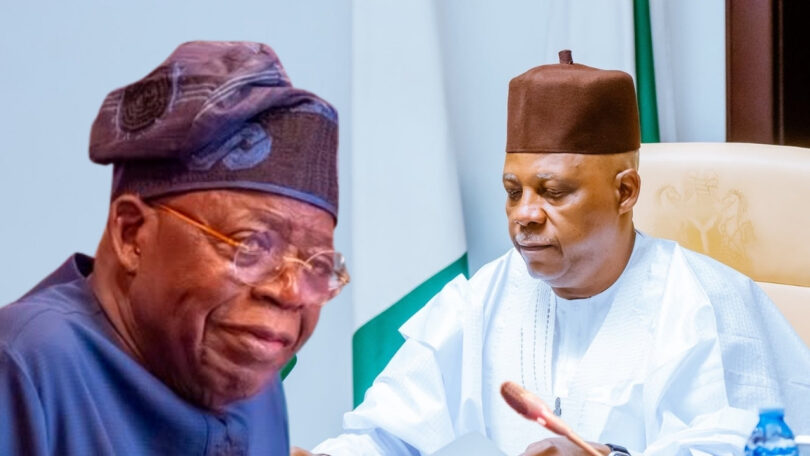
Mr Tinubu departed Abuja on Sunday for London to begin his annual leave, while Mr Shettima was in Luanda, Angola, representing him at an African Union summit.
For the next three weeks, President Bola Tinubu will be away from Nigeria on vacation, reviving controversy over whether a Nigerian president can proceed on holiday and continue to exercise the powers of his office, or does the Constitution require him to transfer those powers to the vice president.
At almost the same time, Vice-President Kashim Shettima travelled to Luanda, Angola, where he was representing the president at an African Union summit. Mr Shettima returned to Nigeria on Monday, a day after the president embarked on vacation.
Bayo Onanuga, the presidential spokesperson who announced the president’s trip, did not indicate if he transmitted the written declaration required under Section 145(1) of the Constitution before embarking on the trip.
Section 145 of the Nigerian Constitution requires the president to transmit a written declaration to the Senate President and the Speaker of the House of Representatives whenever he proceeds on vacation or is otherwise unable to perform the functions of his office. Once such a declaration is transmitted, the vice president is required to perform the functions of the president as acting president.
Section 145(1) states: “Whenever the President is proceeding on vacation or is otherwise unable to discharge the functions of his Office, he shall transmit a written declaration to the President of the Senate and the Speaker of the House of Representatives to that effect, and until he transmits to them a written declaration to the contrary, the Vice President shall perform the functions of the President as Acting President.”
To establish whether Mr Tinubu complied with the constitutional requirement, PREMIUM TIMES contacted officials at the Presidency and the National Assembly to ascertain whether the president had transmitted the required declaration.
Those contacted are Mr Onanuga, the Senior Special Assistant to the President on National Assembly Matters (Senate), Baheer Lado; the President’s Special Adviser on National Assembly Matters (House of Representatives), Wasiu Olarenwaju-Smart, and Senate spokesperson Yemi Adaramodu.
Others contacted were Eseme Eyiboh, spokesperson to Senate President Godswill Akpabio; Lanre Ladipo, special adviser to the Senate President on New Media, and Leke Baiyewu, chief press secretary to the Speaker of the House of Representatives, Abbas Tajudeen.
Messrs Adaramodu and Olarenwaju-Smart did not respond to calls and messages seeking clarification.
Other officials who responded, however, could not confirm whether Mr Tinubu transmitted the constitutional declaration to the National Assembly before embarking on leave.
Mr Onanuga said the president is on a short working vacation, but declined to say whether he had transmitted the required written declaration to the legislature.
Mr Eyiboh said he did not have information on the matter. In contrast, Mr Ladipo said he was not aware of any such communication from the president in the Office of the Senate President.
Similarly, Mr Lado said he was on holiday and was unaware of whether the president had sent the declaration to the National Assembly.
Mr Baiyewu, on his part, said the office of the Senior Special Adviser to the President on National Assembly Matters was better positioned to confirm whether the declaration had been transmitted.
The responses from the officials left PREMIUM TIMES unable to independently establish whether Mr Tinubu had formally notified the National Assembly of his vacation as required by the Constitution.
Section 145(1) appears explicit in requiring the president to transmit a written declaration to the Senate President and the Speaker of the House of Representatives whenever he proceeds on vacation or is otherwise unable to discharge the functions of his office.
Mr Onanuga, who announced the president’s trip, confirmed that Mr Tinubu would spend three weeks on vacation but did not disclose whether the Section 145 declaration had been transmitted to the National Assembly or whether presidential functions had been transferred to Mr Shettima.
If Mr Tinubu has not transmitted the declaration, his administration may be relying on Section 145(2), which provides a 21-day mechanism for the National Assembly to mandate the vice president to act as acting president.
Section 145(2) states: “If the President is unable or fails to transmit that written declaration within 21 days, the National Assembly can, by a simple majority in each chamber, mandate the Vice President to perform the functions of the President as Acting President. This continues until the President writes to the Senate President and House Speaker that he is available to resume his functions,” the section says.
The three weeks Mr Tinubu is expected to be abroad on vacation amount to 21 days. So the president might be relying on section 145(2).
However, constitutional lawyers who spoke with PREMIUM TIMES on the matter have different interpretations of the two sections.
Fadilat Ibrahim said that the literal interpretation of section 145(1) imposes an immediate obligation on the president to notify the National Assembly whenever he proceeds on vacation, irrespective of the period he intends to spend.
“So, by the ordinary literal interpretation of the text of the constitution, President Tinubu is mandatorily required to transmit that letter upon proceeding on his vacation because of the word shall, which ordinary interpretation in legal text connotes obligatory,” she said.
On the 21-day provision in subsection (2), Ms Ibrahim argued that it should not be interpreted as granting the president a 21-day grace period.
“Subsection 2 does not mean that the president has discretion to just travel without transmitting the letter; so far, it’s just for 21 days. Subsection 2 is actually a consequence of what happens when the president fails to do his constitutional mandatory duty in this respect,” she added.
Another constitutional lawyer, Musa Adamu, however, offered a different interpretation, arguing that the Constitution envisages a situation in which a president may be absent for up to 21 days without the National Assembly having to intervene.
Mr Adamu said the president acted within the law if he did not send the declaration to the parliament.
“If you calculate three weeks, that is 21 days, and they also said that while he’s there, he will be intermittently working and resting. However, wrong you think it is or morally wrong you think it is, the president will be away within the time, if the president doesn’t come back within the 21 days that is when you’ll say the president has violated the law but as it is, he was very careful, he has acted within the law and he hasn’t violated any section of the law.
The competing interpretations centre largely on the relationship between the two subsections.