Special Reports
N3.38 Billion Car Grant Bonanza: Securities and Exchange Commission Management Paid Billions Under 2013 Board Resolution, Bypassing Salary Commission Approval


Secret Reporters
Securities and Exchange Commission (SEC), Abuja, spent more than ₦3.55 billion on staff medical bills and monetized car grants between 2017 and 2019, with questions raised over the approval of additional healthcare expenses and the payment of billions of naira in vehicle benefits to management staff.
The larger expenditure involved ₦3,382,313,745.12 paid as monetized car grants to management staff for personal vehicles. The payments were made between 2017 and 2019 based on a 2013 Board resolution rather than approval from the National Salaries, Incomes and Wages Commission (NSIWC).
These findings also raised concerns that some officers received multiple car grants within a two-year period, although the Commission disputed this allegation. The applicable provisions included Sections 3 and 13 of the NSIWC Act, Paragraph 213(ii) of the Financial Regulations 2009, and Section 3, Part 1(B) of the Certain Political, Public and Judicial Office Holders Act 2002. The Monetization of Fringe Benefits Brief, particularly Paragraph 6(v), also provides for a car grant calculated at 400 per cent of annual basic salary, with an interest rate of four per cent and a six-year recovery period.
In its defence, the Commission maintained that the car allowance was approved by its Board in place of transport allowance and was introduced in response to the Federal Government’s monetization policy. Management further relied on Section 16 of the Investments and Securities Act 2007, arguing that the provision empowers the Board to determine the terms and conditions of service for its staff. The Commission also rejected the claim that some employees received multiple car allowances within two years, stating that there was no record to support that allegation.
However, the concern raised was that the Board’s resolution was used as the basis for the payments without evidence of the required NSIWC approval. The risks identified included loss and possible diversion of public funds, as well as difficulties in funding the government budget.
Beyond the car grants, another ₦173,033,395.53 was spent on staff medical bills despite the employees already being enrolled in the National Health Insurance Scheme (NHIS). The Commission had reportedly paid more than ₦100 million in insurance premiums, yet additional medical expenses were incurred without evidence of approval for the extra spending.
The transaction was examined under Public Service Rules 2009, particularly paragraphs 070201, 070202, 070206(d)(i) and 070206(e).
Management defended the expenditure, explaining that the NHIS does not cover every illness and therefore cannot be expected to meet all medical needs of employees.
The Commission also cited Section 20 of the Investments and Securities Act 2007, arguing that the provision empowers its Board to apply proceeds from regulatory activities towards administrative costs and the reimbursement of authorised expenses.
Despite this explanation, the issue remained centred on the absence of documentary evidence showing that the additional medical expenditure had received the necessary approval. The identified risks included loss and possible diversion of public funds.
During the period covered by the findings, the SEC experienced changes in its leadership. Mounir Gwarzo served as substantive Director-General until his suspension in December 2017, followed briefly by Dr Abdul Zubair as Acting Director-General. Mary Uduk subsequently served as Acting Director-General from around April 2018 until May 2020, covering most of the 2018–2019 period. The records provided do not establish which individual personally authorised the transactions.
The two expenditures amount to ₦3,555,347,140.65, with the monetized car grants accounting for the overwhelming majority.
The recommendations called on the Commission to account for and recover the full ₦173,033,395.53 spent on medical bills, as well as the ₦3,382,313,745.12 paid as monetised car grants, and remit the respective amounts to the Treasury. Failure to comply could attract sanctions under Financial Regulations 3106 and 3115.
Although management offered explanations for both transactions, the questions surrounding approval of the additional medical spending and the regulatory basis for the car grants remain significant. The Commission’s position on the multiple car-grant allegation also differs from the concern recorded in the findings.
Follow NewsNGR on WhatsApp: join the channel for every exclusive the moment it publishes.


Governor’s aide flays Amaechi over posture at emir’s palace

N3.38 Billion Car Grant Bonanza: Securities and Exchange Commission Management Paid Billions Under 2013 Board Resolution, Bypassing Salary Commission Approval

2027: Atiku, Obi making victory easy for Tinubu – Sule Lamido

Tinubu, Mbah, APC and the South-East, By Collins Ogbu

Buruj FC CEO Celebrates Son, Noah Salaudeen On 25th Birthday

INEC Chairman Under Fire Over Meeting With APC UK Chairman

EXCLUSIVE: Mo Abudu’s EbonyLife Moved Into the Building of the Kings Cross Firm That Verified Seyi Tinubu’s Wife Layal, the Same Firm That Verified Seychelles Offshore Companies Owned by Politically Exposed Nigerians

Falana urges Tinubu govt to prosecute sponsors of electoral violence ahead of 2027
Nigeria’s Inflation Drops To 14.63% As Food Prices Ease
2027: AbdulRazaq predicts APC victory in Kwara, cites Wike’s support for Tinubu
One Voice Started A Movement: ONC Thanks Burna Boy, VDM, Winnie Miller For Rebuilding Odiokwu School
Enugu Govt Approves ₦32bn For Gratuity Arrears Payment
Reps move to establish national authority for renewable energy, pass bill for second reading
Afrinvest repays undocumented $1 million from Elumelu with interest
Soldiers, terrorists killed in midnight terror attack on Borno military base
Nigerian lawmakers amend Federal Polytechnic Act, empower polytechnics to award bachelor’s degrees

 Special Reports6 days ago
“Customary Law Cannot Override Pension Reform Act” — Court Orders Release Of Late DSP’s Benefits, Awards ₦5m Damages
- Special Reports6 days ago
EXCLUSIVE: Aliko Dangote’s Two Jets Stand on the United States Register Under One Utah Trustee, and No Public Record Names the Beneficiary
- Special Reports7 days ago
Jigawa, Islamic Development Bank collaborate on $110m project to improve schools, teacher development
- Business7 days ago
“Settle Claims Promptly, Not Just Collect Premiums” — Former AfDB President Adesina Tells Insurers, Demands Accountability
- Special Reports7 days ago
EXCLUSIVE: London Fund Manager Dr Aveez Olowoporoku Held Up To 100 Per Cent of Moniepoint’s First UK Company as Its Only Director For a Full Year, Then Secretly Handed Control to Founders Tosin Eniolorunda and Felix Ike, and Walked Away
- Politics6 days ago
“I Have Seen The Light, Tinubu Is Laying A Solid Foundation” — Okowa Explains Why He Dumped Atiku, Backs President’s Re-Election
- Business6 days ago
“Stablecoin Holders Must Not Receive Interest Or Yield” — CBN Introduces New Regulations, Mandates Form M For Import Payments
- Special Reports7 days ago
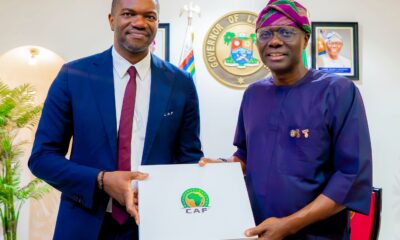
Sanwo-Olu Hosts CAF Scribe, Samson Adamu, Calls For Stronger Collaboration Among Stakeholders In Nigerian Football