News
NDLEA Arrests 77,736 Suspects, Secures 14,200 Convictions In Five Years

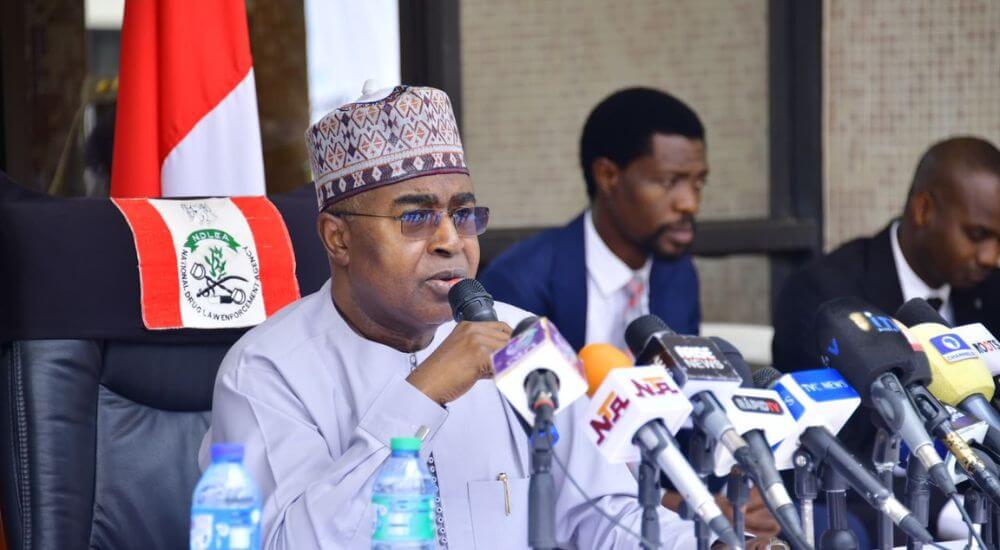
The National Drug Law Enforcement Agency (NDLEA) has disclosed that it arrested 77,736 suspected drug offenders and secured more than 14,200 convictions between 2021 and 2025, while seizing over 14.8 million kilogrammes of illicit drugs across Nigeria.
The figures were disclosed on Monday by the agency’s Chairman, Brigadier-General Mohamed Buba Marwa (retd.), during the launch of the National Drug Control Master Plan (NDCMP) 2026–2030 in Abuja.
Marwa said the figures emerged from the evaluation of the previous five-year drug control plan, which also recorded more than 32,400 beneficiaries of treatment, counselling and rehabilitation services.
The disclosure comes as the Federal Government launches a new five-year strategy to tackle drug trafficking, substance abuse and the growing activities of transnational criminal networks.
Speaking at the event, Vice-President Kashim Shettima urged federal and state governments, security agencies, the National Assembly, private organisations and international partners to ensure the effective implementation of the new plan.
Shettima, who was represented by the Special Adviser to the President on Special Duties, Office of the Vice-President, Dr Modibbo Aliyu Umar, warned that Nigeria could not secure its future without protecting citizens from the dangers of illicit drugs.
He described drug trafficking and substance abuse as threats to public health, national security, economic development and social stability.
According to him, enforcement operations alone would not solve the problem without sustained investment in prevention, rehabilitation, treatment and the disruption of financial networks supporting drug trafficking.
The Vice-President identified six major pillars of the new plan, including supply reduction, drug demand reduction, access to controlled medicines for medical purposes, alternative development and sustainable livelihoods, disruption of the illicit drug economy, and governance, financing and coordination.
He also warned that inadequate funding could undermine the entire initiative, insisting that the plan must be reflected in government budgets, institutional work plans and implementation schedules.
“A national plan without a credible financing pathway risks becoming a declaration of good intentions,” Shettima said.
He urged government institutions and other stakeholders to move beyond policy declarations and demonstrate commitment through concrete actions.
“Five years from now, the significance of today’s launch will not be judged by the ceremony. Let this be the moment Nigeria moves from policy to action,” he added.
Marwa, in his address, said the new master plan was designed to address shortcomings identified in the implementation of the previous 2021–2025 strategy while responding to emerging threats in the illicit drug trade.
He identified gaps in funding, coordination, data management, monitoring, accountability and service delivery, particularly at state and local government levels.
The NDLEA chairman also warned that drug trafficking syndicates were increasingly exploiting encrypted communications, cryptocurrency and sophisticated technological systems to evade law enforcement agencies.
He cited the agency’s recent operations against international drug trafficking networks as evidence of its growing operational capacity.
Among the operations was a joint sting conducted on April 28, 2026, with the United States Drug Enforcement Administration and law enforcement agencies in Switzerland, France and Greece.
The operation reportedly dismantled a transnational criminal organisation and led to the arrest of alleged billionaire drug baron Amadi Simon in Switzerland, alongside two female suspects identified as Jecinta Amara Ikechi in Anambra State and Blessing Ngozi Amadi in Delta State.
Marwa said several bank accounts and cryptocurrency wallets linked to the network had been blocked, while the agency secured interim forfeiture orders covering properties worth billions of naira, including two hotels in Delta State and an apartment building in Mabushi, Abuja.
He also recalled the dismantling of a Nigerian-Mexican methamphetamine trafficking network and the discovery of a clandestine drug laboratory in Ogun State, involving drugs and chemicals estimated at $362.9 million.
According to him, four additional methamphetamine laboratories linked to Mexican criminal networks were subsequently dismantled in Oyo, Ebonyi and Enugu states, leading to the arrest of 10 Mexican nationals and 14 Nigerian collaborators who are facing criminal charges.
The NDLEA chairman described sustainable funding as one of the most critical conditions for the success of the new strategy.
He called on federal budget authorities to incorporate the plan’s priorities into annual budgets and the Medium-Term Expenditure Framework, while urging state and local governments to make dedicated financial provisions for their drug control committees.
He also appealed to banks, telecommunications companies, technology firms, agribusinesses and philanthropists to support prevention, rehabilitation and alternative livelihood programmes.
The Attorney-General of the Federation and Minister of Justice, Lateef Fagbemi, also commended the NDLEA, describing it as the bedrock of Nigeria’s drug control architecture.
Fagbemi said the new master plan would strengthen the agency’s effectiveness by integrating law enforcement with public health, education, social development, financial investigations and community participation.
He pledged that the Federal Ministry of Justice would work with the judiciary to accelerate the prosecution of drug-related cases and ensure that convictions were accompanied by the confiscation of proceeds of crime.
The AGF, however, stressed the need to distinguish between drug traffickers and people suffering from substance dependence, arguing that the latter required treatment, counselling and rehabilitation rather than criminal punishment.
He also commended the NDLEA’s alternative development programme, which encourages communities involved in illicit drug cultivation to embrace legitimate agricultural activities.
The initiative, according to Shettima, has already begun transforming three communities in Ondo State, making Nigeria the first African country to introduce such a programme under the NDLEA’s leadership.
Meanwhile, the Economic Community of West African States (ECOWAS) Commission pledged support for Nigeria’s new drug control strategy, describing it as an important contribution to regional security and public health.
The commission, represented by its Commissioner for Human Development and Social Affairs, Professor Nassirou Bako-Arifari, said the success of the initiative would depend on political commitment, adequate funding and cooperation among governments, civil society organisations and international partners.
The House of Representatives Committee on Drugs and Narcotics also pledged legislative support and effective oversight to ensure the implementation of the plan.
The launch, themed “Strategic Action for a Drug-Free Nation,” was attended by government officials, lawmakers, diplomats, representatives of international organisations, traditional rulers, religious leaders and civil society groups.












Fountain of Life Crisis: Court summons Jimmy Odukoya over alleged contempt

2027 Politics Watch: Atiku’s withdrawal denial, Tinubu’s Lagos turnout push, SERAP’s suit against INEC

NDLEA Arrests 77,736 Suspects, Secures 14,200 Convictions In Five Years

‘I can’t be activist forever,’ Bukarti defends aligning with APC

BREAKING: Four Killed As Omo-Agege Survives Assassination Attempt In Delta

FCTA upgrades 20 health centres, expands free maternal care

UBA Fraud Awareness Week: Experts call for stronger intelligence sharing to combat digital fraud

Ogun 2027: Ijebu Muslim Leaders Endorse & Pray For Senator Adeola’s Success At The Poll
NiMet forecasts Nigeria’s weather for next three days
EXCLUSIVE: Nana Otedola Got a British Virgin Islands Judge to Put Her Husband Femi Otedola’s Company on a Leash Over Their London Knightsbridge Home, Breach Meant Jail
EXCLUSIVE: Pastor Ayo Oritsejafor Controls More Than Half Of London Church Company Word Of Life Bible Church London Ltd As His Earlier London Church Company Died Without Filing One Account And He Has Two Different Dates Of Birth
Kaduna Rises For Continuity: Historic Turnout Affirms Support For President Tinubu’s Renewed Hope Agenda
Dr. Chibueze Ofobuike Champions Career Development for Young Women at COOU, Bags Award of Excellent Leadership
Lagos Obidient Movement Supporter Allegedly Arrested By DSS Operatives
Buy 1 Get 1 Free Chicken Bucket: KFC Nigeria brings back its biggest value deal Wednesday, 28th Oct
Nigerians Abroad: Iheanacho extends scoring streak as Ajayi, Awaziem shine

 Top Stories20 hours ago
“We Are Examining The Video” — Daura Emirate Launches Probe Into Tourist’s Sexual Assault Allegations Against Emir Faruk Umar Faruk
- Special Reports17 hours ago
Beyond the Crown: Ooni of Ife’s Wife, Olori Temitope Enitan-Ogunwusi, Takes Africa’s Malaria Fight to Botswana
- Top Stories20 hours ago
“1,571 Tractors Deployed To 23 States” — APC PCC Lists Agriculture Interventions As Tinubu Approves ₦1.5tn BOA Recapitalisation
- Special Reports22 hours ago
EXCLUSIVE: Frank Timis’s Pan African Burkina Collapses Into Cayman Liquidation With US$97.8 Million Deficit, A US$100 Million Debt To Brazil’s BTG Pactual And An Unpaid US$7.2 Million Settlement Owed By Timis Himself
- Special Reports1 day ago
Davido’s Uncle Adeleke Raised The Airport Bearing His Family Name To N80 Billion After Spending Nothing Of Its First N10 Billion
- Special Reports23 hours ago
REPORTER’S DIARY: My experience at Fountain of Life’s unusual, heavily policed Sunday service
- Special Reports17 hours ago
Comrade Dauda Joins Thousands At Tinubu’s Ibadan Campaign Rally
- Politics1 day ago
Atiku Speaks On Stepping Down From 2027 Presidential Race