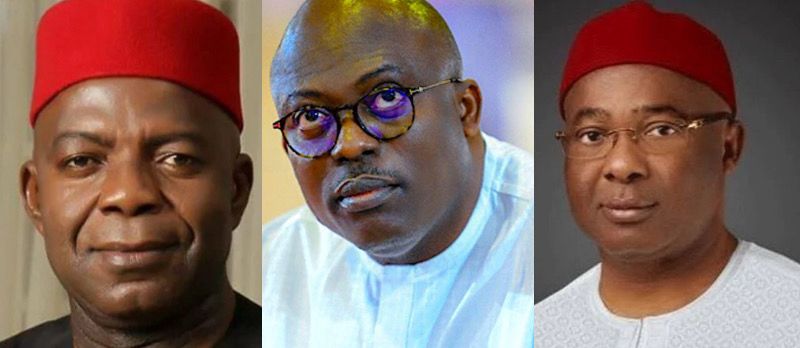
Abia and Rivers slump to joint last position with a 9 per cent score as the report flags weak audit transparency in three oil-producing states.
A new report by Paradigm Leadership Support Initiative (PLSI) has ranked Rivers State, Abia State and Imo State—all oil-producing states—among the worst performers in Nigeria’s 2025 Subnational Audit Efficacy Index.
The report, presented in Abuja on 31 March, is the sixth consecutive annual assessment evaluating transparency and accountability in the management of public funds across the 36 states.
PLSI said the index aims to identify gaps in subnational public finance management systems, strengthen accountability structures and accelerate development outcomes.
According to the report, Rivers and Abia states ranked 36th—the lowest position—with 9 per cent each, while Imo ranked 32nd with 18 per cent.
Benue ranked 34th and Taraba 33rd, featuring among the five worst-performing states.
The ranking showed a troubling pattern among the three oil-producing states, which, despite significant revenue inflows, performed poorly across key audit and accountability indicators.
PLSI said the 2025 index was divided into two tiers: state-level assessment and local government-level assessment.
At the state level, eight indicators were examined, including the audit legal framework, submission of annual audit reports, publication of audit documents, implementation of legislative recommendations, performance audits, citizens’ accountability reports, civil society and media participation, and the effectiveness of Public Accounts Committees.
The second tier assessed local governments across three indicators: audit frameworks, reporting and publication of audit documents.
Abia’s performance has declined over recent years, dropping from 12th in 2022 to 36th in 2025.
The report found that although the Abia State Audit Law 2021 provides for financial autonomy of the Auditor-General’s office, there is no evidence of its implementation.
PLSI also noted the absence of an inaugurated Audit Service Board, weak legal provisions for publishing audit reports online and failure to submit the 2024 annual activity report to the Abia State House of Assembly.
Other gaps include the non-publication of citizens’ accountability reports, the lack of performance audits, and the minimal involvement of civil society and the media in the audit process.
At the local government level, similar deficiencies were highlighted, including non-operational financial autonomy and a lack of published audit reports.
Rivers, which ranked first when the index began in 2020, has experienced a steady decline to the bottom position in 2025.
The report highlighted the non-operationalisation of financial autonomy for the Auditor-General’s office and the absence of an Audit Service Board.
It also cited failures to publish audit reports, to conduct performance audits, and to review audit findings in legislation.
PLSI noted that although the state has legal provisions guaranteeing transparency—such as the Rivers State Audit (Amendment) Law 2021—these have not been implemented in practice.
At the local government level, the report found that audit reports and annual activity reports were not published, while financial and administrative independence remained weak.
Imo ranked 32nd, continuing a trend from its ninth position in 2021.
The report said financial autonomy for the Auditor-General’s office is yet to be implemented despite legal backing, while administrative independence and tenure security remain unresolved.
It also found that audit reports and citizens’ accountability reports were not published, and there was no evidence of performance audits or legislative review of audit findings.
Although the state published its 2024 audited financial statements online, PLSI noted that the documents lacked sufficient detail to enable meaningful civic engagement.
At the local government level, while audit reports were published, they reportedly lacked critical details such as audit observations and recommendations.
PREMIUM TIMES reached out to the Abia State Commissioner for Information, Okey Kanu, and the Rivers State Permanent Secretary, Ministry of Information, Honour Sirawoo, for clarifications on why both states failed to adhere to their audit laws and best practices in transparency and accountability, and what they would do differently to reverse the trend.
Both officials said they were not aware of the report and asked PREMIUM TIMES to share it for informed comments. This was done, but they had not responded as of the time of filing this report
Similar attempts to reach the Imo State Commissioner for Information, Public Orientation and Strategy, Declan Emelumba, were unsuccessful. He did not respond to calls and text messages seeking comments.
PREMIUM TIMES had asked why the state had not operationalised the financial autonomy of the Auditor-General’s office despite existing legal provisions, what steps were being taken to ensure publication of audit and citizens’ accountability reports, and why there was no evidence of performance audits or legislative review of audit findings.
Other questions sought details on plans to strengthen civil society and media participation in the audit process, reforms to improve the state’s ranking as an oil-producing state, and timelines for addressing the identified gaps.