Business
“Our Track Record Will Be Judged By What Is Done” — NNPC Reports ₦11.14tn Federation Payments, ₦509bn September Profit

*Targets 2m Barrels Daily
The Nigerian National Petroleum Company Limited (NNPC) has disclosed that it paid ₦11.14 trillion to the Federation Account as statutory payments between January and September 2026, while recording a profit after tax of ₦509 billion in September alone.
The company also reported revenue of ₦4.608 trillion for September, alongside crude oil and condensate production of approximately 1.70 million barrels per day, as it intensified efforts to increase national oil production to two million barrels per day by 2027.
The figures were contained in NNPC’s September 2026 monthly report summary, which provided an update on the company’s financial performance, crude oil and gas production, petroleum sales, infrastructure development and operational activities.
According to the report, crude oil production averaged 1.45 million barrels per day in September, while condensate production stood at approximately 240,000 barrels per day.
Natural gas production reached 7.789 billion standard cubic feet per day, representing an increase from the 6.997 billion standard cubic feet per day recorded in October 2025.
The report showed that gas production had earlier peaked at 7.841 billion standard cubic feet per day in June 2026 before settling at the September level.
Gas sales also increased to 4.793 billion standard cubic feet per day in September, compared with 4.737 billion standard cubic feet per day in August and 4.713 billion standard cubic feet per day in October 2025.
On crude oil and condensate sales, NNPC disclosed that it sold a combined 24.63 million barrels in September, comprising 23.64 million barrels of crude oil and 990,000 barrels of condensate.
This represented a marginal increase over the 24.56 million barrels sold in August and the 22.53 million barrels recorded in July.
The company’s highest monthly crude oil and condensate sales during the period under review were 28.64 million barrels in October 2025, followed by 28.23 million barrels in June 2026.
NNPC further disclosed that its upstream pipeline availability stood at 100 per cent in September, indicating that no major pipeline disruption affected production during the month.
However, petrol availability across NNPC Retail Limited stations was recorded at 54 per cent.
On infrastructure development, the company confirmed that the Obiafu-Obrikom-Oben (OB3) gas pipeline had reached 100 per cent completion, with the River Niger crossing commissioned and operational.
It also disclosed that the Ajaokuta-Kaduna-Kano (AKK) gas pipeline had reached 95 per cent completion.
According to NNPC, efforts were ongoing with relevant stakeholders to accelerate construction and pre-commissioning activities to enable the delivery of early gas to Abuja before the end of 2026.
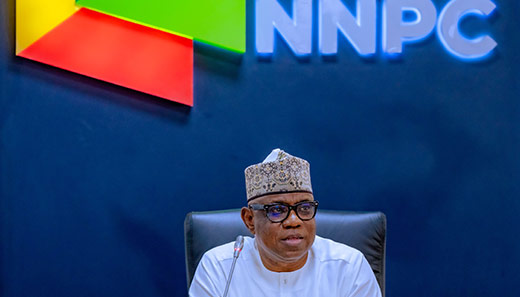
Meanwhile, the Group Chief Executive Officer of NNPC, Mr Bayo Ojulari, has attributed improvements in Nigeria’s crude oil production to reforms in the petroleum sector, saying the country has added approximately 600,000 barrels per day to its output.
Ojulari disclosed that national oil production had increased from approximately 1.2 million barrels per day to 1.8 million barrels per day, following the implementation of reforms designed to improve investment, strengthen operational efficiency and enhance collaboration among industry stakeholders.
He made the disclosure at the 2026 Abu Dhabi International Petroleum Exhibition and Conference (ADIPEC), held in the United Arab Emirates.
The conference, held under the patronage of the President of the United Arab Emirates, Sheikh Mohamed bin Zayed Al Nahyan, and hosted by ADNOC, brought together more than 239,000 participants from over 170 countries.
Participants included government ministers, chief executives, investors and technology leaders who discussed energy security, investment opportunities and the future of global energy supply.
Speaking during a session titled “Nigeria’s Reform Agenda: Competing for Energy Capital,” moderated by John Defterios, Ojulari identified the Petroleum Industry Act (PIA) 2021, improved investment conditions, better investment decisions and closer cooperation between NNPC and its partners as major factors behind the increase in production.
He maintained that the progress recorded in national output demonstrated the impact of reforms aimed at attracting investment and improving the performance of Nigeria’s oil and gas industry.
The NNPC chief executive, however, stressed that achieving 1.8 million barrels per day was not the company’s final objective.
According to him, the national oil company remains committed to increasing production to two million barrels per day by 2027.
“The figure of 1.8 million barrels per day is a stage in a journey towards our objective. We are concentrating on the basics, which are maintaining our infrastructure, protecting base operations and executing the projects that will take production higher,” Ojulari stated.
He explained that the production target would be pursued through the maintenance of existing infrastructure, protection of current production levels, improved output from producing assets and the execution of new projects.
Ojulari said the company was working to strengthen its asset base and address operational challenges while ensuring that ongoing investments translated into increased production.
On the domestic energy market, the NNPC chief executive disclosed that the removal of petrol subsidy had been accompanied by a major Compressed Natural Gas (CNG) programme.
He said more than 400 CNG vehicle conversion centres had been established across the country, while over 1,000 trucks used in transporting petroleum products were now operating on compressed natural gas.
According to him, the programme formed part of efforts to expand the use of natural gas in Nigeria’s transportation and energy sectors.
Ojulari also confirmed that the OB3 gas pipeline was completed in August 2026, while the AKK gas pipeline was expected to begin delivering gas to Abuja before the end of the year.
He explained that the gas supply would support power generation, data centres and industrial hubs.
The NNPC chief executive further stated that the company’s board and management were working to meet the performance targets contained in the mandate given to the organisation by President Bola Tinubu.
He disclosed that management had undertaken a baseline assessment of NNPC’s assets and infrastructure to establish a clearer understanding of the company’s portfolio, its strengths and areas requiring improvement.
According to him, the assessment would guide decisions aimed at improving operational efficiency and delivering the company’s production and investment objectives.
“Our track record will be judged by what is done and not by what is said,” Ojulari stated.
Turning to regional gas development, Ojulari said all countries participating in the Nigeria-Morocco Gas Pipeline project had aligned their positions and executed the necessary agreements.
He also disclosed that Nigeria, Algeria and Niger had reached an agreement on the development of the Trans-Saharan Gas Pipeline.
The NNPC chief executive maintained that the projects formed part of broader efforts to expand regional gas supply and strengthen Nigeria’s participation in international energy markets.
He announced that NNPC was targeting national gas production of 10 billion standard cubic feet per day by 2027 and 12 billion standard cubic feet per day by 2030.
According to him, achieving the targets would require the development of domestic and export markets capable of absorbing increased gas production.
Ojulari identified major petroleum projects, including TotalEnergies’ Ubeta development, Shell’s Bonga South-West project and Eni’s Zabazaba development, as important components of the company’s investment and production plans.
He disclosed that commercial agreements covering approximately $20 billion in investment had been concluded.
The NNPC chief executive also revealed that the company was establishing new relationships with international partners, including ADNOC and Chinese investors interested in Nigeria’s refineries.
He said the company was also working with global oilfield service providers to expand service capacity in the country and support the implementation of planned projects.
Ojulari reiterated NNPC’s commitment to operational execution and transparency, citing two consecutive earnings calls held by the national oil company as part of its efforts to improve engagement and accountability.
The company’s latest financial and operational report, alongside the production targets outlined by its chief executive, reflects NNPC’s stated commitment to increasing petroleum output, expanding gas infrastructure and strengthening its financial contributions to the Federation Account.
With ₦11.14 trillion paid to the federation in the first nine months of 2026 and a ₦509 billion profit after tax recorded in September, NNPC maintained its focus on improving production and completing key infrastructure projects while pursuing its two-million-barrel-per-day oil production target for 2027.
.. “Our Track Record Will Be Judged By What Is Done” — NNPC Reports ₦11.14tn Federation Payments, ₦509bn September Profit … NewsNGR.


Brazil vs Nigeria: Flamingos chase historic first U-17 Women’s World Cup Final
2027 Politics Watch – Tuesday’s Roundup: From Sokoto’s security row to Zamfara’s rival winners

2027: Opposition Parties Decry High Cost Of Campaign Billboards

“I Pledge To Serve With Independence” — Nigerian-British Professor Dapo Akande Elected ICJ Judge, Nigeria Hails Appointment

Osun APC Takes Fresh Decision on Tinubu’s Campaign Council

ASUU threatens industrial action over Wike’s allocation of UniAbuja land

Player dies, several injured in accident involving Nigerian football team

Betta Edu Joins VP, Governors, APC PCC Members At Calabar Rally

INVESTIGATION: How Anthony Kila falsified all his academic qualifications – from Bachelor’s to Doctorate

Customer Service Week: Inside How Jumia Is Using Technology To Go The Extra Mile For Shoppers

Google opens AI-content detector to enable verification

Kayefi headlines Tales & Tunes as ID Cabasa leads music direction in Sheffield

How Houthi military aggression in Red Sea threatens Africa

How Lagos Families Are Allegedly Buying Contaminated Meat In Dirty Conditions At Mushin, Oshodi, Mile 12, Surulere Markets

UK migrant workers wear chains, sing Asa’s ‘Jailer’ to protest proposed visa reforms

Ogaga Ifowodo wins $100,000 Nigeria Prize for Literature
-

 Business5 days ago
“User Funds Are Completely Safe” — Binance Investigates Suspected $6.3 Billion Hack, Suspends Deposits And Withdrawals
-
Special Reports6 days ago
Jumia Nigeria Unveils ‘No Manage Am’ Black Friday 2026 Campaign With Up To 60% Off
-
 Special Reports6 days ago
“Section 65(b) Poses A Threat To Democracy” — Court Reserves Judgment In Suit Challenging INEC’s Power To Review Election Results
-
Special Reports7 days ago
FIFA U-17 Women’s World Cup: Nigeria’s Flamingos, Ghana, Morocco, Kenya lead Africa’s Quarter-Final charge
-
Special Reports7 days ago
How Imeh Patience Okon Took The Public Service Institute Of Nigeria From A Sitting Administrator Whose Renewed Tenure Ran To 2027 And Who Died Five Days After Her Takeover
-
Politics6 days ago
ADC Postpones Presidential Campaign Flagoff, Fixes New Date
-
Top Stories6 days ago
“We Will Meet On The Final List Of Candidates Today” — INEC To Decide Fate Of Pantami, Adebutu, Other Omitted Governorship Candidates
-
Special Reports7 days ago
Court dismisses Nollywood actor’s N10bn damages suit against Wike’s aide, INEC