When history writes the story of Lagos, it will not focus on the noise. It will focus on the numbers. And the numbers coming out of the Y2026 Ministerial Press Briefing marking Governor Babajide Sanwo‑Olu’s seventh year in office are nothing short of staggering.
The man standing behind much of this environmental revolution, Commissioner for Environment and Water Resources, Tokunbo Wahab, did not come to play politics.
He came to present receipts. And those receipts tell a story of a city that has finally decided to take its filth, its pollution, and its climate vulnerability seriously.
Let us be blunt.
For decades, Lagos was famous for two things: its hustle and its rubbish.
The famous Lagos energy was matched only by its famous Lagos filth.
Flooded drains, market waste spilling onto highways, medical waste dumped indiscriminately, plastic bottles choking the lagoons.
Successive administrations made promises and efforts. Sanwo‑Olu’s team made arrests. And that distinction matters. Since the monthly sanitation exercise was reinstated, enforcement has been relentless. Not theatrical. Not selective. Relentless.
Like they say in our local parlance, “if you drop dirty for road or inside canal and Tokunbo Wahab catch you, you go collect”
The numbers tell the truth: 5,715 arrests for highway crossing.
That is 5,715 people who decided that pedestrian bridges were optional. They are learning otherwise. 3,886 street traders and polluters taken off the roads.
102 arrested for open defecation, a practice that should have no place in a city aspiring to global respect. And 931 waste offenders who have discovered that Lagos no longer looks away.
But enforcement without infrastructure is just bullying. Sanwo‑Olu’s administration has built the hardware of a zero‑waste economy. Consider the Ikosi Biodigester Plant in Ketu Fruit Market. It converts just 0.5 tonnes of organic waste daily into 30kWH of electricity, cooking gas, and organic fertilizer.
That sounds small until you do the math: 9,000 tonnes of carbon dioxide emissions saved annually. From fruit waste. That is the kind of quiet, unglamorous innovation that wins climate battles. Or consider medical waste. One hundred and five thousand kilogrammes treated monthly across 3,920 registered health facilities. That is not a rounding error. That is a systematic assault on environmental health hazards. And when five Private Sector Participants (PSPs) underperformed, the government withdrew their licences. No appeals to sentiment. No second chances. Just accountability.
The plastic war deserves its own paragraph.
Lagos has removed over 137,500kg of PET plastic from the environment. But the real statement was the ban on Styrofoam and single‑use plastics. Other states talked. Lagos acted. And despite howls of protest from manufacturers and traders, the ban has held. Why? Because the Commissioner and the Governor understand that convenience today is cancer tomorrow.
No serious city can call itself modern while choking on non‑biodegradable waste. Lagos has chosen the hard path. That is leadership.
On climate governance, the scorecard is equally impressive. Lagos retained its number one ranking for the second consecutive year. That is not a fluke. It is the result of installing over 100 air quality sensors across the state, moving from anecdotal complaints to granular, actionable data. It is the result of hosting the 2025 International Climate Change Summit, bringing global expertise to local problems.
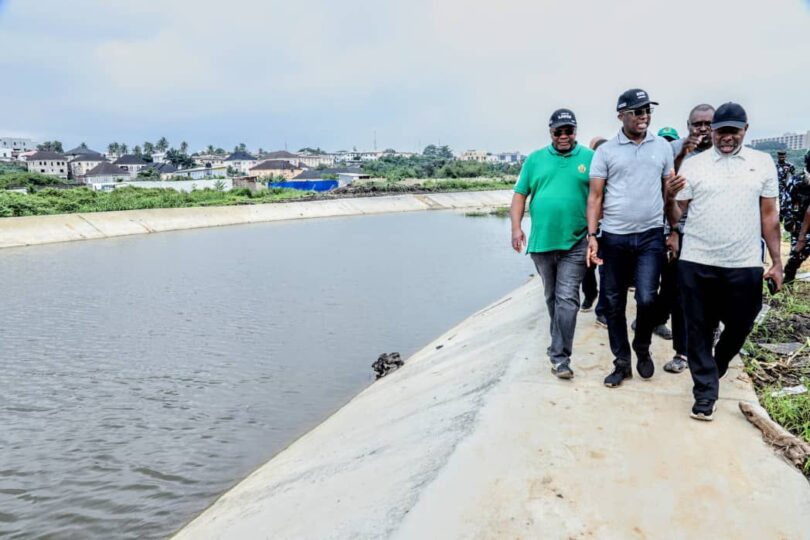
And it is the result of a flood control regime that cleared 76 kilometres of primary channels and 178 kilometres of secondary channels. Emergency Flood Abatement Gangs responded to 210 kilometres of black spots. That is not sexy work. But it is the work that keeps homes dry and businesses open.
Even the green agenda has seen unprecedented action. Sixteen thousand nine hundred and sixty‑six trees planted. Parks rehabilitated.
The Akilo Mini Waterworks commissioned. And critically, the Adiyan Phase II Water Treatment Plant is progressing. Water scarcity is the next great African crisis. Lagos is not waiting for it to arrive. It is building resilience today.
Now, let us address the elephant in the lagoon. No administration is perfect. There are still flooded roads. There are still traders who return to the streets as soon as enforcement vans leave. There are still residents who dump refuse in drains at night.
Environmental behaviour change is a generational project. But what separates the Sanwo‑Olu administration from its predecessors is the refusal to use imperfection as an excuse for inaction. They have arrested thousands. They have built biodigesters. They have banned plastics. They have cleared channels. They have planted trees. They have installed sensors. And they have done it all while maintaining the infamous Lagos energy that never sleeps.
The evidence is undeniable.
Lagos is transitioning from a city that tolerated filth to a city that enforces cleanliness. From a city that reacted to floods to a city that prevents them.
From a city that exported its waste problems to a city that converts waste into watts and gas and fertiliser.
This is the journey to a #CleanerLagos and a #GreaterLagos, and it is happening right now, under the leadership of Governor Babajide Sanwo‑Olu and the relentless execution of Commissioner Tokunbo Wahab.
Seven years in, the trajectory is clear. Lagos is not waiting for permission to become Africa’s cleanest mega city. It is doing the work. Quietly. Relentlessly. And with receipts.