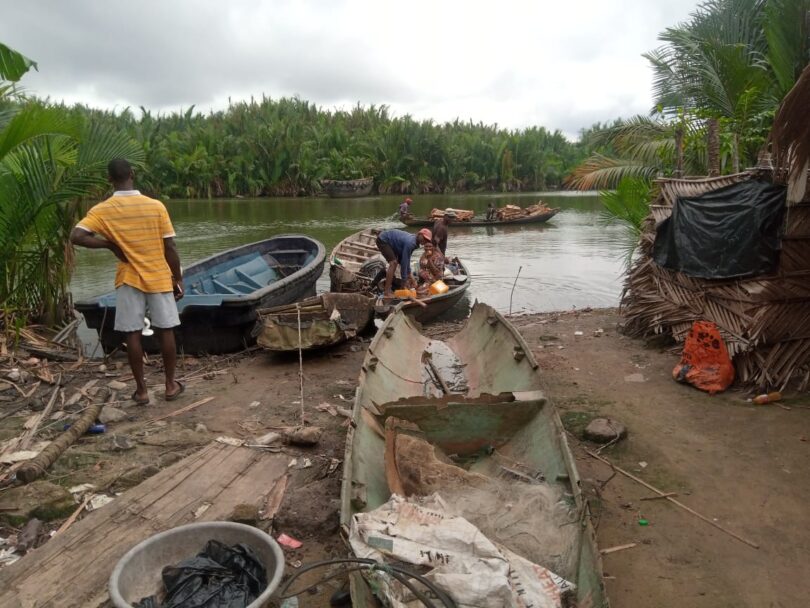
According to Eyo Ambrose, a professor in the Department of Fisheries at the University of Uyo, climate change is worsening the challenges facing Nigeria’s fisheries, while the inability of local fishermen to operate in the high seas allows foreign vessels to exploit the country’s fish resources unchecked.
Clouds hung heavily over the Atlantic coastline, a familiar sight at the peak of the rainy season in Nigeria’s Niger Delta. On this day in June, rain had been falling since morning, leaving the sandy pathways of Ikot Inua Eyet, a fishing community in Ibeno Local Government Area of Akwa Ibom State, slick with mud.
Moments later, as the drizzle became heavier, Mr Inyang looked toward the river that had sustained his family for decades.
He should have been on the water. Instead, like some fishermen across Nigeria’s southern coastline, he was stranded on land.
“There is a lot that has changed,” he began quietly.
“Our catch is no longer like before. If you don’t have a big boat with a powerful engine to go far into the sea, you won’t catch anything,” Mr Christian said.
For decades, the shallow creeks surrounding his community supplied enough fish to feed families and support local markets. Fishermen paddled wooden canoes into nearby waters and returned with nets overflowing with croaker, catfish and bonga.
Today, those waters have become increasingly empty. The fish, fishermen say, have moved farther offshore.
For Mr Inyang, many say it is “climate change”, but he understands well the changes affecting his source of livelihood.
“Some people came here and explained that it is climate change,” he said.
“I don’t know much about it, but what I know is that the fish have gone deeper into the ocean,” he added.
The situation has affected the livelihoods of many fishermen in the area, with some turning to other sources of income, especially when they cannot afford engines powerful enough to take them out to the open sea for a good catch.
Fishing has shaped life in coastal communities across Akwa Ibom, Bayelsa, Delta, Rivers and Cross River states for generations. Long before oil installations took the coastline, fishing was the primary source of income for thousands of households. Children inherited the trade from their parents, learning to paddle canoes before they could even ride bicycles.
Nigeria’s over 200 million people rely on the country’s fishing industry for much of their protein, making the sector a critical part of the economy.
Yet the sector is under growing pressure, arising from many challenges, including climate change.
According to the Intergovernmental Panel on Climate Change (IPCC), rising ocean temperatures, changing rainfall patterns, ocean acidification and sea-level rise are altering marine ecosystems worldwide. Many fish species are moving into deeper or cooler waters as sea temperatures rise, making them harder for small-scale artisanal fishers to access.
The Food and Agriculture Organisation (FAO) has similarly warned that climate change is affecting fish distribution, breeding patterns and the productivity of coastal fisheries, particularly in developing countries where communities depend heavily on traditional fishing methods.
Nigeria ranks among the countries most vulnerable to climate change, with rising temperatures, erratic rainfall, coastal erosion, and flooding threatening livelihoods across the country — from the Niger Delta’s shrinking fish stocks to the Sahel’s advancing desertification. Millions, especially in farming and fishing communities, face growing food insecurity as a result.
On paper, the government has taken steps to respond. Nigeria submitted its third Nationally Determined Contribution (NDC 3.0) in September 2025, pledging a 32 per cent reduction in emissions by 2035 compared to 2018 levels and aiming to raise the share of renewable energy in electricity generation from 22 per cent to 52 per cent. The plan also targets net-zero emissions by 2060, backed by Nigeria’s 2023 Climate Change Act and Long-Term Low-Emissions Development Strategy.
However, implementation failures continue to undermine climate policies. Financing remains a major hurdle: Nigeria estimates it will need $337 billion between 2026 and 2035 to fully deliver on NDC 3.0, a sum far beyond current domestic and international commitments.
For fishing communities like those in Akwa Ibom and across the Niger Delta, this gap between policy ambition and action means the crisis remains largely unaddressed on the ground, leaving residents to adapt on their own, often without support.
In Nigeria’s Niger Delta, where artisanal fishers operate small wooden boats powered by paddles or low-horsepower engines, travelling farther offshore often requires equipment they cannot afford.
“If you don’t have a big boat with a powerful engine to go far into the sea, you won’t catch anything,” Christian said.
For fishermen like Mr Inyang, the changing climate is no longer an abstract scientific concept. It is measured by longer hours at sea, higher fuel costs, smaller catches, and the growing uncertainty of whether each fishing trip will provide enough to feed their families.
“Before, a fishing trip (one week) could bring me fish worth between N700,000 and N800,000. Now, we make about N150,000 or even less. When you remove the cost of fuel, paying workers and feeding the crew, what is left is very small.”
According to WorldFish data, Nigeria produces around 1.2 million metric tonnes of fish annually, 90 per cent of which is consumed domestically. In 2025, the sector produced approximately 1.4 metric tonnes. Although that indicated growth, the federal government said production level remains below Nigeria’s annual consumption estimate of 3.6 million metric tonnes.
In February, the federal government raised the alarm over post-harvest losses of up to 30 per cent in Nigeria’s fish sector,
“Despite fish being one of the cheapest and most accessible sources of animal protein for Nigerian families, post-harvest losses of up to 30 per cent continue to undermine supply and affordability,” the Minister of Marine and Blue Economy, Adegboyega Oyetola, said.
Meanwhile, decades of inadequate government investment and regulation have affected the industry. Small-scale fishers, who form the backbone of the industry, struggle with outdated equipment, inadequate storage facilities, and limited access to credit and training in sustainable fishing practices.
According to Eyo Ambrose, a professor in the Department of Fisheries at the University of Uyo, climate change is worsening the challenges facing Nigeria’s fisheries, while the inability of local fishermen to operate in the high seas allows foreign vessels to exploit the country’s fish resources unchecked.