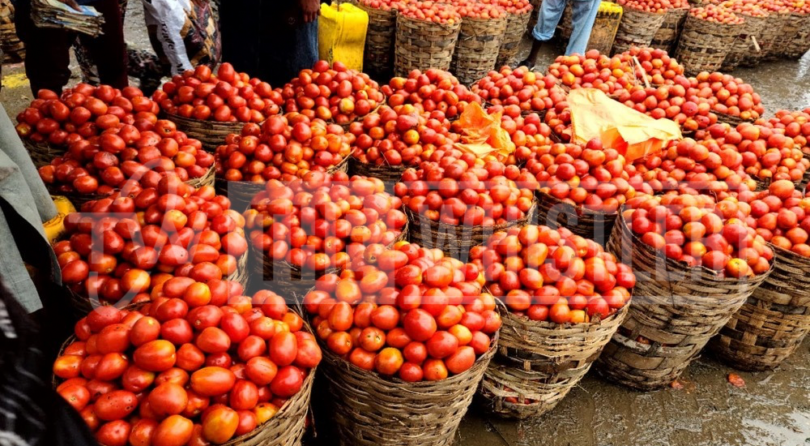
Tomato prices currently weighing on Nigerian households may begin to ease from August as the wet-season harvest brings fresh supplies to market, the Tomatoes Growers and Processors Association of Nigeria (TOPAN) has said.
The Kaduna State Chairman of TOPAN, Rabiu Zuntu, gave the assurance on Sunday, blaming the prevailing spike on the seasonal gap between the close of dry-season production and the commencement of rainy-season cultivation. He said fresh tomatoes from farms are expected to enter markets from late July, triggering a significant price decline from August.
“We projected that the increase in tomato prices would last until the end of July when wet-season harvesting begins. From August, prices will begin to decline considerably because fresh supplies will enter the market,” Zuntu said.
The price surge, which began in early May, has seen a 50kg basket rise from between N18,000 and N20,000 in January to between N100,000 and N130,000, depending on variety. A 25kg crate now sells for between N50,000 and N70,000 in wholesale markets in Lagos.
The development comes against the backdrop of a deepening structural crisis in Nigeria’s tomato sector. NewsNGR recently reported that Kano State — one of the country’s foremost tomato-producing zones — has been unable to translate its production advantage into processing or export revenue, spending over $400m annually importing tomato paste that its own farms could supply. A 2025 outbreak of Tuta absoluta, a leaf-mining moth, put 4,621 hectares of Kano tomato farms at risk, compounding losses already running into billions of naira.
Zuntu said the adoption of flood-resistant tomato varieties had enabled many farmers to sustain cultivation into the rainy season, bringing expected harvest dates forward. Without the improved varieties, he said, consumers might have waited until October or November for prices to ease.
He attributed the recurring May-to-June shortage to climate change, citing unpredictable rainfall and extreme heat that had disrupted production in major tomato-growing states including Kaduna and Kano.
Calling for wider access to heat-tolerant seeds, Zuntu urged the government and private investors to establish more cold-chain storage facilities to reduce post-harvest losses — a structural gap
NewsNGR’s investigation identified as central to the sector’s instability. He said improved storage would allow farmers to preserve surplus produce for several weeks, bridging supply gaps between seasons and dampening the sharp price swings that have made tomatoes a recurring flashpoint of food inflation.
He appealed for sustained government support through the provision of seeds, fertilisers and agrochemicals, warning that without long-term investment in the tomato value chain, farmers would continue to oscillate between bumper-season losses and lean-season scarcity, while consumers bore the consequences at the market.
Zuntu acknowledged that current high prices had helped some farmers recover losses from previous seasons but said the gains were unsustainable without deliberate policy action.