The resolution is part of the #CorrectTheMap campaign led by Togo and backed by all 55 African Union member states.
The United Nations General Assembly has voted to adopt a new world map that more accurately depicts Africa’s size.
Togo introduced the resolution to the assembly about a year after the African Union endorsed it. The resolution is part of the #CorrectTheMap campaign backed by all 55 African Union member states.
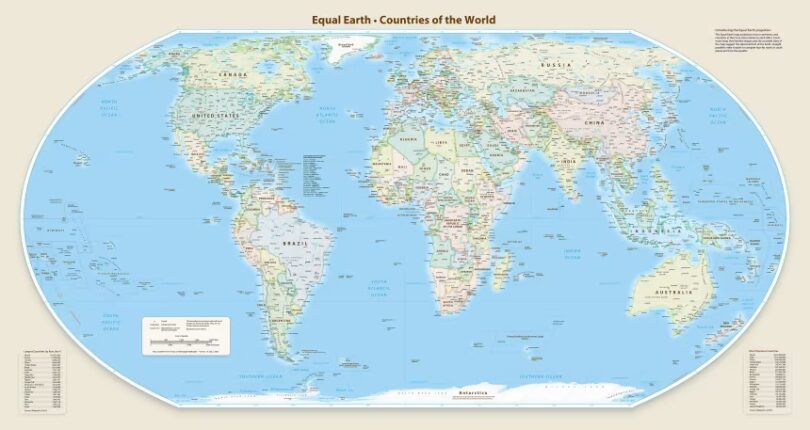
The resolution seeks to replace the traditional Mercator map, which distorts the region, with the Equal Earth projection, which is believed to show countries’ true sizes.
It calls for an “equitable” representation of the globe’s regions, particularly Africa. It also argues that the way the world map is drawn makes the continent seem smaller and less important in people’s minds.
The Equal Earth projection, developed in 2018, is considered to show countries and continents in proportions equal to their actual surface areas.
The Guardian reports that it presents Africa much closer to its true scale. Meanwhile, the Mercator map, created in 1659, shows Greenland as roughly comparable in size to Africa, even though Africa is about 14 times larger.
Historians and geographers have long said the Mercator projection is rooted in Western stereotypes.
Activists have echoed and made similar arguments, with some coining the term “cartographic colonialism”.
At the UN General Assembly, the resolution passed with overwhelming support. 164 member states voted in favour. This includes Nigeria, Togo, Ghana, Morocco, and 50 other African member states.
Germany, France, Turkey and the United Kingdom also voted in support of the resolution. However,
Hungary, Israel, Japan, Pakistan, South Korea, and Venezuela abstained.
The US voted against the resolution, with its representative describing it as “superfluous.”
UN resolutions are non-enforceable, so countries and institutions will not be mandated to use only the new projection or forbidden from using the old one.
However, the outcome could lead to updates to classroom curricula and everyday technology, given the wide use of the Mercator projection in education, technology and governance.
Togo’s foreign affairs minister, Robert Dussey, said the resolution recognises the disproportionate cartographic representations of the Mercator projection.
“The discussion is not a political discussion [but] a scientific discussion, because there is scientific proof, so we all have to accept the reality,” he said.
“The projection has had lasting cognitive, educational, cultural, geopolitical and socioeconomic effects, contributing to a drastic reduction in the perceived size of Africa and other regions of the world in the global collective imagination.”
France also spoke in support of the resolution before it was adopted.
The foreign minister, Jean-Noël Barrot, earlier on Friday, said, “We will abandon the Mercator projection in favour of map representations tailored to specific uses, more faithful to actual surface areas and in line with the recommendations of cartographers and scientists.”
The development also comes months after the UN General Assembly voted to recognise the transatlantic slave trade as the gravest crime against humanity.
PREMIUM TIMES reports that Ghana had introduced the resolution to the assembly. It asked that the UN members consider apologising for the slave trade, and for the designation of a reparations fund.
The Foreign Minister, Samuel Ablakwa, said the reparations funds will be used to repair the damage caused by slavery.
“We are demanding compensation – and let us be clear, African leaders are not asking for money for themselves. We want justice for the victims and causes to be supported, educational and endowment funds, skills training funds,” he said.
The resolution received overwhelming support at the General Assembly. 123 member States voted in favour of the resolution. But the US, Argentina, and Israel voted against it. 52 countries, including Britain, Portugal, and Spain, abstained.
On Monday, the UN Committee on the Elimination of Racial Discrimination (CERD) declared that countries were legally obliged to consider reparations for the harms caused by the transatlantic slave trade.
The committee argued that states remain obligated to address the continuing effects of the slave trade under the current international system, irrespective of whether slavery and the slave trade were illegal under the laws at the time.
“Irrespective of the legal characterisation of the original historical acts, States Parties remain bound by their present obligations under the Convention to address structural inequalities,” the UN Committee said.