Politics
“Do Not Revive Failed Nigeria Air Contracts” — Senate Backs Fresh National Carrier, Seeks Direct Flights To China

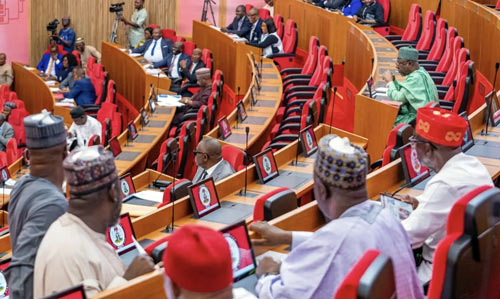
The Senate has rejected proposals to revive contracts connected with the failed Nigeria Air project initiated under former Aviation Minister Hadi Sirika, but declared that the country still needs a national carrier capable of flying the Nigerian flag on international routes.
The upper chamber also called for a review of the Bilateral Air Services Agreement between Nigeria and China to enable Nigerian airlines to operate direct flights to the Asian country.
Senate President Godswill Akpabio announced the resolutions on Tuesday after lawmakers debated a motion sponsored by Senate Chief Whip Tahir Monguno, representing Borno North, on the implementation of the Nigeria-China Bilateral Air Services Agreement.
While senators agreed on the need for a national carrier, the chamber rejected suggestions that the contracts associated with the defunct Nigeria Air project should be revived, describing further consideration of the failed arrangement as unproductive.
The Senate instead urged the Ministry of Aviation and Aerospace Development to explore the establishment of a national carrier through a fresh and workable framework.
Nigeria Air was unveiled shortly before the end of the Muhammadu Buhari administration in May 2023 but subsequently became embroiled in controversy over allegations surrounding its ownership, procurement process and the aircraft presented during its launch.
The Economic and Financial Crimes Commission is currently prosecuting Sirika alongside his daughter, Fatima Sirika, her husband, Jalal Hamma, and their company, Al Buraq Global Investment, over alleged contract fraud and gratification.
The defendants have been accused of offences relating to contracts connected with the aviation sector, while the allegations remain subject to determination by the court.
During debate on the motion, Monguno argued that the existing air services agreement with China should provide for reciprocal direct flights between both countries.
He said direct services by Nigerian airlines to China would help transform the Murtala Muhammed International Airport in Lagos and the Nnamdi Azikiwe International Airport in Abuja into major gateways linking West and Central Africa with East Asia.
According to him, direct flights would reduce travel time, improve supply-chain efficiency, retain more foreign exchange within Nigeria and increase aeronautical revenue accruing to Nigerian airports.
He added that stronger air links with China could support small and medium-sized enterprises, expand non-oil exports and facilitate the movement of perishable goods.
Monguno urged the Ministry of Aviation and Aerospace Development and the Nigerian Civil Aviation Authority to ensure greater reciprocity in flight rights under the agreement.
He also proposed measures including bilateral code-sharing arrangements, temporary airport fee waivers and a direct naira settlement window under the existing currency swap arrangement between Nigeria and China to reduce dependence on the United States dollar.
The senator further called on the Ministry of Foreign Affairs to engage Chinese authorities on business visa facilitation for Nigerian traders and reciprocal airport slot allocations for Nigerian airlines.
Most senators who contributed to the debate supported the motion.
Senator Abdul Ningi, representing Bauchi Central, questioned the imbalance in economic relations between Nigeria and China and expressed concern that Nigerian travellers still had to connect through third countries to reach China.
Senator Ned Nwoko of Delta North argued that the Federal Government should consider restoring a national airline rather than relying entirely on private carriers to provide direct international services.
Senator Khabeeb Mustapha of Jigawa South-West also supported the establishment of a national carrier, referring to the collapse of the former Nigerian Airways.
Akpabio criticised the current situation in which Chinese airlines can operate direct services to Nigeria while Nigerian airlines lack equivalent access to China.
“We are talking about the BASA agreement between Nigeria and China. If it is only Chinese planes that can fly directly to Nigeria and Nigerian planes cannot fly directly to China, Nigerian businessmen going to China have to go through Kenyan Air, Ethiopian Air, all sorts of airlines, but Chinese businessmen fly directly to Nigeria,” he said.
He argued that the agreement should be reviewed to enable Nigerian airlines to operate direct services to China.
The Senate subsequently adopted the motion through a voice vote and mandated its Committees on Aviation and Foreign Affairs to ensure compliance with the resolution and report back within four weeks.
Akpabio also stressed the need for Nigeria to once again have a national carrier.
“We used to have a plane in those days carrying people to Saudi Arabia and all that. At the time, Nigerian Airways had about 32 planes on ground, about 40, going from one place to the other. So, how did we get here?” he asked.
He maintained that existing private airlines were insufficient to meet Nigeria’s growing air travel demand and urged the Federal Government to examine practical options for establishing a viable national carrier.
The Senate’s position is therefore to abandon efforts to revive the controversial Nigeria Air contracts while pursuing a fresh national carrier framework and greater reciprocity in international air agreements, particularly the Nigeria-China route.
.. “Do Not Revive Failed Nigeria Air Contracts” — Senate Backs Fresh National Carrier, Seeks Direct Flights To China … NewsNGR.


Emulate Americans – ADC Urges Nigerians To Reject APC In 2027

North-central: Gunmen killed four, injure five in market attack

2027: APC campaign council restricts ministers, members to rallies in home states

Reserved seats will address years of women’s marginalisation – APC chieftain

Mixta Africa Expands Lakowe Lakes Golf & Country Estate, Introduces Polo As A Lifestyle Component

History in US as Americans elect first Muslim, native American senators, other firsts too

Atiku Camp Sends Message To IGP Over Sealing Of ADC Campaign Office

MTN Nigeria appoints ex-Etisalat boss, four other new directors

INVESTIGATION: How Anthony Kila falsified all his academic qualifications – from Bachelor’s to Doctorate

Customer Service Week: Inside How Jumia Is Using Technology To Go The Extra Mile For Shoppers

Google opens AI-content detector to enable verification

Kayefi headlines Tales & Tunes as ID Cabasa leads music direction in Sheffield

How Houthi military aggression in Red Sea threatens Africa

UK migrant workers wear chains, sing Asa’s ‘Jailer’ to protest proposed visa reforms

Ogaga Ifowodo wins $100,000 Nigeria Prize for Literature

How Lagos Families Are Allegedly Buying Contaminated Meat In Dirty Conditions At Mushin, Oshodi, Mile 12, Surulere Markets
-

 Business5 days ago
“User Funds Are Completely Safe” — Binance Investigates Suspected $6.3 Billion Hack, Suspends Deposits And Withdrawals
-
Special Reports6 days ago
Jumia Nigeria Unveils ‘No Manage Am’ Black Friday 2026 Campaign With Up To 60% Off
-
Special Reports7 days ago
FIFA U-17 Women’s World Cup: Nigeria’s Flamingos, Ghana, Morocco, Kenya lead Africa’s Quarter-Final charge
-
 Special Reports7 days ago
“Section 65(b) Poses A Threat To Democracy” — Court Reserves Judgment In Suit Challenging INEC’s Power To Review Election Results
-
Politics6 days ago
ADC Postpones Presidential Campaign Flagoff, Fixes New Date
-
Top Stories6 days ago
“We Will Meet On The Final List Of Candidates Today” — INEC To Decide Fate Of Pantami, Adebutu, Other Omitted Governorship Candidates
-
Special Reports7 days ago
Court dismisses Nollywood actor’s N10bn damages suit against Wike’s aide, INEC
-
News7 days ago
Nigerians fault INEC for using AI images in Voter Register