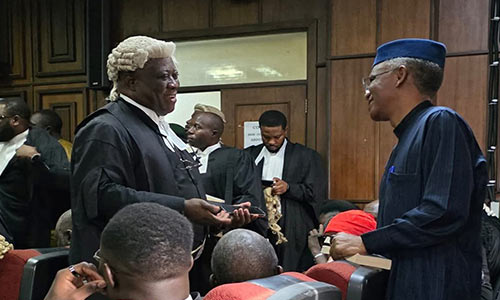
A former Kaduna State Governor, Nasir El-Rufai, has filed a fresh N10bn fundamental rights suit against the Independent Corrupt Practices and Other Related Offences Commission over alleged denial of access to his wife and son while in custody.
In the suit, marked FHC/ABJ/CS/1852/2026 and filed at the Federal High Court in Abuja on August 13, El-Rufai alleged that the ICPC prevented his wife, Aichatou Asabe, and son, Abba El-Rufai, from visiting him.
The former governor, through his lawyer, Ubong Akpan, also joined the ICPC Chairman and the Attorney-General of the Federation as the second and third defendants, respectively.
El-Rufai is seeking nine reliefs, including declarations that his fundamental rights guaranteed under Part IV of the 1999 Constitution remain enforceable despite his detention.
He alleged that the repeated refusal to allow his family members access to him, particularly to provide food, medication and other necessities, without lawful justification or a court order, violated his rights under Sections 34 and 37 of the Constitution and Articles 5 and 18 of the African Charter on Human and Peoples’ Rights.
He also alleged that ICPC officers physically restrained and intimidated his wife and son on July 7, describing the incident as an arbitrary interference with his spousal and filial relationships.
El-Rufai asked the court to declare that “the respondents’ continued denial of family access without lawful authority is unconstitutional, illegal, null and void.”
He further sought an order directing the respondents to grant him “unhindered and reasonable access to members of his family and counsel throughout the period of his detention as earlier directed by the Federal High Court.”
According to the former governor, the alleged denial of access had prevented his wife and son from giving him food, medication and other necessities while in custody.
“This action has subjected the applicant to humiliation, emotional trauma, anxiety and psychological distress,” he alleged.
He further alleged that the respondents “acted arbitrarily, unlawfully and in a manner inconsistent with Sections 34, 37 and 46 of the Constitution and the African Charter on Human and Peoples’ Rights.”
“The respondents’ conduct amounts to an unjustifiable interference with the applicant’s dignity and family life and is therefore unconstitutional,” he added.
In an affidavit filed in support of the suit, El-Rufai’s Principal Secretary, Mohammed Shaba, said the former governor was being detained at the ICPC office in Abuja.
Shaba said the information contained in the affidavit was supplied to him by Asabe on July 12.
According to him, Asabe had been personally responsible for providing her husband with “food, clothing, medication, and other personal necessities required for his comfort, health, and well-being while in custody.”
He said El-Rufai is the first defendant in charge number FHC/KD/73C/2025, pending before the Federal High Court, Kaduna Judicial Division, in which the Federal Republic of Nigeria is the complainant.
Shaba recalled that Justice R.M. Aikawa of the Kaduna Division had, on April 1, ordered the ICPC to allow the defendants access to their counsel and personal physicians whenever they needed to see them.
“Clearly, this order reflects the settled principle of law that detainees are not to be held incommunicado and that the ICPC is subject to judicial oversight regarding the conditions of detention,” he stated.
The affidavit further argued that El-Rufai retained his fundamental rights under the Constitution and the Administration of Criminal Justice Act, including the right to humane treatment and reasonable access to family members.
Shaba said that before July 7, Asabe had regularly visited her husband and delivered meals and other items to him without obstruction.
The fresh suit is the latest in a series of legal actions instituted by the former governor against the ICPC since the commission began investigating him.
In February, El-Rufai filed a separate N1bn fundamental rights suit against the ICPC over the alleged unlawful search of his Abuja residence.
The suit, marked FHC/ABJ/CS/345/2026, challenged the validity of a search warrant issued by a Chief Magistrate of the FCT Magistrates’ Court, which the former governor alleged was used to raid his residence.
He sought declarations that the search violated his fundamental rights to dignity, personal liberty, fair hearing and privacy, as guaranteed by Sections 34, 35, 36 and 37 of the Constitution.
The N1bn suit was later amended, with El-Rufai dropping the magistrate who issued the warrant as a defendant.