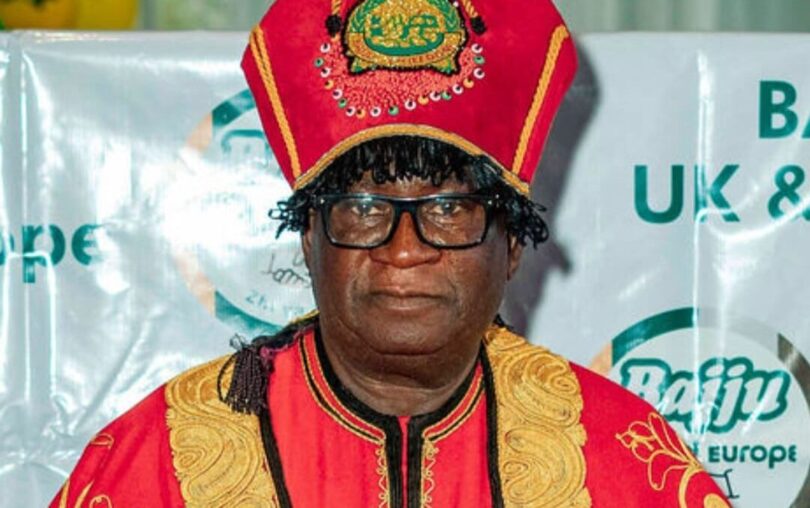
During his recent visit to the United Kingdom, where he met members of the Bajju community and witnessed the launch of the Bajju UK and Europe Association, the monarch spoke exclusively to PREMIUM TIMES.
Since he emerged as the second paramount ruler of the Bajju Chiefdom in 2022, His Highness Luka Kogi Yabwat (Agwam Bajju II) has focused on strengthening the traditional institution, completing a permanent palace project, improving security and deepening the relationship between the chiefdom and its growing diaspora community.
In this interview, the royal father discusses his priorities, the legacy of his predecessor, the proposed educational trust by the diaspora, security challenges, agriculture, investment, youth development, tourism and his vision for the Bajju people over the next decade.
Agwam Bajju II: Thank you for this opportunity. When I came in, my priority was securing permanent residence for the king.
When I came in, I had a lot of problems with accommodation. The late king was not able to secure a permanent palace because he was living in his own house, so he didn’t put much effort into it.
One good thing he did was secure the land and start something. The foundation was laid.
So, building on that foundation, I continued with the committee that the late king appointed for the palace project. I called them and set a time limit for them to secure a temporary residence for me while we worked on the permanent palace.
The timeline I gave them was not enough, so we had to extend it. Meanwhile, they had to find a temporary residence for me, which is where I am now.
From there, I continued working with the committee. It started in a simple form, but to the glory of God, both our sons and daughters are contributing to its completion.
As I am talking to you now, the building is at one stage. We are trusting God that in the next one or two years, we will have a permanent residence, which is my heart’s desire.
Agwam Bajju II: We have never received any support from the state government. We have never received any support from the state government.
Even though we wrote to them about the project, we have not received any support to date. And I think it is not only the Bajju project. It is like that with most chiefdoms in the southern part of the state.
PT: Your predecessor played a significant role in establishing the identity and traditional institution of the Bajju Chiefdom. What lessons have you taken from his leadership, and what aspects of his legacy are you determined to preserve?
Agwam Bajju II: The late chief, whom I owe a lot of respect, actually worked hard to preserve the Bajju identity. He did a lot of things. He set the structure of the chiefdom.
So, by setting the structure of the chiefdom, I have not done anything different from what he had done because he had already set up everything that was needed. We are just trying to add one or two things.
He did a lot.
Agwam Bajju II: To be sincere, that is why, when they invited me to come down, I was so happy that I was coming to meet my people, my subjects in Britain and Europe.
They have been very strong supporters of the chiefdom down there. They have contributed immensely to the position we are now in regarding the progress of the palace project.
We can say we are depending on them seriously. We are looking up to them.
The chairman is here. We are looking up to them. We are not just looking up to them; we are depending on them to lead.
My invitation to Europe, I think they have already taken the lead, and I am sure all the Bajju sons in the diaspora will follow suit.
Agwam Bajju II: It will have a lot of impact. You see, any society that is not literate — I know that literacy could mean so many things — but any society that is not developed educationally is a backward society.
Their thought of establishing a fund for educational development is a welcome one. It will enable my people to rise. It will enable my people to meet the challenges of life.
So, I know that what they have done, the launch last week, was another welcome development that will impact my people, the Bajju and the Kajju, entirely.
Agwam Bajju II: The traditional institution plays a great role if only it is given the opportunity.
Traditionally, most of the things that promote the economy come from rural areas, and that is where traditional institutions are based.
So we encourage our people to engage in a lot of agricultural activities. It is farming and other activities that keep the economy going.
If only the government could support by providing fertiliser, herbicides and the rest, there would be a great change economically.
Secondly, at the grassroots, we are the ones being attacked. Insecurity is high at the grassroots.
If the government can come to the aid of the traditional institution, it will help us. If everyone can go to the farm freely, without fear of being attacked, it will boost the economy.