Special Reports
REVIEW: Davido finds gospel footing with Kirk Franklin on ‘Hope In You’

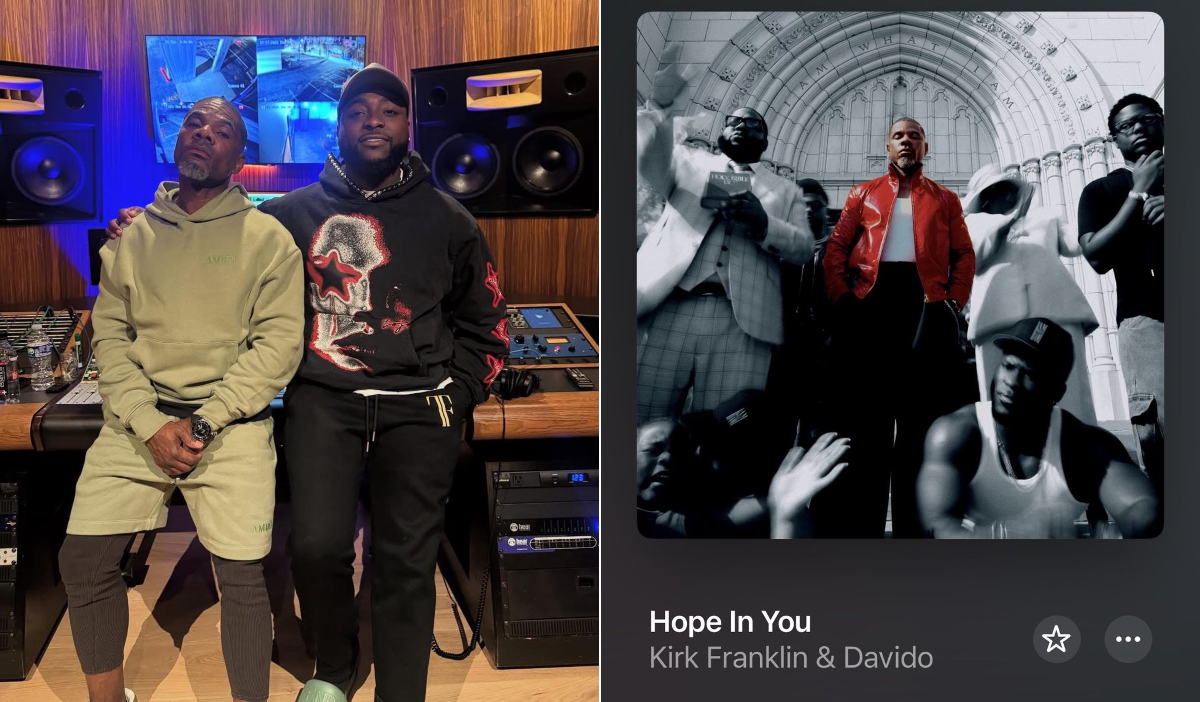
The cross-genre collaboration explores faith, doubt and vulnerability through contemporary gospel and Nigerian influences.
Something is intriguing about hearing Davido, an artiste whose catalogue is largely associated with Afrobeats, romance and mainstream pop, share a gospel record with Kirk Franklin, one of contemporary gospel music’s most recognisable figures.
Released on 30 October as the third track on Franklin’s double album, I Am What I Am, the 3-minute, 27-second record explores doubt, personal struggles, spiritual vulnerability and the reassurance of finding hope in God.
Rather than relying solely on the novelty of bringing two internationally recognised artistes together, the song builds an emotional conversation around faith, with Franklin providing the gospel foundation and Davido introducing an Afrobeats-inflected perspective.
The song opens with Davido’s Yoruba introduction before transitioning into a confession about personal shortcomings and spiritual uncertainty.
Franklin leads the introspective opening, admitting to repeatedly doing wrong despite knowing what is right.
His lines, “I find myself lying to myself more and more” and “And every night, I’m back to You, with my back to You”, capture the contradictions that can accompany a person’s relationship with faith.
This approach is interesting because the song does not present spirituality as an uncomplicated experience. Instead, it acknowledges the doubts, mistakes and moments of isolation that can make holding on to faith difficult.
Perhaps its most affecting moment comes when Franklin questions whether heaven can still hear his prayers and admits that he keeps his struggles private because “no one cares what you go through”.
That line introduces an emotional dimension beyond conventional praise and thanksgiving. It speaks to the loneliness of dealing with personal challenges, particularly when people feel unable to communicate their pain.
The pre-chorus responds to this vulnerability with the plea, “See us, free us, love us, not judge us”. It reinforces the song’s central message that people can be broken and imperfect while still seeking divine compassion.
Davido’s contribution is arguably the collaboration’s most interesting element. Rather than imitate Franklin’s gospel delivery, he keeps his well-known melodic approach and conversational style, introducing Nigerian expressions that give the song a distinct cultural identity.
One particularly striking line is his prayer, “Make I no go enter one chance”.
In Nigeria, the expression refers to falling victim to criminals posing as commercial transport operators. Its inclusion might initially seem unusual on a gospel record, but it grounds the song’s message in everyday Nigerian experiences.
For Davido, faith is not limited to church services or formal moments of worship. It is also about seeking protection while navigating the uncertainties of daily life.
His verse continues with Yoruba expressions, including “Hallelujah, meje meje” and “Oluwa ti gbe mi leke”, celebrating God’s favour and elevation.
He also expresses a desire to bring good things home and ensure that his people benefit from his progress; however, while the cultural references make his verse distinctive, some expressions lean toward familiar praise-song language rather than developing the emotional complexity established in Franklin’s opening.
Nevertheless, Davido does not feel like a guest added merely for commercial appeal. His verse gives the record a recognisable Nigerian identity.
Musically, ‘Hope In You’ finds a middle ground between Franklin’s choir-driven contemporary gospel and Davido’s Afrobeats sensibilities.
The production maintains a gospel-oriented arrangement, supported by background vocals and a steady foundation. Rather than fully transforming into an Afrobeats record, it lets Davido’s delivery complement the established gospel direction.
The chorus, built around the repeated declaration, “Oh my, oh my, oh my hope is in You”, is deliberately simple and accessible. The arrangement also supports the song’s emotional progression. It moves from an individual’s confession to a collective declaration of faith.
“Your people hurting, Your people dying, can You hear us crying?” shifts the focus from personal struggles to collective suffering. The subsequent plea for open heavens and showers of blessings reinforces the record’s appeal for divine intervention.
The transition is effective, but listeners expecting a stronger Afrobeats influence may find the song more firmly rooted in contemporary gospel than in the dance-oriented sound associated with Davido.
That, however, appears consistent with the record’s intentions. Franklin does not abandon his musical foundation to accommodate his guest.
Beyond the music, ‘Hope In You’ raises an interesting question about the relationship between gospel and mainstream artistes.
Davido is not traditionally identified as a gospel musician, and his appearance will inevitably generate conversations about genre boundaries and the participation of secular artistes in Christian worship.
However, the more important consideration is whether his contribution serves the song. Here, it does. His verse introduces cultural specificity and a different vocal texture without disrupting Franklin’s central message.
Ultimately, ‘Hope In You’ succeeds as a purposeful meeting of musical cultures. Franklin provides the spiritual and emotional foundation, while Davido brings a Nigerian perspective that broadens the song’s appeal.
It is not necessarily the most adventurous musical experiment from either artiste, and Davido’s verse could have explored its themes with greater lyrical depth. Still, the collaboration avoids feeling forced.
The track extends Franklin’s longstanding willingness to take gospel music beyond conventional boundaries and, for Davido, it hints at an opportunity to explore a more explicitly faith-centred musical space.


Emulate Americans – ADC Urges Nigerians To Reject APC In 2027

North-central: Gunmen killed four, injure five in market attack

2027: APC campaign council restricts ministers, members to rallies in home states

Reserved seats will address years of women’s marginalisation – APC chieftain

Mixta Africa Expands Lakowe Lakes Golf & Country Estate, Introduces Polo As A Lifestyle Component

History in US as Americans elect first Muslim, native American senators, other firsts too

Atiku Camp Sends Message To IGP Over Sealing Of ADC Campaign Office

MTN Nigeria appoints ex-Etisalat boss, four other new directors

INVESTIGATION: How Anthony Kila falsified all his academic qualifications – from Bachelor’s to Doctorate

Customer Service Week: Inside How Jumia Is Using Technology To Go The Extra Mile For Shoppers

Google opens AI-content detector to enable verification

Kayefi headlines Tales & Tunes as ID Cabasa leads music direction in Sheffield

How Houthi military aggression in Red Sea threatens Africa

How Lagos Families Are Allegedly Buying Contaminated Meat In Dirty Conditions At Mushin, Oshodi, Mile 12, Surulere Markets

UK migrant workers wear chains, sing Asa’s ‘Jailer’ to protest proposed visa reforms

Ogaga Ifowodo wins $100,000 Nigeria Prize for Literature
-

 Business5 days ago
“User Funds Are Completely Safe” — Binance Investigates Suspected $6.3 Billion Hack, Suspends Deposits And Withdrawals
-
Special Reports6 days ago
Jumia Nigeria Unveils ‘No Manage Am’ Black Friday 2026 Campaign With Up To 60% Off
-
Special Reports7 days ago
FIFA U-17 Women’s World Cup: Nigeria’s Flamingos, Ghana, Morocco, Kenya lead Africa’s Quarter-Final charge
-
 Special Reports7 days ago
“Section 65(b) Poses A Threat To Democracy” — Court Reserves Judgment In Suit Challenging INEC’s Power To Review Election Results
-
Politics6 days ago
ADC Postpones Presidential Campaign Flagoff, Fixes New Date
-
Top Stories6 days ago
“We Will Meet On The Final List Of Candidates Today” — INEC To Decide Fate Of Pantami, Adebutu, Other Omitted Governorship Candidates
-
Special Reports7 days ago
Court dismisses Nollywood actor’s N10bn damages suit against Wike’s aide, INEC
-
News7 days ago
Nigerians fault INEC for using AI images in Voter Register