Special Reports
EFCC Witness Claims Arik Air Owed No Debt To Union Bank, Receivership Was Fraudulent

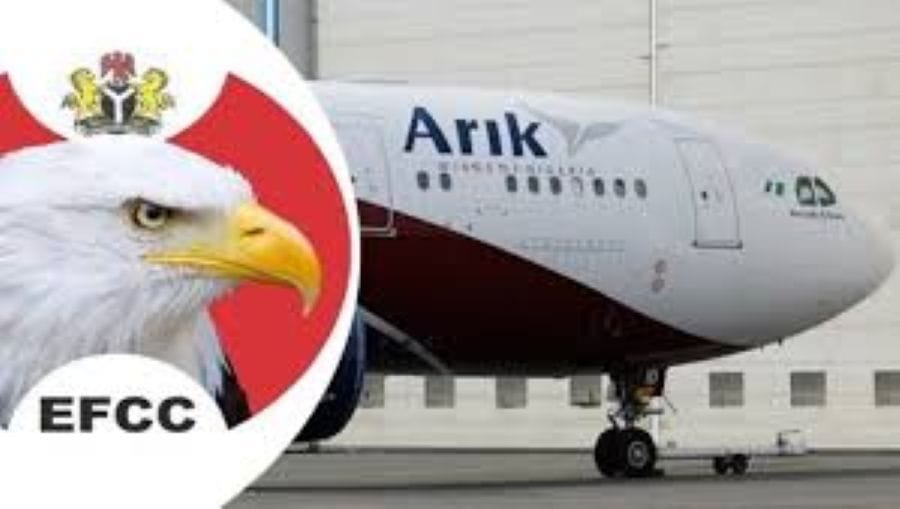
The Director of the Lagos Zonal Directorate 2 of the Economic and Financial Crimes Commission (EFCC), Bawa Usman Kaltungo, Monday described the receivership of Arik Air as fraudulent, insisting that the airline was not indebted to Union Bank of Nigeria Plc.
Kaltungo, the fourth prosecution witness in the ongoing trial of former Managing Director of the Asset Management Corporation of Nigeria (AMCON), Ahmed Kuru, and others over an alleged N76 billion ($31.5 million) fraud, told the Special Offences Court in Ikeja, Lagos, that the purported bad debt that formed the basis for the receivership did not exist.
The witness, who testified before Justice Mojisola Dada, said his investigation into a petition concerning the airline revealed that the foundation for appointing a receiver-manager over Arik Air was faulty.
However, in a significant development, the court admitted AMCON board resolutions tendered by Kuru’s counsel, Uyi Giwa-Osagie, to challenge the prosecution witness’s assertion that the former managing director had unilaterally approved the receivership.
The documents were admitted despite the prosecution’s objection to their relevance, with the court holding that they emanated from AMCON’s board as a corporate body and were duly certified in accordance with Section 104 of the Evidence Act.
During cross-examination by Giwa-Osagie, counsel to the second defendant, Kaltungo said he headed the EFCC team that investigated the petition concerning Arik Air.
He told the court that he had informed AMCON’s top management at a meeting that the airline was not indebted to Union Bank and that the appointment of a receiver-manager to take control of the company was defective.
“The foundation for the appointment of a receivership over Arik Air was fraudulent and faulty. There was no bad debt; it does not exist,” the witness said.
The testimony came amid allegations surrounding the handling of Arik Air’s loan obligations, its takeover by AMCON and transactions involving the airline’s assets.
During the cross-examination, Kaltungo maintained that Kuru, as AMCON’s managing director and chief executive officer, had extensive powers and had unilaterally sanctioned the appointment of a receiver-manager over Arik Air.
Giwa-Osagie challenged that account by tendering AMCON board resolutions intended to demonstrate that the receivership decision was taken at the corporate level rather than solely by Kuru.
The prosecution objected to the admissibility of the documents, arguing that they were too remote to the issues before the court.
However, Giwa-Osagie submitted that the documents were relevant to determining his client’s culpability in the alleged offences.
He argued that Kuru was not standing trial over the propriety of AMCON’s power to appoint a receiver-manager but over the specific allegations contained in the charge sheet.
The defence counsel maintained that the board resolutions were necessary to establish the circumstances surrounding the decision and challenge the witness’s account of Kuru’s role.
He further argued that the documents were public records that could properly be tendered from the Bar.
In her ruling, Justice Dada upheld the relevance and admissibility of the documents.
The judge held that the documents emanated from AMCON’s board as a corporate body and had been duly certified in accordance with Section 104 of the Evidence Act.
The admission of the resolutions provides the defence with documentary evidence to challenge the prosecution witness’s assertion that Kuru acted unilaterally in approving the receivership.
However, their admission does not, in itself, determine whether the receivership was lawful or resolve the allegations against the defendants.
The EFCC instituted the case following a petition by human rights lawyer, Femi Falana, SAN, on behalf of Arik Air’s promoters and shareholders over the airline’s receivership and related transactions.
The defendants are Kuru; Kamilu Alaba Omokide, a former receiver-manager of Arik Air; Captain Roy Ilegbodu, the airline’s chief executive officer; Union Bank of Nigeria Plc; and Super Bravo Limited.
They are facing a six-count charge bordering on conspiracy, stealing and abuse of office.
The prosecution’s case includes allegations concerning the handling of Arik Air’s loan obligations, the transfer of its debt exposure to AMCON and the alleged conversion of N4.9 billion belonging to the airline for the use of NG Eagle Limited.
The dispute also raises questions about the exercise of AMCON’s statutory powers and the responsibilities of a receiver-manager appointed to take control of a distressed company.
Section 553(2) of the Companies and Allied Matters Act 2020 requires a receiver-manager to act in the company’s best interests, including preserving its assets and furthering its business objectives.
Whether the circumstances surrounding Arik Air’s receivership involved any breach of statutory obligations or criminal conduct remains a matter for the court to determine.
The defendants were arraigned on January 20, 2025, and pleaded not guilty to all the charges.











IPOB Declares Total Boycott Of APC Over Kanu

Why I now focus more on singing than dancing — Paul P-Square

Unpaid 12 Months Staff Salaries: APC Urges Nigerians To Reject Atiku And All ADC Candidates

Why I married Davita Lamai- Zlatan

Domestic Refineries Got 127 Million Barrels Of Crude In Nine Months

PREMIUM TIMES journalist nominated for PSHAN health investigation award

Benue APC Crisis Deepens As Peace Talks End In Deadlock

Electricity firm explains planned six-day blackout

INVESTIGATION: How Anthony Kila falsified all his academic qualifications – from Bachelor’s to Doctorate

Google opens AI-content detector to enable verification

Customer Service Week: Inside How Jumia Is Using Technology To Go The Extra Mile For Shoppers

Kayefi headlines Tales & Tunes as ID Cabasa leads music direction in Sheffield

How Houthi military aggression in Red Sea threatens Africa

How Lagos Families Are Allegedly Buying Contaminated Meat In Dirty Conditions At Mushin, Oshodi, Mile 12, Surulere Markets

Ogaga Ifowodo wins $100,000 Nigeria Prize for Literature

UK migrant workers wear chains, sing Asa’s ‘Jailer’ to protest proposed visa reforms

 Investigations6 days ago
Emirates explores a range of new innovations for customers with accessible travel requirements at AccessAbilities Expo, Dubai 2026
- Special Reports6 days ago
Orie Uga Market Traders To Hold Mega Rally For APGA, Set To Endorse Dr. Chibueze Ofobuike For House Of Reps
- Special Reports6 days ago
Igbo Speaking Community Lagos Suspends Crowning Of Ezendigbo As New Executives Vow To Restore Past Glory
- News6 days ago
Lagos Alone Cannot Afford Fourth Mainland Bridge — Hamzat
- Politics7 days ago
Moses Can’t Return To Egypt – Tinubu Rules Out Fuel Subsidy
- Special Reports6 days ago
NIMASA DG Dayo Mobereola Squanders N6.77 Billion On Cleaning, Hospital Bills And Imprest Including N1 Billion To Maintain Its London Office In Just One Year
- Special Reports6 days ago
FRSC orders probe into Otedola bridge tanker inferno

 Special Reports6 days ago
Abandoned newborn rescued at Plateau mining site