Special Reports
PT State of the Race: Atiku’s 2027 ambition caught in ADC’s survival battle

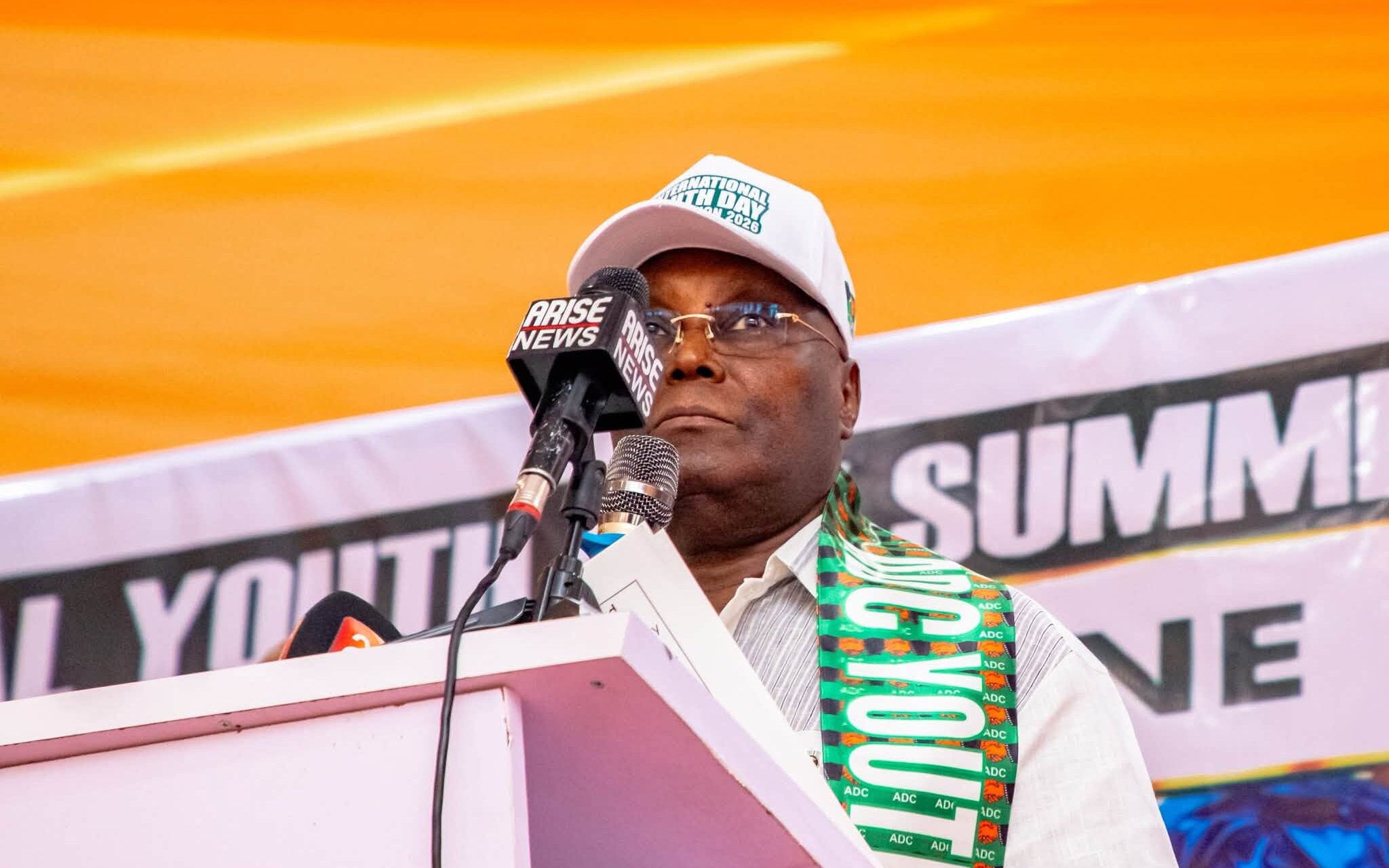
A court ruling invalidating the leadership of the African Democratic Congress and the process that produced Atiku Abubakar as its presidential candidate has exposed a major vulnerability in the opposition’s 2027 strategy: the party chosen to unite its forces is struggling to establish who has the authority to lead it.
For a politician who has spent more than two decades pursuing Nigeria’s highest political office, Atiku Abubakar’s latest presidential ambition has encountered an obstacle that goes beyond the familiar contest for votes, alliances and political influence.
The African Democratic Congress (ADC), which attracted prominent opposition politicians seeking a common platform ahead of the 2027 elections, is facing a fresh leadership crisis following a Federal High Court judgement that invalidated the emergence of its leadership under former Senate President David Mark.
With barely 68 days to the 16 January 2027 presidential election, the legal uncertainty surrounding the ADC raises questions about whether the party can resolve its internal crisis, secure the legitimacy of its candidates and organise an effective nationwide campaign before Nigerians head to the polls.
The development is particularly significant because the ADC was expected to provide the institutional foundation for a coalition of opposition politicians who believed that a united platform would offer a stronger challenge to the ruling All Progressives Congress (APC).
Instead, the party is now fighting to establish who has the authority to lead it and whether decisions taken by its disputed leadership can stand.
More significantly, the ruling also nullified the decisions taken by the disputed leadership, including the process that produced Atiku as the party’s presidential candidate.
The judgement, delivered by Peter Lifu on 5 November, followed a challenge by Nafiu Gombe, a former deputy national chairman of the ADC, who disputed the process through which Mr Mark and other opposition figures assumed control of the party.
Atiku rejected the judgement, describing it as an attempt to derail what he called a national movement. In a statement issued through his campaign, he questioned the timing of the decision, which came shortly after the launch of his campaign in Sokoto, and alleged that it was part of a strategy to weaken his political support in the North. He also vowed to challenge the ruling at the Court of Appeal.
Although the ADC has moved to challenge the decision, the development has placed its presidential candidate in an uncomfortable position. His ambition is now tied to the outcome of a legal battle over the legitimacy of the party’s leadership and the decisions taken under it.
The crisis also raises a wider question about the opposition’s preparations for 2027. Can a coalition assembled to challenge the ruling party provide the internal stability and organisational discipline required to prosecute a nationwide election campaign?
One of the most consequential aspects of the latest judgement is that it has reopened questions about the legal foundation of the Mark-led leadership, despite an earlier court decision that Atiku’s camp says had already addressed the dispute.
The former vice president has argued that the ruling delivered by Mr Lifu conflicts with an earlier judgement by Musa Liman, a judge of the Federal High Court in Abuja on 2 July.
That earlier case was instituted by Leke Abejide, a member of the House of Representatives, who also challenged the emergence of Mr Mark and Rauf Aregbesola as the party’s national chairman and secretary.
According to Atiku, Justice Liman dismissed the challenge after considering objections relating to jurisdiction, the plaintiff’s standing and the failure to exhaust internal party remedies.
This argument raises a significant legal question: If a court had already considered a challenge to the emergence of the Mark-led leadership, why was another case on the same leadership dispute entertained, and what distinguishes the two decisions?
The distinction matters because two cases concerning the same political dispute do not necessarily present identical legal questions. Equally, a judgement delivered in one case does not automatically settle every subsequent dispute involving the same political actors.
In an interview with PREMIUM TIMES, Paul Ibe, Atiku’s spokesperson, dismissed the possibility that the judgement would affect the former vice president’s participation in the election. He said the campaign was continuing its activities and had already challenged the ruling in court. “The election cannot be affected in any shape or form,” Mr Ibe said. “As you and I speak, Atiku will be on the ballot on 16 January 2027. So also all the other candidates who won elections in the ADC primary under the leadership of Senator David Mark.”
Mr Ibe said the campaign had appealed the judgement and filed an application for a stay of execution. He described the court decision as an attempt to undermine the opposition’s efforts ahead of the election and said the campaign would explore every available legal option to have it set aside.
Mr Ibe also accused the APC of using its control of political institutions to weaken the opposition. He alleged that the ruling party did not want a competitive election, pointing to its control of several state governments and its strong presence in the National Assembly. He further accused the police, the judiciary and the Independent National Electoral Commission (INEC) of failing to guarantee a level playing field.
He linked the timing of the judgement to the ADC’s recent campaign activities, including its flag-off in Sokoto, arguing that the opposition’s growing political presence had unsettled the ruling party.
“This is clearly an agenda. The APC does not want a contest,” Mr Ibe said, adding that the party was “so scared, especially with what happened in Sokoto”.
He also warned that continued political tension and the perception that the electoral process was being undermined could damage public confidence in democracy. He urged the international community to prevail on the Nigerian government to guarantee a free, fair and credible election.
An earlier reaction from Peter Obi, the presidential candidate of the Nigeria Democratic Congress (NDC), showed that the implications of the judgement extend beyond Atiku and the ADC. Mr Obi described the development as “unsettling and surprising,” arguing that the timing had created uncertainty for political parties and candidates close to the election. He also accused the APC of engineering instability within opposition parties.
However, Aviation Minister Festus Keyamo welcomed the court’s decision, arguing that the law should be determined by facts and evidence rather than political sentiments. He accused the Mark-led faction of taking over the ADC without following the party’s constitutional procedures and maintained that the party remained intact despite the court’s decision.
The ADC’s predicament is particularly significant because the party was expected to provide an alternative political home for opposition figures seeking to avoid a divided challenge to Mr Tinubu.
The coalition brought together politicians from different political backgrounds, including Atiku, Mr Mark, former Kaduna State Governor Nasir El-Rufai, former Minister of Transport Rotimi Amaechi and former Osun State Governor Rauf Aregbesola.
Their convergence around the ADC was driven by the need to establish a platform through which opposition politicians could organise against the ruling APC.
The arrangement was also intended to address one of the major challenges that confronted the opposition in the 2023 presidential election: the inability of prominent opposition candidates to rally behind a single candidate.
However, the latest dispute clearly shows that a coalition can attract influential politicians, command media attention and generate enthusiasm among supporters, but its ability to contest an election also depends on the legitimacy of its leadership, the integrity of its internal processes and the capacity of its structures to function without prolonged disputes.


Police commissioner warns officers against unlawful detention, abuse of power

Ministry of Finance Spent ₦19.7 Million on Foreign Trips Without Required Approval, Review Finds
PT State of the Race: Atiku’s 2027 ambition caught in ADC’s survival battle

Union Bank, Partners Recognise Outstanding Educators and Commission Digital Learning Centre in Abuja

Nigerian Army destroys suspected criminal hideouts in Old Oyo National Park

2027: ‘We’re prepared to secure victory for all APC candidates’ – Ukwueze

Speeding car kills tricycle rider, four passengers

Troops rescue 119 civilians, recover eight vehicles in Borno

UK migrant workers wear chains, sing Asa’s ‘Jailer’ to protest proposed visa reforms

Ogaga Ifowodo wins $100,000 Nigeria Prize for Literature

How Lagos Families Are Allegedly Buying Contaminated Meat In Dirty Conditions At Mushin, Oshodi, Mile 12, Surulere Markets

Emirates Holidays unveils Thailand Pass, unlocking exclusive perks and savings for holidaymakers

Man Loses Two Properties, N8m In N132m Money Laundering Case

NLO warns clubs, players against participation in unapproved Private Leagues

At TEDxEnugu, Gov Soludo Harps On Ndigbo Transiting From Individual Success To Building Collective Institutions

Pantami reacts after INEC omits his name from Gombe governorship candidates list

 Special Reports5 days ago
ADC warns Sokoto govt, vows to hold governor responsible for intimidation, violence against opposition

 Special Reports7 days ago
Health Review: Ebola case, child malnutrition, medicine security, other developments that shaped October
- Special Reports6 days ago
2027: PDP expels aspirants challenging Pantami’s candidacy as Gombe governorship candidate
- Investigations6 days ago
WEMA BANK SETS NOVEMBER 6 FOR HACKAHOLICS 7.0 GRAND FINALE, UNVEILS “FESTIVAL OF THE FUTURE” AS THEME
- Special Reports5 days ago
United Nigeria Airlines Boss Receives Trailblazer In Aviation Award At Daily Times Centenary Celebration
- Top Stories3 days ago
“Courts Must Guard Their Independence, Impartiality And Integrity” — NDC Warns After Atiku’s Candidacy Is Nullified
- Special Reports7 days ago
Failure to prosecute electoral offenders, threat to free, fair elections, says NHRC
- Politics5 days ago
“28 State Assemblies Have Approved The Bill” — NASS Moves To Transmit State Police Amendment To Tinubu For Assent