Special Reports
Fewer attacks, more deaths recorded in seven northern states after 2023 election – Report

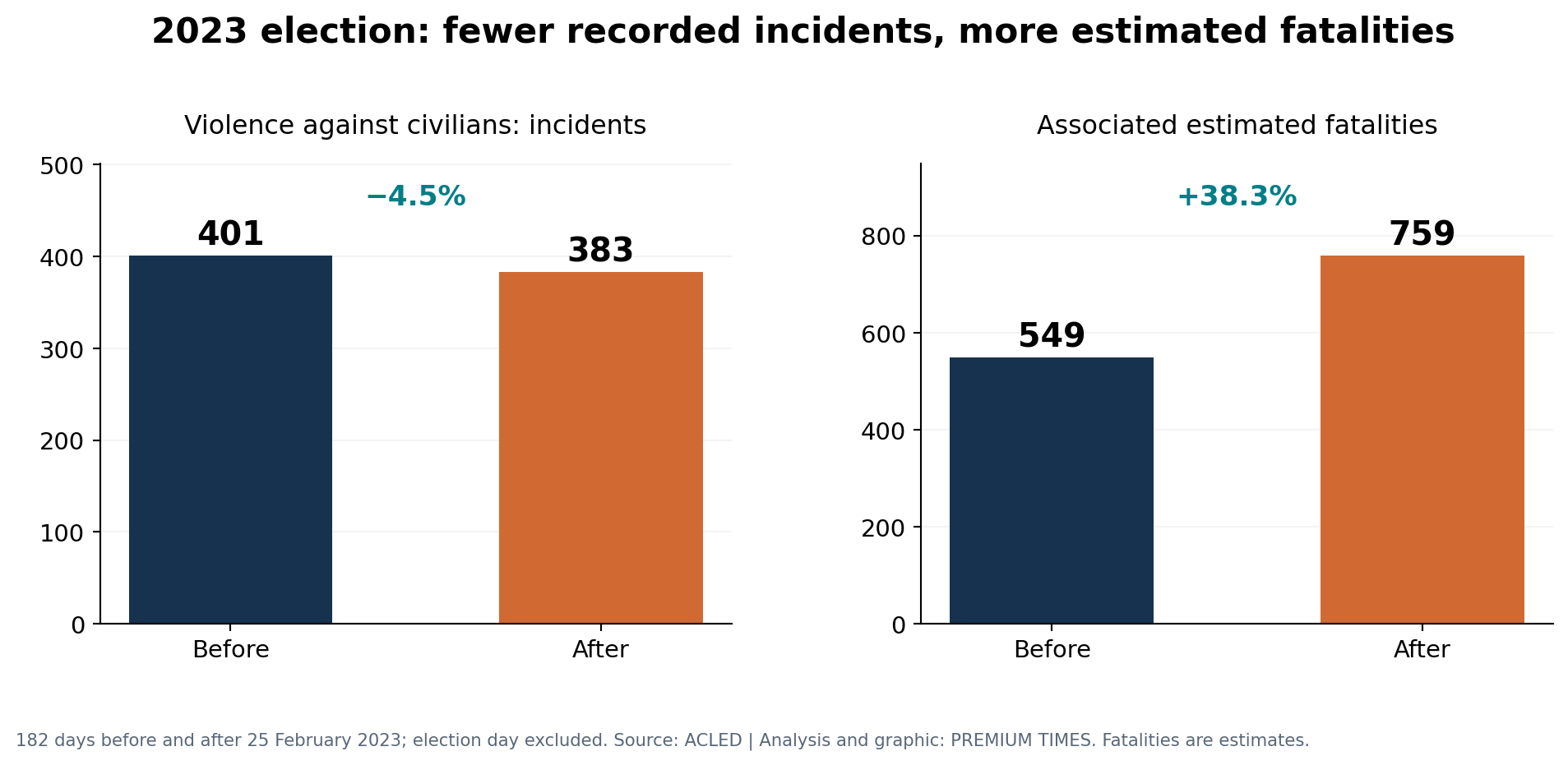
An analysis of 17,114 ACLED conflict records across seven Nigerian states found that recorded attacks on civilians declined slightly in the six months after the 2023 presidential election, while estimated fatalities increased.
Recorded attacks against civilians declined slightly across seven northern Nigerian states in the six months after the 2023 presidential election, but estimated fatalities associated with those attacks increased, an analysis of conflict records by PREMIUM TIMES has found.
Most of the net increase in estimated fatalities was concentrated in Benue, where the figure rose from 111 before the election to 315 afterwards. The state’s increase of 204 accounted for almost all the net rise of 210 across the seven states.
The analysis covered Katsina, Zamfara, Sokoto, Kebbi, Kaduna, Niger and Benue. It also examined comparable periods around the 2015 and 2019 presidential elections and changes in recorded violence outside election years.
The findings describe violence recorded during selected periods. They do not establish that the elections caused the attacks or that the incidents were connected to electoral activity.
The decline in recorded incidents after the 2023 election was not uniform. Katsina recorded 93 incidents before polling day and 74 afterwards. Zamfara declined from 100 to 86, Kaduna from 72 to 56, and Kebbi from 12 to six.
Other states moved in the opposite direction. Sokoto rose from 38 incidents before the election to 58 afterwards, while Benue increased from 45 to 61. Niger remained almost unchanged, with 41 incidents before polling day and 42 afterwards.
Estimated fatalities did not follow the same pattern as incident counts. In Zamfara, they increased from 136 to 154 despite a decline in recorded incidents. Sokoto recorded an increase from 45 to 98, while Benue’s estimated fatalities rose from 111 to 315. A decline in the number of recorded attacks does not necessarily mean fewer people were killed.
ACLED’s fatality figures are estimates derived from reported incidents. They should not be treated as independently verified death counts.
PREMIUM TIMES also examined comparable periods around the 2015 and 2019 presidential elections.
In the six months before the 23 February 2019 election, ACLED recorded 83 incidents of violence against civilians across the seven states. The number increased to 147 in the equivalent period afterwards — a rise of 77.1 per cent.
The 2015 comparison showed an increase from 29 to 40 incidents.
Although recorded incidents declined slightly after the 2023 election, their number remained substantially higher than during the corresponding periods around the earlier votes. Across the combined pre- and post-election windows, ACLED recorded 69 incidents around the 2015 election, 230 around 2019, and 784 around 2023.
These comparisons describe changes in recorded events. They do not establish that presidential elections caused the increases or declines. Changes in the availability and sources of conflict reporting over time must also be considered when interpreting differences between election years.
Katsina recorded one of the sharpest increases in the 2019 comparison.
ACLED logged 10 incidents of violence against civilians in the six months before the election and 37 afterwards. Estimated fatalities associated with those incidents rose from 16 to 161.
..-election incidents were concentrated in three local government areas: Kankara (10), Batsari (9) and Danmusa (6). Together they accounted for 25 of the state’s 37 recorded incidents. In neighbouring Zamfara, incidents increased from 21 to 31, while estimated fatalities rose from 148 to 360. Shinkafi and Kaura Namoda accounted for eight and seven of ..-election incidents respectively.
The conflict records also show substantial changes outside presidential election years.
In Katsina, ACLED recorded 37 incidents of violence against civilians between 24 February and 24 August 2019. The equivalent 182-day period in 2020 recorded 71 incidents, while the period from 24 February to 23 August 2024 recorded 98.
Zamfara recorded 31 incidents during the 2019 period and 22 in the equivalent period in 2020. The 2024 comparison recorded 130 incidents.
Annual records also show substantially higher incident counts in later years. Across the seven states, ACLED recorded 279 incidents classified as violence against civilians in 2019, compared with 750 in 2023 and 1,192 in 2024.
These figures show that changes in recorded violence were not confined to election periods. However, the number and composition of reporting sources in the dataset also changed over time. Differences in recorded incidents cannot automatically be read as equivalent changes in the underlying level of violence.
While the ACLED records show how violence changed around the elections, reports from INEC and election observers document specific ways insecurity affected voting arrangements in Niger and Katsina states during the 2023 presidential election.
The Independent National Electoral Commission (INEC) reported difficulties deploying personnel and materials to Alawa in Shiroro Local Government Area of Niger State. INEC Chairman Mahmood Yakubu attributed the delay to security concerns, according to an election-day report by PUNCH.
In Katsina, the commission reported the seizure of six Bimodal Voter Accreditation System (BVAS) devices by thugs in Safana Local Government Area. Three devices were recovered and replacements deployed, Mr Yakubu said, according to Channels Television.
Election observer Yiaga Africa reported that polling units had been relocated in parts of Shiroro, Mariga, Magama and Rafi local government areas of Niger State following attacks. Its election-day situational statement raised concerns about the effect on voters’ access to polling locations.
INEC’s Report of the 2023 General Election states that special voting arrangements covered 155,101 registered voters across 323 polling units and 42 registration areas in five local government areas of Niger State affected by banditry and flooding. The commission said voting took place at established camps for internally displaced persons under security protection.
Earlier public statements gave different figures. In March 2022, officials identified 270 affected polling units across Mariga, Shiroro, Rafi and Munya. A February 2023 briefing referred to 247 or 248 units, while the final report recorded 323.
The differences may reflect changes in displacement, coverage or administrative definitions. They cannot be compared directly without the underlying schedules.
The European Union Election Observation Mission, in its report on Nigeria’s 2023 general elections, raised wider concerns about the information available to displaced voters on registration, voter cards, polling locations and the implementation of special voting arrangements.


EXCLUSIVE: Ahmadu Bello University Teaching Hospital Director Of Administration Buhari Zailani Accused Of Cutting His Age From 1969 To 1973, Parading As A Barrister Without Call To Bar And Occupying Office Without Transfer Of Service

Nigeria’s Economic Renewal: Prof. Taiwo Oyedele’s Commitment To Reform, Investment And Inclusive Growth

Nigeria’s Child Exploitation Crisis Exposes Gap Between Policy, Practice

Army recover two AK-47 rifles after gunfight in Benue

Five Arrested Over Alleged Online Dating Kidnappings In Rivers

Toluwanisings’ burial dispute deepens as uncle calls for death probe

Peter Obi Lists Tinubu’s Failures Since Assuming Office in 2023

Fewer attacks, more deaths recorded in seven northern states after 2023 election – Report

INVESTIGATION: How Anthony Kila falsified all his academic qualifications – from Bachelor’s to Doctorate

Customer Service Week: Inside How Jumia Is Using Technology To Go The Extra Mile For Shoppers

Google opens AI-content detector to enable verification

Kayefi headlines Tales & Tunes as ID Cabasa leads music direction in Sheffield

How Houthi military aggression in Red Sea threatens Africa

How Lagos Families Are Allegedly Buying Contaminated Meat In Dirty Conditions At Mushin, Oshodi, Mile 12, Surulere Markets

Ogaga Ifowodo wins $100,000 Nigeria Prize for Literature

UK migrant workers wear chains, sing Asa’s ‘Jailer’ to protest proposed visa reforms

 Investigations7 days ago
Emirates explores a range of new innovations for customers with accessible travel requirements at AccessAbilities Expo, Dubai 2026
- News7 days ago
Lagos Alone Cannot Afford Fourth Mainland Bridge — Hamzat
- Top Stories5 days ago
“The Task Force Is On Top Of It, NCDC Is On Top Of It” — FG Assures Nigerians Of Capacity To Contain Ebola
- News7 days ago
Kano Police Arrest Suspect In Falgore Forest Kidnapping
- Investigations7 days ago
MILO and Ahmed Musa Support 2500+ Young Footballers Through Kano Sports Clinic

 Politics7 days ago
Tinubu Campaign Speaks on Reported Plot To Assassinate Atiku

 News7 days ago
FG Approves Five-Station Monorail Link To Lagos Airport
- News7 days ago
Police Nab Suspected Cultists Terrorising Ajah