News
Police Turn Checkpoints To ‘Toll Gates’ In Anambra


Allegations of extortion at police checkpoints are not new in Nigeria. For years, commercial drivers and travellers on major highways have known the routine too well, but what is surprising is the ridiculous amount now being collected by the police, and how openly it has become the main business of the checkpoint.
NEWSNGR noticed this activity on the Owerri-Onitsha Road, Anambra State, as police turned checkpoints into collection points, where a N100 is demanded from these drivers at every stop.
On Saturday, NEWSNGR reporter who travelled from Idemili Junction straight to Ihiala observed the practice during the journey.
The reporter counted four checkpoints on the route, and at every one of the four checkpoints, N100 was collected.
The journey runs through a busy commercial corridor that links Onitsha to Owerri, passing through towns like Oba, Oraifite and Okija before getting to Ihiala.
It is a route used daily by traders, students, workers and travellers moving between Anambra and Imo states, and it is one of the busiest roads in the South East.
At the checkpoints, NEWSNGR observed that vehicles were not searched and papers were not checked.
The stops appeared to be centred on the N100 payment, after which vehicles were waved on to continue their journey.
The drivers with high denomination of money do not worry at all as the police have ample change to give them. It was a transaction, pay and go.
A driver, Nonso, who plies the route regularly told NEWSNGR that drivers have resigned to the practice in order to avoid delay and trouble on the road.
“We just give them the money and move. What can we do?” he said.
Nonso said the payment has become an unwritten rule on the road. He stated that drivers know what is expected at each stop and they pay without being asked, because refusing or arguing only wastes time and could lead to further delay.
“If you start arguing or anything… is it not your time you are wasting? We just give and continue with our journey,” he said.
For drivers like Nonso, the N100 is small on its own, but it is the repetition that hurts.
“I have given them N100 at four checkpoints now. There are still others… and then the return journey, and then the next trip, and the next. By the end of the day, what looked like a small amount has eaten a big hole in our pocket. That’s the issue. People will say, ‘Is it not N100?’ But it is N100 at various stops. It is not easy for us,” the driver said.
NEWSNGR also observed that at every stop, the driver asks his conductor for N100 to offer to the police. When the conductor doesn’t have that amount but a higher denomination, the police at the checkpoint deeps hands in one of his combat pockets, to fish out change and passed on to the driver with a wave to pass on.
Passengers who spoke with NEWSNGR expressed worry that the brief checks were focused on the payment rather than on ensuring the safety of road users.
One of the passengers, Mary Iheanacho, said that with the situation, a lot of criminal elements will get away with whatever they are doing, because they know the police do not check the vehicles any longer.
“They can carry anything contraband they want to carry because they know that nobody will check the vehicle,” she said.
Iheanacho said the checkpoints have therefore lost their security purpose, because the attention of the officers is on the payment and not on what is inside the vehicles passing through.
However, another passenger, Ikechukwu Ozo, a trader who plies the route, holds a different opinion.
He said the collection of N100 by the police has made their journey easier because they do not waste time again waiting for the police to check the vehicle or to ask too many questions.
“The N100 stops the whole question, it stops the whole checking and makes the journey faster. Imagine if we are being checked in each of the points, before I get to Owerri and get my goods, we must have spent one hour extra. This is good, they should continue,” he said.
Ozo, who deals on clothes, said for regular travellers like him, the speed of the journey matters, and the payment removes the long interrogation that used to delay vehicles at checkpoints.
Other commuters however questioned the rationale of having many checkpoints on the road, lamenting that though the N100 per point seems small, the drivers eventually passed on the cost to passengers through higher fares.
“Imagine from that Idemili Junction to Ihiala, they are collecting N1,500, something that we were going for N800 to N1,000 before. Now, they will say it is because of fuel hike. But I know the constant collection from police is part of the issue,” Boniface Uzoegbuna, another commuter said.
This practice is not peculiar to only the express way, NEWSNGR had discovered. Police and Udo-ga-chi, an outfit organised by the Anambra State government, mount checkpoints in express road within communities to extort money from drivers.
The drivers who spoke with NEWSNGR explained that the securities give them numbers as they collect their money to identify that they have paid in their way back.
“I ply that Nkpor-Ugwunwasike-Abagana road.. around 9. am, they are already out and they give us numbers as they collect money from us so that when we come back, they will identify our number and allow us pass. It is really eating deep inside our pocket,” a driver said.
The Nigeria Police Force has repeatedly warned officers against extortion at checkpoints, but the practice has persisted on highways across the country.
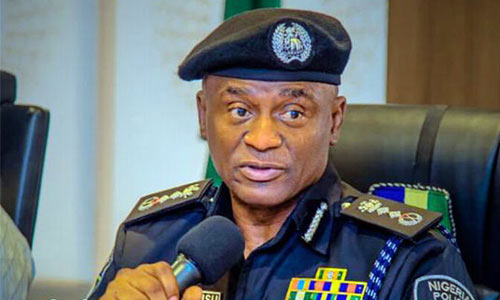
The Inspector-General of Police (IGP), Olatunji Rilwan Disu, had issued a sweeping directive few months back to Commissioners of Police nationwide, ordering an immediate end to extortion, illegal checkpoints, harassment of citizens and other acts of misconduct.
He declared that restoring public confidence in the Nigeria Police Force was now a top operational priority.
The order was contained in a signal to members of the police management team, including Commissioners of Police and other operational commanders.
However, observations in Anambra suggest the practice has not stopped, with drivers alleging that officers have devised new ways to make them pay without complaining.
When NEWSNGR contacted, the Police Public Relations Officer of the Anambra State Police Command, SP Tochukwu Ikenga, assured that action would be taken.



ADC Crisis: ‘The Judge Disappeared With the Judgment’ – Amaechi

Nigerian lawmakers urge aviation regulators to consider alternative landing when VIPs are flying
Police Turn Checkpoints To ‘Toll Gates’ In Anambra

Makinde presents N1.1trn final budget, allocates N670bn to capital projects

No Justification For High Fuel Prices, FCCPC Cautions Marketers

Nwanze Defends Ohanaeze Fact-Finding Committee

2027: Security tightened in Ondo ahead of APC presidential campaign rally

Nigeria, India sign MOU on human rights promotion

How Lagos Families Are Allegedly Buying Contaminated Meat In Dirty Conditions At Mushin, Oshodi, Mile 12, Surulere Markets

Delta records highest oil spill as nine incidents release nearly 130,000 litres of crude

Edo police kill three suspected kidnappers, rescue kidnapped victim

ADC, NDC, PDP decry attacks on opposition parties in Enugu

EFCC arraigns ALSCON, Russian director on N582.4 million money laundering charges
Tinubu Encouraging Political Indiscipline With Opposition Inclusion In Campaign Council — Olawepo-Hashim

Court rejects Euracare’s bid to halt inquest into Adichie’s son’s death

Nigerian University to honour Ghanaian President John Mahama today

 Special Reports7 days ago
ADC warns Sokoto govt, vows to hold governor responsible for intimidation, violence against opposition

 Special Reports6 days ago
United Nigeria Airlines Boss Receives Trailblazer In Aviation Award At Daily Times Centenary Celebration
- Top Stories5 days ago
“Courts Must Guard Their Independence, Impartiality And Integrity” — NDC Warns After Atiku’s Candidacy Is Nullified
- Politics7 days ago
“28 State Assemblies Have Approved The Bill” — NASS Moves To Transmit State Police Amendment To Tinubu For Assent
- Special Reports7 days ago
Fidelity Bank Deepens Creative Sector Support with CANEX WKND 2026 Partnership
- Politics6 days ago
“Hospitals Must Assess Emergency Patients Within 15 Minutes” — Senate Advances Bill Proposing Six-Month Jail, ₦300,000 Fine
-
 News6 days ago
“Destroying Campaign Posters Is A Criminal Offence” — IGP Disu Orders Nationwide Crackdown, Cites Criminal Code, Penal Code Ahead Of 2027 Elections
- Politics6 days ago
“State Police Bill Has Received The Backing Of 29 State Assemblies” — Kalu Announces Transmission As Senate Confirms 30 Approvals